
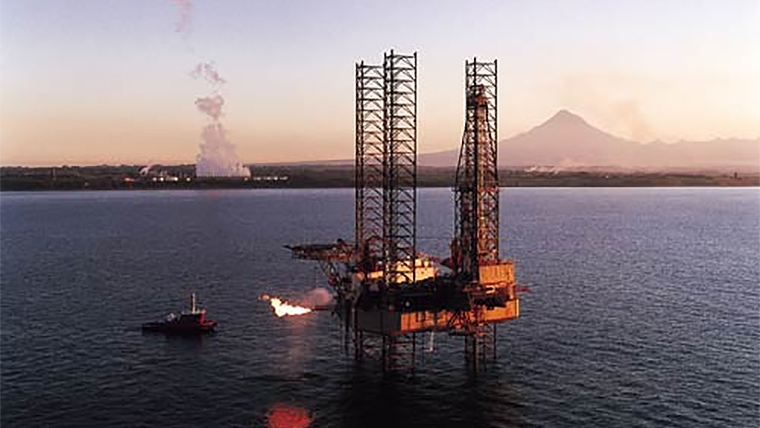
The energy industry thinks it might be able to extract gas from under the ocean more quickly than critics suggest.
That is because tens of thousands of previously written reports on the state of the earth’s crust under the sea are available for public inspection.
In addition, gas companies would drill close to existing oil and gas fields to eke out product from an established facility, or to acquire gas from a branching or adjacent reservoir.
These methods could avert the need for costly and sometimes fruitless quests for oil and gas in virgin territory.
They might also help the local gas industry win the race with imported Liquified Natural Gas (LNG) to replenish New Zealand’s gas reserves.
The Government has said it wants an LNG terminal to be ready for the winter of 2026. It will pass legislation to remove any barriers and Cabinet will debate this matter further in October. The domestic energy industry is reluctant to put a time frame on its own efforts, though it suggests 18 to 24 months as a possible number. But it says it is awaiting legislation and stresses that both LNG and local gas production need companies to do the work on a commercial basis safe from changed legislation from a new administration.
This problem has arisen in the wake of the previous government’s ban on new offshore oil and gas prospecting in 2018. The current administration blames this for a dwindling supply of gas which has pushed electricity spot prices sky high and led to some industrial plant actually stopping production.
Labour says new gas fields were not being found even before the ban. But at any rate, the current government has committed to restoring the supply of gas either by local exploration or by imports of LNG.
Oversight of the gas industry comes from New Zealand Petroleum and Minerals (NZP&M), which is a branch of the Ministry of Business, Innovation and Employment (MBIE), and its efforts have produced a library of geology which is bulging with information.
“The catalogue contains information and data relating to 13,800 reports on coal, minerals and petroleum, 1,200 seismic surveys, and 47,300 wells and drillholes,” NZP&M says.
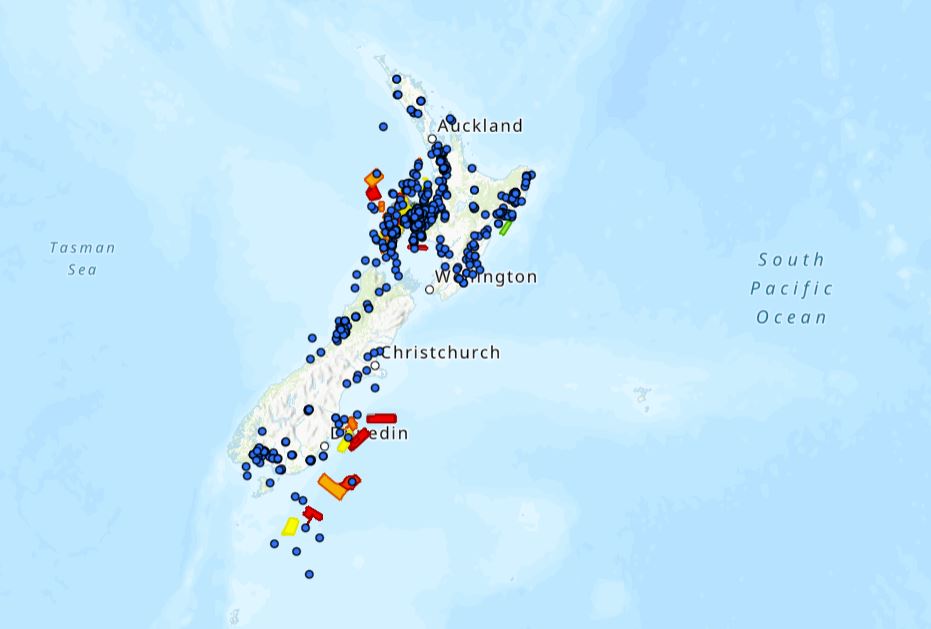
One of these maps shows the number of oil wells drilled in this country over the years as small circles and has the area of 3D seismic testing shown as rectangles.
Seismic surveys are done when a sound wave is sent down through the sea and into the ocean floor. The pattern of its returning echo gives a clue about the rock structure underneath. Surveys like this are essential precursors for actual drilling. And when that drilling takes place, rock samples taken from the well head can be analysed for further information, even if the well itself came up dry.. All the information gleaned in this way has to be made public under the Crown Minerals Act 1991.
“This includes physical core samples, all seismic and aerial survey data, and petroleum well data,” NZP&M says.
“This technical data is made publicly available at the earliest of five years after it was acquired, or when a permit ends…..this is a free, public service available to anyone, anywhere.”
An exception to the five-year rule is made for some classes of business, and those companies have to give up their information after 15 years.
Maps are included in the catalogue, and they provide a visual representation of the geographic extent of the data. The density of petroleum wells and surveys provides a snapshot of areas where effort has historically been targeted. These are concentrated in and around Taranaki but have been undertaken in many other places as well, including Northland and off the coast of the South Island.
In addition, NZP&M manage collections of core samples taken from drilling operations at a special facility in Featherston, called The Core Store.
Meanwhile an umbrella group, Energy Resources Aotearoa (ERA), says there are three ways in which the prospecting industry could take advantage of a renewed search for gas.
One would be to undertake appraisals of wells that have been drilled but have not yet been assessed. The second method would be aimed at positions close to existing gas fields. This is known as near field tie-ins. They would leverage off existing infrastructure to search for gas close to existing wells, and would thus require less capital investment upfront. The third method would be to search for gas in so-far unproductive stretches of ocean.
“That’s probably the least likely option,” says the ERA’s chief executive, John Carnegie.
“But the near field tie-ins are likely to produce gas, if it’s there, quicker and more cheaply than imported gas (via LNG terminals).”
The ERA has meanwhile has joined other industry groups in seeking a bi-partisan approach to energy security, saying energy projects are long term things, and need a consistent approach spanning several electoral cycles to make investments worthwhile.
Carnegie remains hopeful that this can be achieved, and the current government is looking at ways of safeguarding long term investment from the three year electoral cycle. Details of how this will be done are still not clear.
We welcome your comments below. If you are not already registered, please register to comment
Remember we welcome robust, respectful and insightful debate. We don't welcome abusive or defamatory comments and will de-register those repeatedly making such comments. Our current comment policy is here.