

Here's our summary of key economic events overnight that affect New Zealand with news both the US and China are adopting radical short-term gratification policies that leave you fearful of the medium term consequences.
But first, US retails sales were +4.2% higher in January from a year ago, a slightly slower pace than in December (+4.4%). This official data backs up the Redbook survey we report weekly. But we should note that the good January data came despite a sharpish fall-off in car sales in the month. That fall-off contributed to seasonally adjusted retreat in January from December.
Business inventory data out for December actually shows lower levels, and their inventory-to-sales ratio improved unexpectedly. This shift might be due to public-policy uncertainty around tariffs.
With inventories lower than expected, it therefore won't be a surprise to know that US industrial production in January rose on a year-on-year basis, and by more than expected. But the January rise from December wasn't as strong. But at least it was a rise
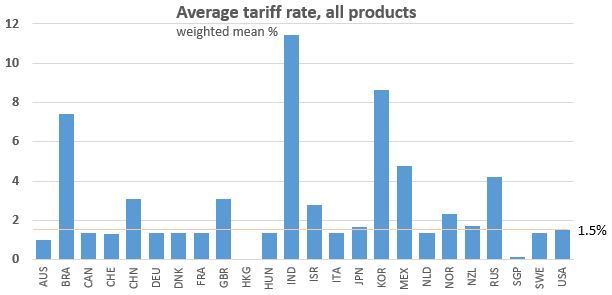
The new US Administration policy on tariffs emphasises reciprocity. But this is likely to be weasel words for most. Their definitions of 'fair' and 'reciprocal' seem very distorted. But even if you took this at face value, they shouldn't amount to much. The OECD reported weighted average tariff rates for most countries. For the US it is 1.5%. We have summarised the tariff load of other key countries here, and all but a handful are less. So, if it is to be reciprocal, will the US lower theirs to match most? I don't think the facts will get in the way of prejudice, however. The recalcitrants are only Brazil, China, the UK, India, Korea, Mexico and Russia.
Canada manufacturing sales rose, and for a third consecutive month in December.
Canada also released its Q4-2024 senior loan officer survey which revealed a sharp tightening in credit conditions in the period.
Not everyone is tightening. Some are loosening in a dramatic way. Across the Pacific in China, banks lent a record +¥5.22 tln in new loans in January, above +¥990 bln in December and easily beating forecasts of +¥800 bln. It is a spectacular show of support by banks for the push by Beijing to juice up its economy via more debt. We haven't been able to work out how much went to the property sector, so if you know, please note it in the comment section below.
Foreign direct investment in China plunged -99% over the past three years, Chinese government data shows, as their economic slowdown and concerns about their 'everything is national security' approach drove investors away. China only recorded a net inflow in 2024 of +US$4.5 bln and that is their lowest in more than 30 years. In two of the four quarters of 2024 there was in fact a net outflow.
Up from +1.8% in 2023, Singapore's economy grew +4.4% in 2024 on the back of stronger-than-expected rebounds in exports and tourism. This was an upward revision from the preliminary +4.0% rate reported by them earlier. By itself, Singapore's Q4 rose at a +5.0% rate.
Malaysia downgraded its growth in its Q4-2024 update to +5.0% from a year ago. This was due to weak progress in Q4 from Q3.
As expected the Russian central bank held its policy rate at 21%, despite inflation data showing it rising at about 12% and more than anticipated.
Apparently the Indian government has agreed to replace its oil imports from Russia with imports from the US. It is an odd move by the US because if it actually happens it will gift the Indians enormous leverage over the new Administration. India is one of the more extreme outliers on the tariff front the US says it is targeting. So it could be a great deal for the Indians, really problematic for the US.
The UST 10yr yield is at 4.48%, back down -6 bps from yesterday at this time. A week ago it was at 4.49%. The key 2-10 yield curve is still at +22 bps. Their 1-5 curve is flatter at +10 bps. And their 3 mth-10yr curve is very much flatter at +14 bps. The Australian 10 year bond yield starts today over 4.45% and down -1 bp from yesterday. The China 10 year bond rate is now at 1.66% and up +3 bps. The NZ Government 10 year bond rate is now at 4.61%, down -5 bps from yesterday, but up +5 bps from a week ago.
Wall Street has opened its Friday trade little-changed on the S&P500 but up +1.2% for the week. Overnight, European markets were mixed with London down another -0.4% but Paris up +0.2%. Yesterday Tokyo closed down -0.8% to cap its weekly gain at +0.6%. Hong Kong however ended its Friday trade up a spectacular +3.7% to be up +6.6% for the week. Shanghai was up +0.4% for a +1.2% weekly gain. Singapore was down -0.1%. The ASX200 ended up just +0.2% for a +0.5% weekly rise. The NZX50 ended up +0.6% in Friday trade to be up +0.7% for the week.
The Fear & Greed Index ends the week unconvincingly in the 'neutral' zone, and barely out of the 'fear' zone where it was last week.
The price of gold will start today at just under US$2988/oz and down -US$25 from yesterday, but up +US$27 from a week ago.
Oil prices are down -50 USc at just under US$71/bbl in the US and the international Brent price is now just under US$75/bbl. These are levels little-different to a week ago. These low prices mean that the North American rig count is unchanged from last week, and lower on a quarterly and annual basis.
The Kiwi dollar is now at 57.4 USc and up +90 bps from this time yesterday. A week ago it was at 56.5 USc. Against the Aussie we are up +40 bps at 90.2 89.8 AUc. Against the euro we are also up +40 bps at just on 54.6 euro cents. That all means our TWI-5 starts today just under 67.3, up +60 bps from yesterday at this time to its highest since Christmas Eve. A week ago it was at 66.9.
The bitcoin price starts today at US$98,702 and up +3.3% from this time yesterday, but only up +0.9% from this time last week. Volatility over the past 24 hours has been modest at +/- 1.8%.
Daily exchange rates
Select chart tabs

The easiest place to stay up with event risk is by following our Economic Calendar here ».
We welcome your comments below. If you are not already registered, please register to comment
Remember we welcome robust, respectful and insightful debate. We don't welcome abusive or defamatory comments and will de-register those repeatedly making such comments. Our current comment policy is here.