

The number of visas approved for full fee paying international students in June was the highest in a government dataset that dates back a decade.
Full fee paying students are people who come to New Zealand to study and are charged the full cost of their studies by the institutions they are attending.
It includes younger students sent here to study at NZ schools and older students studying at tertiary institutions, although most are older students studying at universities.
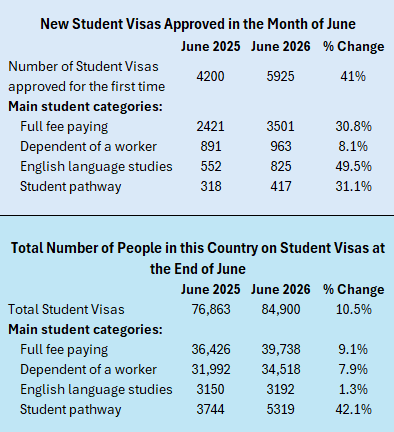
Data from the Ministry of Business Innovation and Employment (MBIE), which incorporates Immigration NZ, shows 3501 visas were approved for full fee paying international students in June this year.
That's up 31% compared to June last year, and was the first time the number has topped 3500 in any month of the year in the MBIE dataset which goes back to 2016.
In total there were 39,738 full fee paying international students in NZ at the end of June. That's up 9.1% compared to June last year, with full fee paying students making up just under half (47%) the total number of foreign students in NZ at the end of June.
The second biggest group were the children of foreign workers on work visas.
If children of foreign workers are of school age they are legally required to attend school. But they receive what is commonly referred to as a free education because they only pay the normal school fees paid by NZ citizens and residents.
Their numbers have also shown significant growth, with 963 student visas approved for dependents of foreign workers in June this year, up 8% compared to June last year.
At the end of June there were a total of 34,518 children holding student visas in NZ who were dependents of foreign workers, also up 8% compared to the end of June last year.
Their numbers passed the 34,000 mark for the first time in March this year and have doubled since 2018.
The other major categories of student visas were those issued for English language studies with 825 approved in June, and those on Student Pathway visas, which are valid for five years and allow holders to work part time, with 417 approved in June.
The table below gives the main breakdowns of student visa numbers.
The comment stream on this story is now closed.

We welcome your comments below. If you are not already registered, please register to comment
Remember we welcome robust, respectful and insightful debate. We don't welcome abusive or defamatory comments and will de-register those repeatedly making such comments. Our current comment policy is here.