
NZIER originally published this report as part of its self-funded Public Good Programme.
China provided New Zealand with an economic tailwind
The first quarter of this century has provided New Zealand with an unusually favourable trading environment, despite interruptions caused by the global financial crisis, earthquakes and COVID-19. Strong international demand for New Zealand's exports and favourable terms of trade have meant that what we sell overseas has bought us more of what we import.
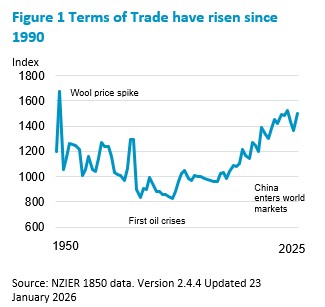
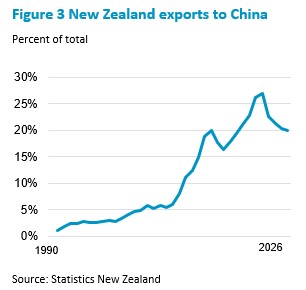
China has been central to this story. Its rapid growth coincided with New Zealand's efforts to reform its economy and to improve access to international markets (Nixon and Yeabsley 2002).
The circumstances are changing. China's growth is slowing, and the international trading environment is becoming less predictable. The question is what New Zealand should do next.
This Insight looks at the position and what might be done.
China has reshaped New Zealand’s economic opportunities
China's emergence as a major economic power has had a significant positive impact on New Zealand's trading environment. New Zealand is a small, distant economy that largely depends on finding overseas markets for the relatively narrow range of products it produces competitively.
Furthermore, from a trade perspective, the radical economic reforms beginning in the 1980s left New Zealand much better placed to respond when new opportunities emerged. Removing much of the protection and assistance that had insulated the economy from international competition encouraged resources to move towards activities in which New Zealand had a comparative advantage and made exporters more responsive to international markets.
So, China's emergence into the world trading system with its scale, rapidly rising incomes, and growing demand for many of the food and fibre products in which New Zealand has a comparative advantage has provided significant economic benefits for New Zealand.
China’s entry into the world trading system embraced services as well as goods. Their desire to have their children educated abroad and to travel the world has boosted New Zealand’s services trade.
But wait – there’s more…
Exports tell only half the China story, and probably less than half. The benefits of China's emergence have spread throughout the New Zealand economy, including to households and businesses that have never exported a dollar to China. China's emergence as the world’s largest manufacturing powerhouse has given New Zealand households and businesses access to an enormous range of competitively priced goods, increasing purchasing power and lowering business costs.
And there’s more beyond the two direct effects: China's growth has stimulated activity and incomes elsewhere in the global economy, increasing demand and thus prices in third countries for New Zealand’s range of goods and services. This provides a form of hedging.
New Zealand has benefited from China as a customer, a supplier, and an engine of growth in the world economy. New Zealand did not drive China’s economic growth spurt, nor did it bring all that came with it. But our economic and regulatory changes had done much of the work needed to take advantage of it when it happened.
New Zealand was well placed to capture these gains
We were first off the mark. The 2008 New Zealand-China Free Trade Agreement (FTA) gave New Zealand an early start in building the market access, regulatory arrangements and institutional relationships needed to turn China's growth into commercial realities. The FTA did not create the opportunity, but it helped New Zealand take advantage of it.
But all good things come to an end…
The circumstances are now changing. China's economy is maturing, and its economic growth is slowing, mirroring its population contraction. In addition, the international trading environment has become less predictable. The challenge for New Zealand is not how to retreat from a successful relationship, but how to preserve the considerable gains from China while building the next sources of growth alongside it.
The China dividend runs many ways
The usual scorecard for the China relationship starts with exports, but to understand the full impact requires examining the whole trading picture. New Zealand consumers have benefited from imports and the additional supply growth in third-country markets that China's integration into the global economy has generated. All New Zealand firms and households have shared in these gains.
Export drivers
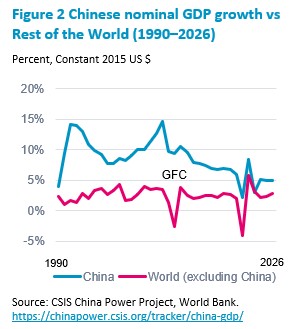
Exports are the most visible dividend. China's rapidly growing demand for New Zealand products reflects rising incomes and changing consumption patterns. These have been particularly well aligned with New Zealand's comparative advantage in selected food and fibres. China now accounts for around 30 percent of New Zealand's goods exports, compared with virtually none in 1990.
The trade in services also contributes. China's rising incomes and opening to the rest of the world have created demand for New Zealand services, most visibly through tourism and international education. These flows broaden the relationship and spread its benefits across sectors, such as hospitality and education, which are quite different from the primary sectors that dominate goods exports.
Imports across the board
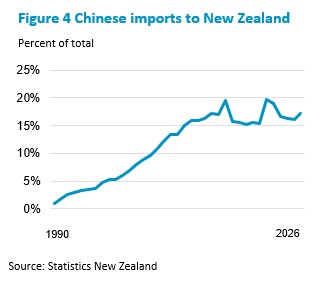
The focus on exports captures only half the trading story. China’s integration into the global economy has greatly expanded the supply of manufactured goods and intensified competition, both in China and in third-country markets. The result has been cheaper, more plentiful imports, with gains shared widely across New Zealand households and firms.
Investment is a slow starter
Investment is a slow burn. That is not particularly surprising. Australia and the United States have spent more than a century developing their investment relationships with New Zealand. China's modern commercial relationship with New Zealand is much younger. As its commercial and institutional relationships continue to deepen, investment may become a more important part of the relationship, but this is likely to take time.
Worldwide effects
Growth elsewhere has benefited New Zealand. China's integration into the global economy has also stimulated trade, investment and incomes in third countries. In turn, these countries demand more goods and services – potentially from New Zealand. This means the benefit of China's growth cannot be measured simply by looking at bilateral New Zealand-China trade: some of it arrives indirectly through stronger markets elsewhere.
China and world trade institutions – making their own rules?
China's integration into the world trading system, albeit on its own terms, increased trading confidence. For a small trader such as New Zealand, China's accession to the WTO and growing participation in trade agreements brought a large, fast-growing economy more or less fully within a system of agreed international trade rules. China has also shown a marked willingness to adopt and work with international standards, thereby reducing some of the uncertainty and transaction costs involved in trading with it.
That commitment to the rules has not always been consistent. Like other major trading powers, including the United States, China has at times allowed wider political and strategic considerations to spill into its approach to trade. China's use of trade restrictions against Australia as political relations deteriorated demonstrated how quickly commercial relationships can become entangled with geopolitical disagreements. The episode proved temporary, with most restrictions subsequently unwound as relations improved. The lesson is not that trade rules are ineffective, but that, in practice, they cannot completely insulate trade from politics.
For New Zealand, a country with limited negotiating power seeking to minimise transaction costs, the system's value lies in rules, standards and institutions that constrain uncertainty, even if they cannot eliminate it. The harder question is whether those existing disciplines will remain as effective as geopolitical tensions increase and the wider international trading system comes under pressure.
It took more than the China FTA to open doors
How much of New Zealand's success in China can be attributed to the FTA and its subsequent upgrade? China was growing rapidly and importing more from the world, so New Zealand would undoubtedly have benefited even without an agreement. Therefore, the FTA was not the source of the opportunity with China. The more important question is whether New Zealand would have captured as much of the potential without the FTA.
For agricultural trade, successful market access involves much more than low tariffs. Sanitary and phytosanitary requirements, product standards, official certification, customs procedures and other regulatory requirements determine whether and how products can enter a market. The FTA provided a rules-based framework for addressing these issues between co-signatories, supplemented over time by equivalence, recognition and other technical arrangements.
The FTA therefore did more than lower tariffs. It made access to a difficult agricultural market more predictable and provided mechanisms for resolving problems when they arose. The value of the trading relationship therefore lies partly in the institutions and relationships that keep trade moving.
Without the FTA, access would have been less certain and potentially more costly. The FTA also conferred status and credibility on New Zealand within the Chinese system, making it easier to resolve regulatory issues quickly and quietly before they became significant barriers to trade.
Being first helped; maintaining the relationship mattered more
As the first developed country to conclude an FTA with China, New Zealand gained an important head start. Officials, regulators and businesses were able to build relationships and work through technical market-access issues while China's import markets were still expanding rapidly. This helped establish New Zealand as a credible and familiar trading partner.
But first-mover advantage is not permanent. Other countries have since negotiated agreements with China and improved their own access. What has mattered is that New Zealand has continued to invest in the relationship. This includes upgrading the FTA, developing equivalence and recognition arrangements, and maintaining regular contact between officials and regulators.
This matters because rules do not interpret themselves. Small differences in certification, biosecurity requirements or product definitions can have significant commercial consequences, particularly when perishable products are held at a port. New Zealand therefore maintains senior officials in Beijing who can work directly with their Chinese counterparts when problems arise.
By being the first to build the relationship, New Zealand has preserved much of the initial advantage by working to maintain it.
Concentration is not necessarily vulnerability – wider effects can be a hedge
The success of the relationship with China has inevitably raised concerns about concentration. With such a large share of New Zealand's goods exports going to one country, the argument is that New Zealand has become overly dependent on China and should reduce its exposure.
But concentration is not the same thing as vulnerability. New Zealand exporters have increased their volumes to China because it has frequently been the most attractive market for their products. Redirecting those exports simply to reduce China's share would come at a cost if alternative markets offered lower prices, smaller volumes or less favourable conditions. The relevant counterfactual is the returns New Zealand would receive if it sold its products elsewhere. It’s about opportunity cost.
Risks remain and so need to be assessed
There are nevertheless genuine risks associated with concentration. A major disruption to Chinese demand, market access or trade flows caused say, by shipping problems would have consequences for New Zealand exporters and, ultimately, for our trade. Those risks may also have increased for other reasons, as the international trading environment has become less predictable and shipping has faced serious disruptions. But the appropriate response to these threats depends on the nature and likelihood of the risk, and on the cost of reducing it. Giving up profitable trade today to insure against an uncertain future event is not costless; whether it is worth it depends on the details of the situation.
Diversification means adding markets, not abandoning China
New Zealand has long been a trader with the world (Nixon and Yeabsley 2002). Only the details have changed. This experience should shape how we think about diversification. Diversification is often presented as a way to reduce New Zealand's exposure to China. But deliberately diverting exports from a high-value market to less profitable alternatives would make New Zealand poorer. Whether it makes us more resilient depends on the risks we face (NZIER 2022). For instance, alternative markets may face their own problems.
Nor is establishing alternative markets cost-free. Exporters face high fixed costs in understanding markets, meeting regulatory requirements, establishing distribution channels and building commercial relationships. Who bears those costs also matters. An individual exporter may have little commercial incentive to invest in an alternative market simply as insurance against disruption in China, particularly when much of the resilience benefit may accrue to the wider industry or economy. For instance, focusing on Vietnam as an insurance policy against disruption in China may make little sense for an individual firm if the market cannot justify the establishment costs on its own commercial merits.
If a government or an industry body seeks greater diversification because it values the wider resilience benefits, the question then becomes who should bear the costs and risks of developing the alternative market.
Perhaps the answer is ‘China plus’ not ‘less China’?
A better form of diversification is therefore to seek growth elsewhere, too, rather than retreat from China. New Zealand should continue to pursue commercially attractive opportunities with ASEAN, India, the United States, Europe and other markets. If those markets grow faster, China's share of New Zealand's exports will decline naturally, even if exports to China remain strong. If they do not, but still make economic sense, we will be building a more diversified export structure.
This is diversification by addition rather than subtraction. The objective should not be to make China smaller in New Zealand's trade figures; it should be to make other markets bigger. That preserves the gains from a highly successful trading relationship while reducing concentration through the development of additional sources of growth. A mature trading strategy: protecting the base while finding the next growth opportunity.
But the world keeps changing – especially China
The New Zealand-China economic relationship is entering a new phase. The extraordinary combination of rapid Chinese growth, rising incomes and expanding demand that characterised the past two decades is unlikely to be repeated at the same pace. However, slower growth does not diminish the relationship’s importance. China is now a large and established part of New Zealand's economic base.
A mature relationship may also develop in different ways. Trade in established products may grow more steadily, while services, investment and new products become relatively more important. Investment, in particular, takes time to evolve, as history shows. New Zealand’s current pattern of inward foreign investment reflects generations of economic interaction. China's modern commercial relationship with New Zealand is much younger, so we should not expect investment links to have developed as quickly as trade. As commercial relationships deepen and firms become more familiar with opportunities in each other's markets, investment may gradually become a more important part of the relationship.
So where does that get us? The new opportunities and challenges
The immediate policy task is partly one of maintenance. China remains enormously important. New Zealand needs to protect the market access, regulatory relationships and commercial connections built up over the past two decades, while continuing to adapt the relationship as China itself changes. But maintenance will not be enough. New Zealand also needs to find the next sources of trade growth.
We should not expect another China. China's combination of extraordinary scale, rapid income growth, increasing openness, and demand for products that New Zealand produces competitively was exceptional. We didn’t see another example in the Twentieth Century. Even Japan’s growth in the mid-Twentieth Century was slow by comparison, involved a smaller population, and offered limited prospects for agricultural exports.
India is often presented as the next great opportunity (NZIER 2026). Its scale and growth make it increasingly important, and the recently negotiated FTA helps New Zealand traders further through the door. There are important differences. India remains much more protective in precisely the agricultural products where New Zealand has a strong comparative advantage. India is also not experiencing growth on the extraordinary scale that characterised China's take-off. It is therefore unlikely to provide either the same surge in demand or the broad opening for New Zealand's food and fibre exports that China did. The opportunity in India is real, but it is likely to develop differently and more slowly.
Is there a Plan B?
That points to a different model of trade growth. Rather than waiting for the next China (which may never arrive), New Zealand will need to accumulate gains from across a wider range of markets, products and services. India will be part of that story, as will ASEAN, the United States, Europe and other potential growth markets.
Some opportunities will come from reducing tariffs, but increasingly from less visible work. This includes reducing non-tariff barriers, improving regulatory recognition, facilitating digital trade, developing distribution channels, and helping New Zealand firms establish the relationships needed to turn market access into actual trade.
There is a wider growth point here. Economic growth does not depend solely on occasional transformative opportunities. It also comes from innovations building on innovations, firms discovering opportunities and productive knowledge spreading through the economy. The trade-policy equivalent is to create the conditions in which many relatively small commercial opportunities can emerge, be tested, and, where successful, grow. The objective should not be for government to predict the next export winner, but to reduce the barriers facing firms that are already taking the risk of entering new markets.
The key dynamic is how innovations spread and generate further innovations, while the practical policy problem is how to foster that process. For a small country with limited resources, this still requires choices. New Zealand cannot devote the same depth of government attention and trade-support resources to every possible market. The challenge is to combine broad, even-handed support for experimentation with sufficient concentration of resources to make a difference where opportunities begin to emerge.
That means finding new ways of operating. Perhaps, being prepared to follow firms into markets, learn from what is working, and deepen regulatory and commercial support where the potential becomes clearer, rather than attempting to select the next China in advance. Practically, this means helping firms that actually start along the export track, rather than trying to identify winning sectors around a table.
China was the exceptional opportunity of the past generation, and New Zealand made much of it. The next generation of trade growth is unlikely to arrive in one large package. It will probably have to be built incrementally, that is, market by market, barrier by barrier and opportunity by opportunity.
References
Nixon C & Yeabsley J (2002) New Zealand’s Trade Policy Odyssey. Ottawa, via Marrakech, and on. NZIER Research Monograph No. 68. Wellington, New Zealand.
NZIER (2026) The New Zealand-India FTA: Playing the long game in a fragmented global economy – NZIER Insight No. 128. https://www.nzier.org.nz/publications/tag/trade
NZIER (2022) Celebrate resilience: supply chains have passed the test. NZIER Insight 104. https://www.nzier.org.nz/hubfs/Public%20Publications/Insights/NZIER%20Insight%20104%20Supply%20chains.pdf
NZIER (2020) Land-based industries see New Zealand through tough COVID times. NZIER Insight 90. https://www.nzier.org.nz/publications/land-based-industries-see-new-zealand-through-tough-covid-times-nzier-insight-90
Chris Nixon is Principal Economist at NZIER. NZIER originally published this report as part of its self-funded Public Good Programme.
We welcome your comments below. If you are not already registered, please register to comment
Remember we welcome robust, respectful and insightful debate. We don't welcome abusive or defamatory comments and will de-register those repeatedly making such comments. Our current comment policy is here.