
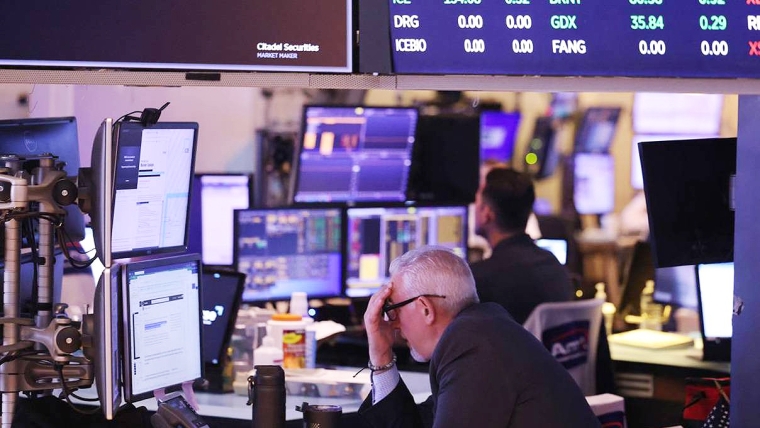
It is difficult to remember a time when economies, financial markets, politics, and societies were subject to significant volatility and uncertainty simultaneously, let alone to the degree they are today.
The global economy is entrenched in a cycle of sluggish economic growth, with rates in many countries, particularly the major developed economies, stalling well below 3%, the level needed to double per capita incomes in a generation. While the emerging AI super-cycle could help offset this trend—in the United States, annual investment appears set to approach 4% of GDP by 2032—the technology raises serious, even existential, risks. Industry leaders, including Anthropic’s Dario Amodei and OpenAI’s Sam Altman, have recently called for frontier-AI development to be paused until labs can credibly control their models.
Meanwhile, many economies continue to struggle with inflation, which remains persistently above the 2% headline rate targeted by central banks worldwide. Last month, annual inflation in the eurozone hit 3.8%, its highest rate in three years, and the United Kingdom’s headline consumer price index reached 3.1% in August. In the United States, median inflation expectations for the next year rose to 3.9%, while holding steady at 3% for the five-year horizon.
Some think that inflation is being fueled largely by the Iran war—energy prices have soared since the beginning of this year—and thus amounts to a temporary challenge. But concerns about structural unemployment and job diminution, together with arguably unsustainable public-debt burdens (reaching or exceeding 100% of GDP in several advanced economies), suggest that current economic woes will not be overcome so easily.
Public-debt risk is compounded by financial-market developments. For starters, the role of institutional investors that could traditionally be relied upon to hold long-term debt, such as pension funds and insurance companies, is being displaced by hedge funds operating on shorter time horizons. Heightening the risks further, particularly for the US, is the large share of public debt held by foreign governments—including those that, as with China, are not politically or ideologically aligned.
The US has another potential problem: the dollar’s longstanding role as the world’s leading reserve currency and a safe haven in times of crisis is increasingly in doubt. Gold assets have now surpassed US Treasuries in central-bank portfolios. If the dollar does become less dominant, the US can expect its global political clout and economic maneuvering room to decline as well.
Growing economic uncertainty is apparent in bond markets. Yields on ten-year US Treasuries are running above 5.3%, and on 30-year Treasuries have surpassed 5.6%—the highest levels since 2002. But it is not just the US. Yields are elevated across nearly the entire global bond market. In January 2022, just 12% of global fixed income yielded more than 3%; today, the share is around 84%.
The stock market is also making observers queasy. To be sure, the CBOE Volatility Index (VIX)—a common measure of volatility expectations—appears rather stable on a five-year historical basis, at around 15.31. But market concentration has reached extreme levels, with just seven tech firms accounting for more than 30% of the S&P 500’s market capitalization. Moreover, the price-to-earnings (P/E) ratio has reached 26.6—far higher than the 16 that prevailed for much of the last quarter-century.
Underlying these economic and financial vicissitudes are the eroding foundations of healthy economies and societies. For example, recent data from the OECD’s Programme for International Student Assessment show that education performance continues to decline in core subjects, such as reading, mathematics, and science. And infrastructure investment continues to lag. The American Society of Civil Engineers issued US infrastructure—including roads, rails, bridges, and ports—a C grade last year.
As the quality and availability of public goods declines, the social fabric is fraying—and polarization is intensifying. A 2022 Pew study showed that 72% of Republicans viewed Democrats as more immoral than other Americans, up from 47% in 2016, while 63% of Democrats held the same view of Republicans, up from 35% in 2016. According to a 2024 Gallup poll, 80% of US adults believe Americans are deeply divided on the “most important values.”
This division extends to views of capitalism. In a 2025 Gallup poll, 54% of respondents reported a favorable view of capitalism, down from 60% in 2021. That decline is concentrated among Democrats and independents—each group showed an eight-percentage-point drop—with Republicans’ views having remained essentially unchanged. The upcoming midterm elections promise to be among the most closely watched in US history.
European politics also make for uncomfortable viewing nowadays, as support for far-right parties continues to grow. Germany’s Alternative für Deutschland has scored notable victories in recent state elections. At a minimum, the political fragmentation this trend implies is likely to compound the time-inconsistency problem in policymaking, leading to greater policy volatility, lower investment, and weaker economic growth.
All of this is happening against a backdrop of rising geopolitical volatility. As tensions rise and the global balance of power shifts, the institutions that have long underpinned multilateral cooperation are under growing strain, with implications for the global energy transition, trade, capital flows, and global commodity prices.
Of course, from a practical perspective, it is not enough simply to restate this growing list of challenges, many of which are already top of mind for global decision-makers. But it is worth underscoring just how rare—and dangerous—it is for all of them to be salient at the same time. Those with the power to shape the global economy must never lose sight of the stakes.
*Dambisa Moyo, an international economist, is the author of four New York Times bestselling books, including Edge of Chaos: Why Democracy Is Failing to Deliver Economic Growth – and How to Fix It. This content is © Project Syndicate, 2026, and is here with permission.
We welcome your comments below. If you are not already registered, please register to comment
Remember we welcome robust, respectful and insightful debate. We don't welcome abusive or defamatory comments and will de-register those repeatedly making such comments. Our current comment policy is here.