

It has been a long time between drinks for our Top 5 column. A very long time given the last one was published on December 13 last year!
We hadn't completely forgotten about it, however. And a quietish Friday and some interesting goings on gave me an excuse to bring it back. At least this once...
As always, we welcome readers' thoughts in the comments below. If you're interested in contributing a guest Top 5 yourself, let us know; Reach out either to david.chaston@interest.co.nz or me; gareth.vaughan@interest.co.nz.
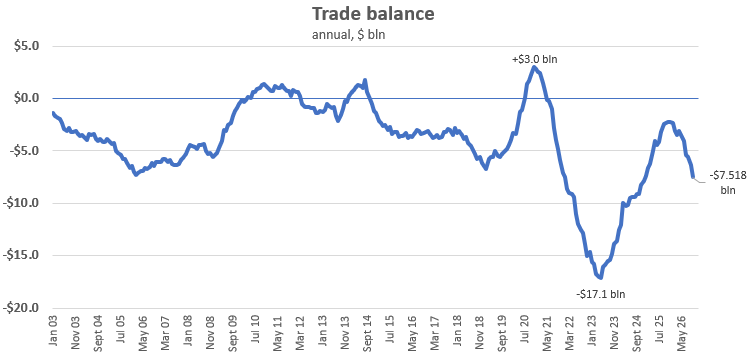
*The chart above highlights the $7.5 billion October year trade deficit detailed by Statistics NZ this week.
1) A bad week for Douche Bank.
Back in the 1990s German banking behemoth Deutsche Bank was flexing its muscles by expanding outside its homeland. This included acquiring Bankers Trust of the US in 1999. The story goes that some American bankers and traders who joined Deutsche Bank through the acquisition pronounced it "douche" bank, leading to the posting of a sign in the bank's London lobby explaining how to say "Deutsche." (I remember hearing a bit about the culture clash between the US and German entities from a friend who worked at Bankers Trust in London at the time).
Today Deutsche Bank is regarded as a globally systemically important bank by international regulators. But that didn't save it from a pile-on this week.
That's because a series of media outlets are reporting on what they describe as 15 million internal Deutsche Bank documents leaked by whistleblowers.
Deutsche Bank has long had a challenging relationship with its regulators, as the Financial Times noted in its coverage of the leak.
Deutsche, which was subject to a deferred prosecution agreement with the US Department of Justice in 2021, has been raided by the German authorities three times this year alone.
Since 2012, it has paid €18.6bn to settle alleged conduct violations and litigation in relation to a string of scandals that included market manipulation, Russian money laundering, weak controls, mis-selling and misrepresentation.
The massive file leak reportedly dates back to the early 2010s.
Emails, internal probes, board minutes, compliance files and employee chat logs throw new light on the career and leadership of chief executive Christian Sewing, an insider who took over in 2018 and is widely credited with bringing the scandal-prone bank back from the brink to deliver record profits.
In private, the files show, the man who promised to draw a line under a series of scandals pushed for greater risk-taking, railed at compliance and kept some of the bank’s problems from shareholders.
The Inside Deutsche Bank investigation also reveals accounting tricks, financial disclosures that border on deception and previously unknown details about the bank’s relationship with paedophile Jeffrey Epstein and US President Donald Trump.
In terms of Trump, Deutsche Bank reportedly;
...accidentally leaked Trump’s tax statements during his first presidential term and kept the mistake secret from the White House, with Sewing briefed on its handling of the crisis.
Al Jazeera picks up on Trump's response to the leaking of his tax information.
The Financial Times reported that the bank inadvertently sent a Trump tax document to another client’s accountant in 2017, during his first term in office, and never told him about the error. Asked about the disclosure during his visit to Manila for the ASEAN summit on Tuesday, Trump said the bank should not have released that information.
“They shouldn’t have done it. It’s illegal for them to do it,” he said. Deutsche Bank declined to comment on his remarks.
2) Anti-fascist economics.
German economist Isabella Weber, who previously made a splash by advocating the use of targeted price controls to stabilise prices of essential items as inflation soared around the world, and by promoting "sellers' inflation" whereby corporates pass on a major cost shock to consumers by increasing prices to protect or boost profit margins, is back promoting a new book. It's called Anti-Fascist Economics, In Defense of Affordability, Dignity and Democracy.
Weber told the ABC Western democracies are in deep crisis, with the extreme right on the rise. To combat this essentials - or the foundations for a dignified life - such as housing, food, energy, water, healthcare and transport need to be made affordable again.
The Guardian reports Weber also homes in on fossil fuel dependency, and speaks to her about the rise of Alternative für Deutschland (AFD) in her homeland.
In her book, Weber argues that fossil fuel dependency fans the flames of fascism: “Keeping essentials tethered to fossil fuels [leaves] ordinary people exposed to the price volatility of oil and gas that generates the economic insecurity on which authoritarian politics feeds.”
Weber cites Mexico's canasta básica policy, through which retailers cap the price of a range of essential goods in exchange for tariff and tax relief. Whilst The Guardian explains the indelible mark childhood learnings had on Weber's attitude to fascism.
Fascism is not an abstract concept to Weber. She was raised in Nuremberg, once a focal point of Third Reich propaganda. Family legend is that her grandfather, a priest in the Ruhr Valley, refused to hang a swastika in his church. As a small child, she realised “something so terrible happened that the only way to resolve it was to bomb our city to the ground”. During the 90s, resurgent neo-Nazis regularly marched through the medieval city. Weber and her grandmother would take to the streets in opposition. “I grew up with the threat of fascism,” she says, “and learnt that being anti-fascist and preventing its return is my first civic duty – in Germany, our democracy exists only because we defeated it.”
With New Zealand still haunted by Muldoon-era price and wage freezes, price controls feel some way from the mainstream political agenda here. But if they gather momentum overseas, and cost of living issues continue squeezing New Zealanders' finances hard, who knows?
3) Millennials vanquish boomers.
Writing in The New York Times, Jean M. Twenge highlights the shift towards younger generations, and away from older ones, in the recent US midterm elections.
Boomers ran against Generation X-ers (born from 1965 to 1979) or millennials in 15 Senate and governor’s races identified as competitive by the Cook Political Report. With Mary Peltola’s final victory in Alaska on Tuesday night, all 15 of those races have been called. In 80 percent of them — 12 out of 15 — the boomer candidate lost.
Millennials were especially successful. In the six races where millennials ran against boomers in competitive Senate and governorship elections, the millennial candidate won in all six (the Senate races in Michigan, Mississippi, New Hampshire, South Carolina and Texas, and the governor’s race in Wisconsin).
Mr. Talarico’s victory, then, was not the exception; it was the norm. The 2026 midterm elections may be remembered as the beginning of the end of boomer political power and the rise of substantial millennial political power.
With boomers and Gen X-ers still dominating both chambers of Congress, it may take some time for millennials to advance their agendas, including affordable housing, student loan forgiveness and climate change mitigation. Research on gender parity found that women usually had a significant impact on group decision-making only when they were in the majority. If the same is true for generations, it will be a decade or more until millennials truly take hold of legislative power.
Talarico is 37 year-old new Texas senator James Talarico who defeated a 63 year-old opponent. The article also highlights the massive shift to the Democrats among 18 to 29 year-olds after they voted strongly for Donald Trump in the presidential election just two years ago.
Two years ago, Mr. Trump’s 44 percent vote share of 18- to 29-year-olds was the highest for a Republican candidate in decades.
According to The Times’s Voter Trends analysis, 18- to 29-year-olds (all Gen Z) shifted 34 points toward the Democrats, the largest change of any age group.
RNZ's been running a useful series breaking down voting patterns from our recent election. They say the results show it was "the moodiest election we've seen in decades."
To get a grip on all of these different goings on, RNZ has conducted a deep analysis of the results. It examines the votes of communities of roughly 1000 to 4000 people who live around polling booths.
To paint a picture of each neighbourhood in the country, we looked at its defining features using information from the 2023 census. Are residents older and retired or younger? Do they rent, or do they own their home? How much do they earn?
We grouped the "statistical area 2" (SA2) areas using 13 census measures, including age, household income and ownership, household make-up and population density into seven types of neighbourhoods. We've named these by their most defining characteristic.
For example, in Auckland's Tāmaki electorate, Glendowie North falls into 'higher income areas' and Glen Innes West into 'young renting families'. These two neighbourhoods are only a few kilometres apart but are strikingly different in their profile - and the way they voted. Glendowie North's residents are older and richer - they increased their support for ACT and decreased it for National. People living in Glen Innes West are younger and earn less, they increased support for the Greens.
The articles make great use of data and are interactive.
5) New Zealanders estimated to have lost more than $500m to scams in a year.
A report from Netsafe and the Global Anti-Scam Alliance says New Zealand adults lost an estimated NZ$503.5 million to scams over the past year, with victims reporting an average loss of NZ$1,623. The report describes the NZ$503.5m figure as being "at a 95% confidence level," with estimated losses ranging from NZ$255.7m to NZ$751.2m.
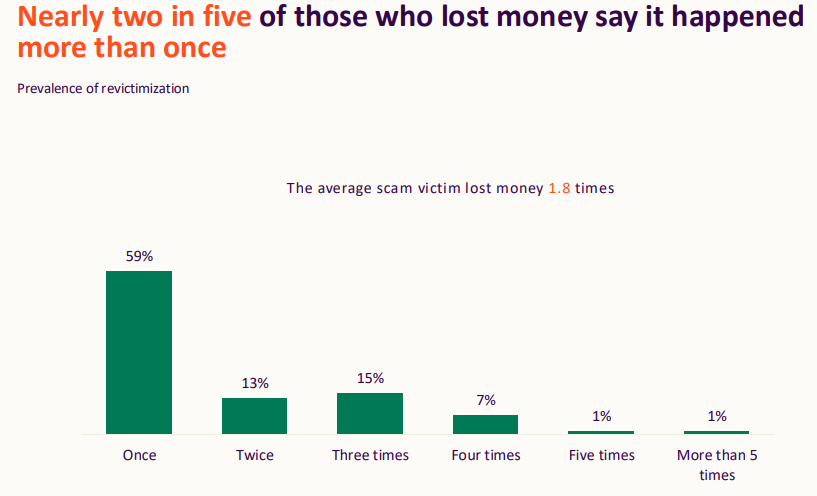
Included in a global survey were 1,180 adults in NZ. And seemingly if you are scammed once, there's a reasonable chance you will be again, with the report saying 37% of victims reported they were scammed more than once. (See chart below).
The final value lost to scams was calculated using the mean loss per victim and extrapolated to the national adult population using official population statistics.
In New Zealand, 90 of 1,180 respondents reported losing money to scams, equating to an estimated 310,125.97 affected adults nationally.
Multiplying this by the average loss (NZ$1623.40) produces an estimated total loss of NZ$503,458,493.37.
Emails and text messages remain the most popular routes for scam attempts, with Gmail and Facebook the platforms where people are most likely to encounter scam attempts.
We welcome your comments below. If you are not already registered, please register to comment
Remember we welcome robust, respectful and insightful debate. We don't welcome abusive or defamatory comments and will de-register those repeatedly making such comments. Our current comment policy is here.