
There are ideas and lessons New Zealand can take onboard from other small, developed countries such as Singapore, Denmark and Israel as the Covid-19 pandemic moves into its next stage, suggests David Skilling.
Skilling, director at economic advisory firm Landfall Strategy Group and former chief executive of public policy think tank the New Zealand Institute, now lives in the Netherlands having moved from Singapore in 2019. With a specific focus on small, advanced economies, Skilling sees learnings for NZ from overseas as it grapples with the current Delta variant outbreak and looks to reopen to the world.
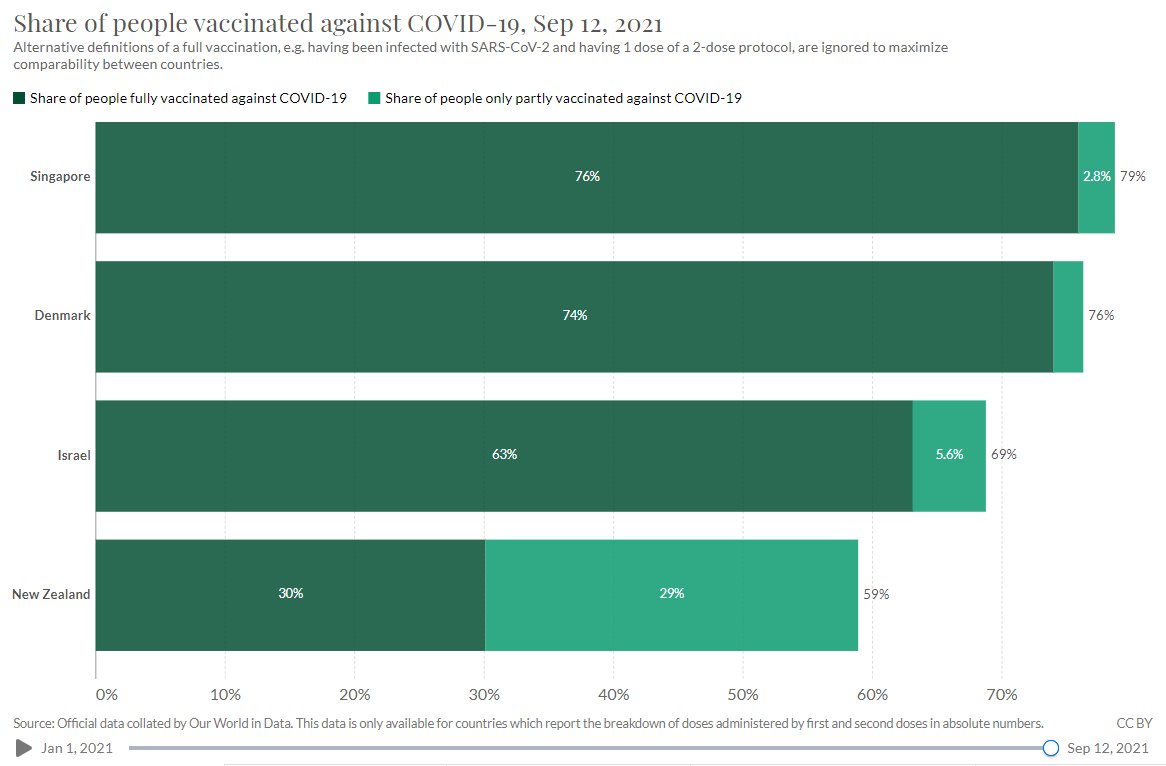
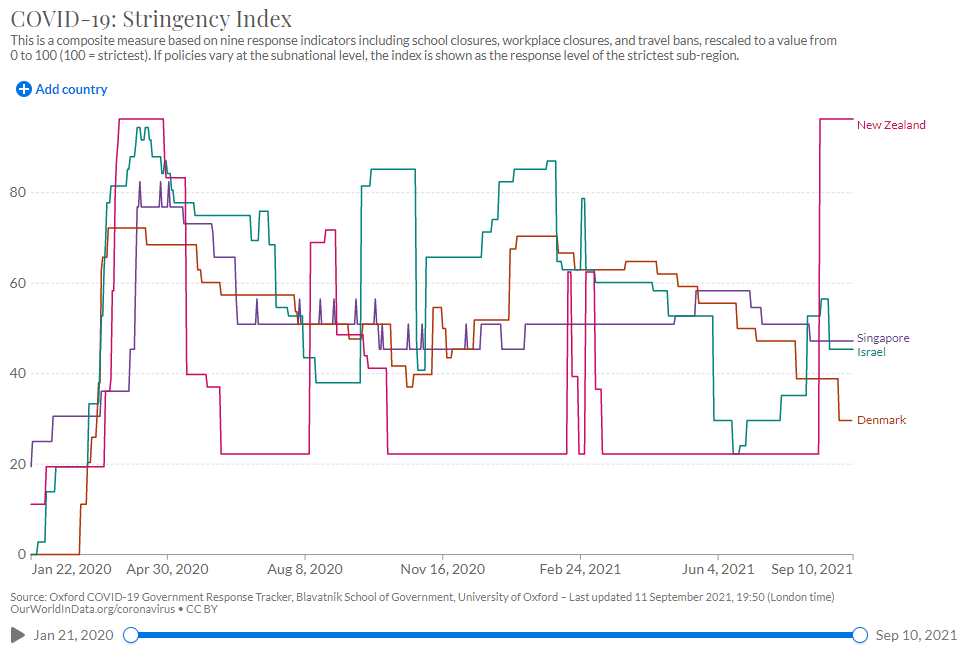
Speaking to interest.co.nz in a Zoom interview, Skilling notes Singapore took a similar approach to New Zealand in the early stages of the Covid pandemic, by trying to get case numbers as close to zero as possible. Even though Singapore now has one of the highest vaccination rates, they're still imposing restrictions with Covid cases in the community.
"They're now trying to get into this balancing act of how do we sensibly reopen, get jobs back, get the economy moving in a way that doesn't jeopardise public health outcomes as well. They have various travel windows that are open, they are actively thinking about how do you loosen quarantine arrangements, what's the timeline for reopening the economy," Skilling says.
"They are being very pragmatic, very balanced about it if you like, understanding that there are trade-offs, that you can't keep the economy closed indefinitely. So they are edging their way forward signaling that they're going to be opening up over the next several months. They're going to do that in an incremental way, [and] they're going to tighten up if they need to."
"But in general they've got a pretty clear direction of travel. And I think over the next two, three months we'll see Singapore begin to open up quite markedly. They are very aware that there are going to be some risks associated with that, which they will manage as those risks manifest. But I think they are in a position where, because vaccination rates are so high, they've got a public health system that's very functional and the [Covid] death rates remain really low, there's a sense they really are in a position to move," Skilling says.
On August 12 the NZ Government outlined a risked-based approach for how the country could gradually reopen to the world from the first quarter of 2022. Travelers were to be categorised either low, medium or high-risk depending on where they come from and their vaccination status. Businesses and organisations needing to send staff overseas were to be invited to partake in a pilot project involving some isolation at home upon their return.
However, the current community Delta outbreak has seen opening up to the world slip down the Government's priority list. When it's a focus again, Skilling says there's a lot to learn from Singapore.
"There are things to learn from Singapore in terms of logistics, the techniques, what the strategy looks like, but also there are things to learn from Singapore in terms of how do you begin to adjust from Covid being a global pandemic to something that's endemic, that's going to be with us for some time. We'll never completely kill it, at least not for the foreseeable future, [so] we have to learn to live with it," says Skilling.
"To me that's the bigger learning from Singapore and from some others, is how do you adjust your mindsets and your approach to something that's endemic?"
Skilling is supportive of the NZ government's reluctance, so far, to set a specific vaccination rate target arguing there's no magic number.
"Even if you get vaccination rates of 80%, 90%, which is where Singapore, Denmark and the like are, you are going to have Delta spreading. You'll have cases, you'll have hospitalisations, you'll have deaths. There is no magic number of vaccinations that will satisfy the elimination criteria."
Denmark's recent move to remove formal Covid restrictions is an acceptance that the virus is endemic, he says.
"I think the reality for New Zealand is there is no magic vaccination rate that we can then relax and things will go back to normal. Israel is the classic example of this. It led the world in terms of very high vaccination rates, then began to normalise and then discovered actually cases were rocketing. Not so much hospitalisations and deaths, but certainly the number of cases. So they had to clamp down again. And in the last week or so they've begun a systematic programme of third shots, and they're talking now about getting supplies so they can give fourth shots to people if required," says Skilling.
It's possible to return to a "normal-ish" world, but not 2019 normal, he adds.
"The unfortunate reality is that normal is not going to be zero cases or zero deaths."
"In a sense because New Zealand has been so successful in keeping the cases and the deaths so low compared to other countries, and as far as I can tell the voting base also regard it as a huge success, that makes it a bit more difficult to begin to depart from that policy setting which is quite a binary one [where] we're going for zero," says Skilling.
"Moving to a more grey set of scenarios is a tricky thing to do both as a matter of policy but also as a matter of politics. Covid is always better seen as a marathon rather than a sprint. New Zealand did extraordinarily well through the early stages of Covid in terms of keeping cases and deaths down and being able to reopen the economy. But the reality is there is no finishing line for Covid. And Israel gives us an indication it's going to keep rolling probably for years to come."
"So I think the trick is just because something worked incredibly well in the early days...doesn't mean that we can keep on rolling that strategy out indefinitely. At some point we do need to transition to something else. And I think that's where looking at the international experience, Singapore, Denmark, Israel and the like is quite instructive. It gives us a sense of what other tradeoffs, what other choices are open to us, and what has worked well and not well," says Skilling.
"I don't think we can continue running the elimination strategy indefinitely, and my sense is that's now becoming the consensus view. The challenge is what does that actually look like specifically? And that's going to be quite a difficult conversation to have."
'It is unfortunately everyone for themselves'
Skilling last spoke to interest.co.nz in April 2020, in the early days of the pandemic. In that interview he made the point that there was a lack of global coordination in the fight against Covid-19. He still sees that as a problem now, noting the unfortunate reality is even though a pandemic is a global event, all politics is local.
"I'm not expecting to see a global response from the G20, the WHO, UN. It is unfortunately everyone for themselves. The consequence of that is that suggests there is going to be ongoing spread in many parts of the developing world. It raises the likelihood of further [virus] mutations, which will ultimately affect all of us," says Skilling.
"From an economic and commercial perspective it also means if you look at many developing countries that are essential to global supply chains, South East Asia being one obvious one where from Malaysia to Vietnam to Indonesia and the Philippines, [they] are all really struggling with Covid. You're going to have parts of the global supply chain that just aren't functioning fully because of the huge pressure, be it lockdowns, people being sick and the like. So even if you take it from a narrow economic perspective, it's bad news. And certainly from a broader health and social perspective it's awful news. But I don't see that changing anytime soon, unfortunately."
We welcome your comments below. If you are not already registered, please register to comment
Remember we welcome robust, respectful and insightful debate. We don't welcome abusive or defamatory comments and will de-register those repeatedly making such comments. Our current comment policy is here.