
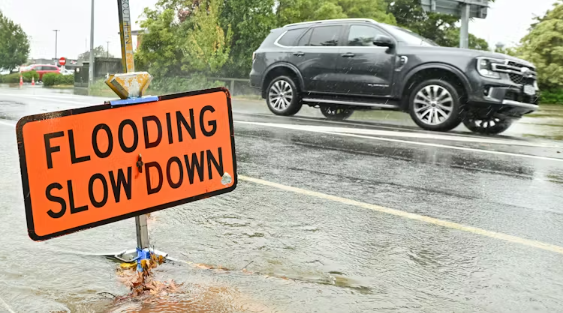
IAG NZ, New Zealand’s largest general insurer, is warning that if the Government continues with the country's current approach to natural hazard risk reduction, it will have to reconsider what parts of NZ it can afford to continue insuring.
Following the general insurer’s annual results, interest.co.nz asked IAG NZ chief executive Phil Gibson if the company will have to adjust its risk-based pricing or withdraw insurance completely from areas in NZ that are more prone to natural hazards in the future if the Government’s mitigation efforts around natural hazards continue at its current pace.
“Yes,” he said. “We don't want to come to that [but] you come to this nexus of affordability and availability.”
Gibson, who joined IAG NZ in February, previously spent 30 years working across insurance in North America. He described Florida’s hurricanes and California’s wildfires as examples of insurers struggling to cope with worsening natural hazards.
“You see places where the price [of insurance] keeps going up, up, up, up, up,” he told interest.co.nz.
“And it's not because insurance companies are mean or insurance companies want to take more profit. It's actually just the opposite. It's because those losses become so extraordinary, they almost become inevitable,” he said.
“And there comes a point where there's no price you can charge that can cover the risk because there's almost certainty. With us here, it's floodplains, right? It's places that we know are going to be at increased risk of flooding.”
IAG NZ responded to 44 severe weather events across the country during its 2026 financial year. Gibson was unable to provide the sum that the general insurer had paid out for these events.
The company insured NZ$1.07 trillion in assets during the June year, received more than half a million worth of claims and paid out NZ$2.24 billion in total.
He said NZ was fortunate that only a small percentage of the population lived in flood-prone areas, but the country had flood maps and knew where those places are.
“We all know that we need to do things to either increase the resilience of the properties that are there or even consider strategic retreat,” he said.
“I don't think it’s in the best interest of insurance companies, governments, or individuals to let people stay in harm's way.”
'The wheels of government turn slowly'
It’s why IAG NZ wants to see better natural hazard resilience plans from the Government. This has recently included another call from the general insurer in June for the Government to put forward a long-term road map that’ll strengthen the country’s ability to reduce natural hazard risk.
IAG NZ has proposed a potential 15-year roadmap after finding 42 gaps it believes need to be addressed in NZ. Gibson said IAG NZ wants to partner with the Government and doesn’t want to take an “adversarial position.”
He has met various ministers in his first six months at the company to discuss natural hazard risk, including Finance Minister Nicola Willis, describing the conversations as “great meetings.”
“We're very early on in those conversations, and I like things to move more quickly, but I understand the wheels of government turn slowly,” Gibson said.
Asked if this pace is unique to NZ or a trend he’d also experienced working in North America, Gibson said it was governments in general.
“Sadly, it's just part of the very conservative nature of government. And you actually kind of want this. You don't want them changing too quickly, or they might, you know, find they reverse themselves. Government generally tends to move at a very deliberate, cautious pace,” he said.
“Versus climate change, sometimes that can work against us because we need resiliency today. We need to make sure we're not building in dumb places anymore starting today.”
'Banks rely on us to be good partners'
Banks are also keeping a close eye on what insurers get up to, according to Gibson, who described banks as “really good partners” for IAG NZ.
“We have insurance programmes with several banks, so we take care of their retail insurance for their customers. But more so, they really rely on us to be good partners in terms of insuring the things that they're making big loans on. Homes especially,” he said.
“They're looking for us to make sure that we're here when the big one comes, whether it be the next big earthquake or the next big storms that come through, that we're here to make sure that we're there for the customers because [banks] want the customers to have those properties rebuilt, repaired or restored to pre-loss condition, or else the banks are at risk for their mortgage.”
IAG NZ being the country’s largest insurer also helps. Around one in two NZ households have a relationship with IAG NZ and the general insurer has 1.7 million customers across the country, according to its 2030 growth strategy.
“They know we're going to be here. They know we've got solid capital and solid reinsurance in place,” Gibson said.
“That size really helps us because there are going to be more storms. Sadly, there's probably going to be more earthquakes and that scale really helps us not just mobilise claims people and personnel to get repairs done quickly and effectively, but also to make sure we have the capital in place that we can weather it.”
'This is me personally taking a big risk'
Before he joined IAG NZ, Gibson said he'd been initially worried about the amount of natural hazard exposure NZ is subject to, describing the country as being on the “front lines of climate change.”
“The natural perils risk versus GDP or versus population, it's one of the highest. It's right up there with Japan,” he said. So I was a little nervous about it and I thought, this is me personally taking a big risk.”
But this changed when he found out about the levels of reinsurance cover that IAG NZ had available.
For the 2026 calendar year, IAG NZ’s Australian parent company, IAG, secured catastrophe reinsurance cover for two events up to A$10 billion, with an attachment at A$500 million. IAG’s catastrophe reinsurance program covers its entire group operations, including NZ.
“I felt so good about it because we have effective reinsurance cover in place, and reinsurers feel great about that,” Gibson said. “So all conversations with reinsurers before I got here and after I've been here have been very positive.”
He was unable to confirm how much reinsurance cover IAG NZ had secured for natural hazards in the 2027 financial year.
IAG NZ reported an annual insurance profit of A$467 million, or NZ$563 million, on Thursday. In local currency terms, its gross written premiums decreased by 2.7% to NZ$4.060 billion.
IAG NZ trades under the AMI, State, NZI, Lumley and Lantern brands. It also provides general insurance products sold by ASB, BNZ and The Co-operative Bank.
National adaptation progress
The Coalition Government released NZ's first National Adaptation Framework in October last year, which built on the previous Labour Government’s National Adaptation Plan that was introduced in August 2022.
Some of the actions set out in the framework were around introducing legislation to clarify the responsibility of local government around climate adaptation as well as the development of a National Flood Map.
The Ministry for the Environment is planning to release the map in 2027. It will show where flooding is likely to happen, both now and in the future as a result of climate change.
The Climate Change Response Amendment Bill was introduced in July, which means councils are now required to come up with 30-year climate adaptation plans as well as the projected costs.
However, Climate Change Minister Simon Watts has said that decisions on who should pay for these adaptation plans won’t be made until after the general election, which is set for November 7.
The Government also announced last year that it was planning to invest close to $97 million into 32 flood resilience projects across the country, 22 based in the South Island.
In its 2026 national adaptation plan progress assessment released earlier this month, the Climate Change Commission said that nationwide adaptation action “is not keeping pace with growing climate risks” and leaving NZ “inadequately prepared.”
Climate Change Commission chief executive Jo Hendy said natural hazards, including climate change, were costing Central Government and insurers over $4 billion a year, and those were just the direct costs.
We welcome your comments below. If you are not already registered, please register to comment
Remember we welcome robust, respectful and insightful debate. We don't welcome abusive or defamatory comments and will de-register those repeatedly making such comments. Our current comment policy is here.