
By Amanda Morrall
Despiriting as it may be turning 50, what's arguably more depressing is snapping out of a middle age funk to find yourself on the doorstep of retirement with insufficient funds to get over the threshold let alone see you through the twilight years.
Those who have mastered the art of living frugally (that is making do with a net income of less than $14,000 per year) may be comforted by the arm of New Zealand Superannuation extending its reach at 65. (For extact entitlements see Work and Income.)
Others who enjoy a higher standard of living and perhaps don't want to bank on the long-term survival of a savings pool set to be drained by a super-sized demographic bulge barrelling toward retirement might want to make alternative arrangements.
At the late stages of pre-retirement, KiwiSaver is not what you would call a panacea but it represent a savings opportunity nonetheless.
At least that is a commonly held view among those in the financial advisory sector including respected investment writer Martin Hawes who describes KiwiSaver as a "bolt-on extra.''
With a limited window for savings, it won't likely pay for the retirement villa of one's dreams but it could make the difference between a few visits to a daughter or son living abroad, he suggests.
As a KiwiSaver himself, Hawes believes it is "well worth taking advantage'' of primarily because of the subsidies.
Under the current rules, all New Zealanders under the age of 65 are eligible to enroll. Those shy of their 65th birthday can still receive the NZ$1,000 kick start and tax credits of NZ$1,042 a year.
Late stage KiwiSavings, while modest, are not insignificant.
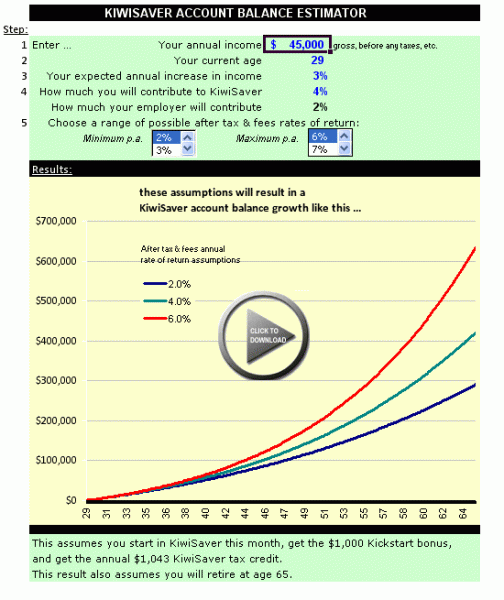
For example, someone earning NZ$25,000 a year, making 4% monthly contributions (with a 3% annual salary increase) and employer contributions of 2%, could end up with between NZ$14,000 and NZ$18,000 depending on the rate of return. (To calculate your possible KiwiSaver earnings at age 65, download our account balance estimator here.)
Like Hawes, ANZ Wealth's General Manager of Funds Management David Boyle sees KiwiSaver as a supplementary savings tool for those in their '50s and '60s.
"It's a piece of the pie and a contributing factor to help people get an income and a top-up on the other investments they might have once they reach retirement.''
While an estimated 50% of the eligible population in that demographic have joined, Boyle said many were still missing out on the potential benefits. He believed the reluctance had to do with the belief that a contracted investment time frame would not make a material difference.
Fund performance among select KiwiSaver providers might suggest otherwise. Some of the better performing actively managed funds have produced more than 10% returns per annum since KiwiSaver started.
Irrespective of the returns it delivered, financial advisor Craig Myles, director of Myles Wealth Management, maintained that KiwiSaver was a good way to enhance savings. That's because of the added value of employer contributions, tax credits, a kick-start and the beauty of compounding interest.
"It's a different investment paradigm to the investment performance paradigm if everyone is putting money it in because you can still be ahead in dollar terms,'' said Myles.
Myles said an awakening among this demographic to mortality meant many were becoming more interested in preparing for retirement.
"Particularly at age 55, we find they start to get focussed on the figures; how much they have and how long that might last.''
Myles said one of the many benefits of seeking professional advice was getting models that could forecast the numbers more accurately.
"The earlier they get engaged in that advisory process, the easier it is for them to understand their choices. They start to realise that the decisions they make, about how much to spend and how much to save, can be quite crucial.''
As everyone's situation is unique, Hawes emphasised the individual nature of investing. He admitted to being in an aggressive KiwiSaver fund himself but said it was not what he would advise a 58-year-old who didn't have other retirement savings and assets to fall back.
While rates of return, over long periods of time (usually 10 years and beyond) can make a big difference to the bottom line, Hawes placed greater emphasis on level of savings over variable rates of return. He said a 2% plus 2% savings policy (as has been adopted with KiwiSaver) fell far below what other countries, like the United States were now advocating.
Annual savings in the order of 12 to 15% of income have become the new norm, he said.
"The amount you save is more important than the way you invest,'' emphasised Hawes.
"The amount of surplus you can put aside, and that clearly brings in the length of time as well, will make a bigger difference than over whether you get 2 or 4 or 6% return on your money.'' (To read more about "safe savings rates" read this blog by Wade Pfau, Associate Professor of Economics at the National Graduate Institute for Policy Studies (GRIPS) in Tokyo, Japan.)
Generally speaking, he said those between 50-55 could therefore reasonably expect to withstand higher volatility in the type of fund they were invested in having higher growth exposure in a conservative or balanced fund. After age 55, Hawes (like many others in the financial advisory sector) advocates scaling back exposure to risk assets, that is equities and property. A conservative fund would therefore be more appropriate, he said.
Although 50 to 60 years old were advantaged in the sense that they were most likely at their highest income earning years at the late stages of working life, they were limited by the period with would they could invest in KiwiSaver. Hawes said that drove home the importance of starting one's retirement savings early and also KiwiSaver being just a piece of a much larger financial puzzle.
One's goals, desired quality of life, personal and professional circumstances all needed to factor into an overarching financial plan.
At age 50 Hawes reduced his future to '20 good summers.'
As an avid outdoorsman and passionate climber, he reasoned that by age 70 the gig would be up...at least he speculated that his breathtaking views of the Southern Alps would be greatly diminished.
Accordingly, he mapped out a plan that would allow him to make the most of his money - and time - so that he might conquer the mountains of his dreams while he was physically able to do so without breaking any bones - or the bank.
Striking this balance may be easier said than done with low-risk age appropriate investment returns at odds with longer life expectancy projections.
In his book, "Investing for Twenty Good Summers,'' Hawes frames the condunundrum as such:
"We are staring into the face of the end of full-time work and starting to think about how we will have to rearrange our money. We know that we will have to become reliant on investment returns for least some of our income and some of us are not sure how that will work.''
By choice or necessity, many are opting to work beyond the age of 65.
That being the case, KiwiSaver could outlive its usefulness, at least to the extent that it provides those added benefits for late-comers.
According to the KiwiSaver Act, employers are no longer obliged to continue making contributions to an employee's KiwiSaver scheme once they reach the age of 65 and if they've been in the scheme for more than five years. The same goes for Government member tax credits. Anyone over the age of 65 who has been a member of a KiwiSaver scheme for more than five years is no longer entitled.
KiwiSaver's inevitable maturation date has also raised questions about ease of access to those accumulated funds. The concern being that years of hard-earned savings be wiped out in the face of a lump-sum cheque the size of which most people are unaccustomed to dealing with.
Boyle allays those fear. He said KiwiSavers who wanted to protect and preserve their capital could keep their money in their account, draw down on it as necessary, continuing investing (without the benefit of employer contributions and tax credits) or transition the money into an alternative savings vehicle. At least that was the case with OnePath, fund manager for four ANZ schemes. Rules on withdrawals varied among providers.
Boyle said knowing well in advance what the money was for was key to both saving and spending it in retirement.
"People need to have something to plan for. If they haven't done so at this age, they still have time to do it. Particularly those in their 50s or early 60s because they are going to be living for a long time after that. One of the key things is don't stop paying that money to yourself. And KiwiSaver is a great way to ensure that you do.''
We welcome your comments below. If you are not already registered, please register to comment
Remember we welcome robust, respectful and insightful debate. We don't welcome abusive or defamatory comments and will de-register those repeatedly making such comments. Our current comment policy is here.