
By Amanda Morrall
KiwiSaver default providers may boast the highest enrollment levels all up, but when it comes to account size the numbers stack up in favour of the small fries.
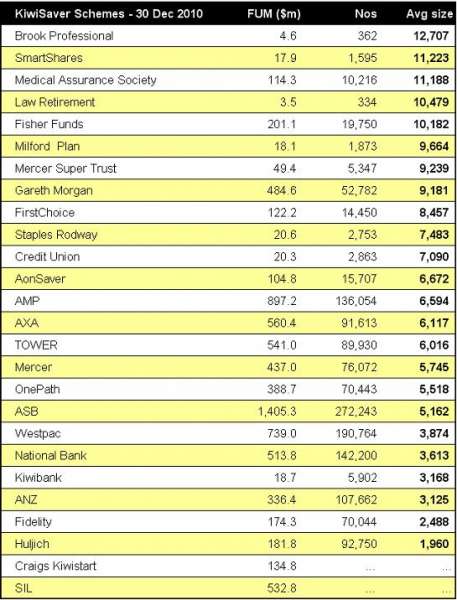
While the average account among the default providers holds around NZ$6,000, the lesser represented boutique providers are close to double that.
Brook Professional KiwiSaver Scheme is at the top of the chart with an average account size among its 362 members estimated around NZ$12,707. That's followed by SmartShares with KiwiSaver nest eggs averaging NZ$11,223 for its 1,595 members, and the Medical Assurance Society at NZ$11,188 for its 10,216 members.
ASB, by comparison, which has the second highest enrollment rate among all the default providers (with more than 270,000 members) has an average account size valued at NZ$5,162.
Account balances themselves are no indication of how well a fund _ or its provider _ has performed because values and matching employer contributions are to a large degree obviously income-driven. Regardless, the rankings are useful to the extent that they give an indication of where discriminating KiwiSavers are actively deciding where to park their retirement savings.
Just under 30% of the more than 1.6 million KiwiSavers invested are with default providers, the vast majority of which remain in default funds.
By luck more than design that has served those KiwiSavers well. On average, default funds have delivered the best returns since KiwiSaver was introduced, owing to their heavier weighting in cash and bonds. Several 'growth funds' with a higher exposure to equities took a hammering during the global economic downturn and the financial crisis.
With the market recovering, the tables have started to turn. KiwiSavers invested with some of the boutiques have benefited. Fisher Funds Growth KiwiSaver, for example, has delivered an 8.4% return per annum over three years, after fees but before taxes and expenses.
KiwiSaver membership volumes and returns are not necessarily inversely related. Fidelity KiwiSaver Scheme has an average account size of NZ$2,488 and yet its cash-option fund has returned 11.59% (after management fees) over the past three years. CEO Milton Jennings, in an interview with interest.co.nz, said this was where 80% of Fidelity's senior managers were invested in KiwiSaver.
As KiwiSaver is a long-term investment, short-term performance is not necessarily the best guide to how well your fund is doing.
Providers and financial advisers say it is more important to make sure you are in the right type of fund for your age and risk appetite and also that fees are not unreasonable. As fees typically vary depending on the kind of fund you are invested in, it is best to compare like with like.
To see how much your expense ratio (that's total fees) are relative to other funds in the same category check out our KiwiSaver fund section. Select the highlighted type of fund you are in (conservative, balanced, growth or aggressive).
In this same section, you can compare adjusted performance rates of funds by category.
We welcome your comments below. If you are not already registered, please register to comment
Remember we welcome robust, respectful and insightful debate. We don't welcome abusive or defamatory comments and will de-register those repeatedly making such comments. Our current comment policy is here.