
By Amanda Morrall
Retirement researchers at Auckland University are recommending Government revise the residency requirement for New Zealand Superannuation (NZS) from 10 years to 25 years to help resolve identified "injustices" affecting foreign pensions.
The proposal, contained in a report by the Retirement Policy and Research Centre (RPRC), says the adjustment would be one of the quickest and most efficient ways to address "anomalies and inequities" affecting an increasing number of New Zealand residents with overseas pensions.
Researcher Claire Dale said while it was clear that no person should get two full basic state pensions, New Zealand's "current policy works unfairly for many of the 50,000 plus people affected.''
As an example, Canadian employment-based pensions are now deducted from NZS by virtue of the direct deduction policy (DDP) "because they are run by the state."
Dale and co-author Susan St. John said Government's continued neglect of the issue, in the face of growing challenges related to the sustainability of New Zealand Superannuation and also potential Human Rights conflicts, would only serve to complicate matters down the road. Both the Ministry of Social Development and Retirement Commission have raised the issue but to no avail.
The aim of the DDP is to prevent residents who spent time working abroad, but who live in New Zealand, from "double dipping" - earning pensions in both countries.
Migrants have denounced the DDP as unfair because in some instances they paid into pensions through earnings deducted from their pay. In some cases, the policy even punishes the New Zealand born and domiciled spouses of migrants if the amount their partner's earn from a foreign pensions is above the NZS entitlements.
While this and other pension anomalies identified by the RPRC affect around 50,000 New Zealand residents currently, the number of those affected is expected to grow because of migrant flows. (See table below).
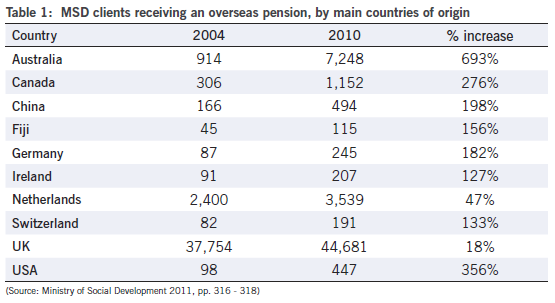
The report's authors argue that the simplest way to resolve the pension problem is to change the qualifying period of residency, now at 10 years, to 25, "rather than tinker with administrative rules in a complex reform to apportion NZS.''
The 10(5) rule requires qualifying NZS candidates to have lived five of the 10 years in New Zealand after the age of 50.
Dale said the requirement was among the most lenient in the world because those that met the residency requirement need not have even paid tax here to receive the NZS.
"If the NZS required at least 25 years' residence between the ages of 20 and 65, it may then be far less important to identify the kinds of overseas pensions that are brought into New Zealand,'' the report states.
The report notes that 85% of the 51,618 NZS recipients affected by the DDP have lived in New Zealand for more than 30 years.
Another problem identified by the RPRC is the inequitable nature of pension policy with Australia.
As it stands, Australians with large savings from the Australian compulsory superannuation scheme can come to New Zealand and qualify for the full NZS, whereas if they retired in Australia, the means-test could disqualify them from receiving the Australian Age Pension.
We welcome your comments below. If you are not already registered, please register to comment
Remember we welcome robust, respectful and insightful debate. We don't welcome abusive or defamatory comments and will de-register those repeatedly making such comments. Our current comment policy is here.