
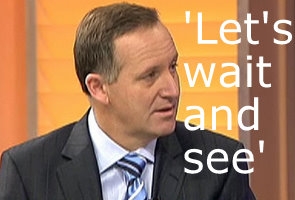
Prime Minister John Key has said he thinks the New Zealand dollar is probably going to go "a little bit higher" than it is now, and that it "unfortunately" seems to be 'wait and see' for New Zealand exporters waiting for the currency to fall from its now 30 month highs against the US$.
Key also downplayed talk on any currency intervention by the government, citing losses in Australia, where authorities had been "intervening a little bit more aggressively" than usual.
“I have been saying it’s going up, unfortunately, and I think it’s probably going a little bit higher than that," Key told Alison Mau on TV1's Breakfast program.
"The problem for that is what’s forcing it up is, as we know, a very weak US economy," he said.
"The world has decided that they need to rebalance. Now the quantitative easing, where they print money and all those things, in a way that’s just a signal that they need further adjustment in the US. So it’s very problematic, and we agree, if you’re non-commodity linked, so if you’re making something that’s not linked to a commodity price, it’s a big problem.
"The question is what you can do?"
Mau asked about the government’s recent deal with Warner Brothers, and why had the government acted for them, but not for others?
Key said the government deal still did not help Warner Brothers "anywhere near compared to the risks or costs that they run".
"So when Warner Brothers first looked at making the Hobbit movies in New Zealand, the exchange rate was 50 [US] cents, and now as we know its 79 [US] cents," he said.
Intervention not the key
"The problem is, let’s say you intervene, which is something that others have advocated, and there’s no evidence that’s ever worked in the past," Key said.
"Japan’s been doing that ever since dollar-yen was at 330 and now it’s about 80 odd, so it’s gone one way.
"But, for instance, the Australians announced, I think last week, that they’ve been intervening a little bit more aggressively
"They announced that their mark-to-market losses – so the losses on the positions that they’ve opened – are over A$4 billion.
"So it’s very expensive, and it doesn’t necessarily work. Now unfortunately seeing the adjustment process that’s happening now. Look, over time the exchange rate’s going to come back down."
Mau asked whether, then, it was the case of 'just wait and see'?
“Unfortunately," Key said.
Agriculture key to Pacific free trade agreement
Meanwhile Key pressed that any Trans Pacific Partnership free trade deals would have to include agriculture. Japan and Canada have been expressing interest in joining the TPP, while US Secretary of State Hillary Clinton last week said the TPP was the US's priority over any bilateral deal with New Zealand.
"We said to Japan and Canada, both who want to come in, ‘look if you want to, we want a comprehensive, high quality agreement. If you can’t sign up to that - and that really means agriculture’s part of the deal - if you’re not going to be willing to participate at that level, don’t come into the negotiations," Key said.
"But it’s looking like Japan might, possibly," he said.
"It would be great if they do come in. You can’t force them.
"You go into a trade agreement if you believe it’s in your interest. But from Japan’s point of view, they’re looking at the rest of the region like we are, and we see huge growth there.
"If you look at China, India, all these kind of countries – massive growth. Now either you want to be part of that, or you don’t. If you have a free trade agreement it helps you be part of it."
Finance Minister Bill English got currency advice from Bank of Japan
Finance Minister Bill English said he had received advice from the Bank of Japan that it was very difficult for a nation to hold down the value of its currency. English was talking to Morning Report host Geoff Robinson on Radio New Zealand after a meeting of APEC finance ministers in Japan last week. English also met with the governor of the Bank of Japan.
“We’re talking here about the third largest economy in the world," English said.
"The advice from the Bank of Japan was that it is very difficult to hold down the value of your currency, and they’re not planning to intervene consistently over time, because they don’t think it will work," he said.
“I think that fitted a general consensus [at the APEC conference] that intervention in your exchange rate can be costly and very risky and you’re better to do in fact what New Zealand’s doing, and that is to focus on making sure that your exporters are very competitive, by getting your domestic policies right, and pursuing free trade agreements so that you can simply get more options for selling your exports."
Make free trade, not currency war
English told Robinson how Japan was looking to join the Trans Pacific Partnership.
“I think they’ve realised the same thing as we have – that when your currency is getting stronger, as theirs is, then one of the things you can do for your exporters is to get free trade agreements," English said.
"So Japanese business in particular seems to be keen on it, but they will have the traditional problem of how to deal with an agricultural sector in Japan that’s highly protected."
So what about the US signalling it may join TPP and issues coming from its agriculture sector?
"Well the Koreans have always been quite aggressive about free trade agreements, as the same way New Zealand has. They’ve got agreement ready to be ratified with the US," English said.
"I think it’s part of a more general picture that in the Asia Pacific region. New Zealand’s long-term push for free trade has got momentum because everyone realises they will be better off if they trade with each other.
"That’s an environment that would be very good for New Zealand."
English said currencies were "probably" the main issue focused on at the APEC meeting. "We (New Zealand) are quite concerned about the effect of our strengthening dollar on our exporters, but we found we’re not alone," he said.
"Pretty well every other country with the exception of the US and China is worried about it, so there was a strong common interest in the issue of how to help your own exporters in the shorter term, while the US economy comes right and until China changes its policy to some extent.
Japanese housewives
Robinson asked English about the flow of Uradashi bonds (see more here), and whether 'Japanese housewives' were still piling into the New Zealand currency?
“Well no, not so much, which is probably helping us a bit," English said.
"At the moment there are probably more attractive investment options such as the Australian dollar, because they’ve got higher interest rates than New Zealand, and other currencies that hadn’t been traded much before, such as the Brazillian currency.
"That was one positive feature of the discussion – that the Japanese housewife, the mythical Mrs Watanabi, is not trying to buy New Zealand dollars and so that helps us a bit."
(Updates with Bill English comments, Key's free trade comments.)
No chart with that title exists.
We welcome your comments below. If you are not already registered, please register to comment
Remember we welcome robust, respectful and insightful debate. We don't welcome abusive or defamatory comments and will de-register those repeatedly making such comments. Our current comment policy is here.