
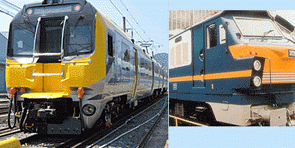
State-owned KiwiRail is being urged to enforce local content provisions in a contract for building 38 trains for Auckland which is being contested by two foreign companies.
The Rail and Maritime Transport Union (RMTU) pointed to work by economic researcher BERL on the benefits of building the 38 trains in New Zealand, saying the State Owned Enterprise must rigourously enforce provisions for the winning bidder to look at using local facilities or expertise when building the trains.
KiwiRail told interest.co.nz bidders were encouraged to explore local content options for building the trains and that further discussions would be held with the two parties on opportunities for the involvement of New Zealand skills and resources.
KiwiRail announced yesterday two bidders had been shortlisted for the contract - Hyundai Rotem Company; and Construcciones y Auxiliar de Ferrocarriles S.A/Mitsubishi Corporation. KiwiRail has set aside NZ$500 million for the contract to build the 38 trains.
Long-term economic benefits
The BERL report (see below) suggested the price of building the trains in New Zealand would be internationally competitive as train manufacturing was largely capital intensive. This meant labour costs, which are cheaper in countries like China, played a smaller role in the overall cost of the project.
Building the trains in New Zealand would also bring other benefits to the country in areas like employment, GDP growth, and increased government revenue.
Read the full BERL report here
Your view?
BERL's 'business case' for building the trains in New Zealand is below. Should KiwiRail be forced to force the two foreign bidders that the trains be built here?
Is this an area where government should be intervening?
We welcome your views and insights in the comments space below
Here is the BERL 'Business case' for building the trains in New Zealand from the report:
This project was commissioned by the Rail and Maritime Transport Union (RMTU) and Dunedin City Council (DCC). The purpose of the project was to estimate the likely economic benefit of New Zealand building new rolling stock for the Auckland rail network. Kiwirail has plans to purchase 38 three-car Electric Multiple Units (114 cars), and 13 electric locomotives. This new rolling stock is likely to cost NZ$375 million to produce in New Zealand.
Some stakeholders question whether New Zealand has the capacity to build the rolling stock in the timeframe suggested in Kiwirail‟s Industry Engagement Document. We have therefore estimated impacts for two scenarios: a “mandated” scenario and a “constrained” scenario.
The key benefits of producing the rolling stock in New Zealand, at a national level, include:
- an average of 1,270 full-time equivalents (FTEs) employed across New Zealand over a period of 45 months (mandated scenario) or 770 FTEs across New Zealand over a period of 69 months (constrained)
- NZ$250 million (mandated) or NZ$232 million (constrained) added to total GDP, including NZ$117 million (mandated) or NZ$108 million (constrained) in direct GDP.
Our research suggests that overseas manufacturers would need to produce the rolling stock at between 29 percent and 62 percent less than the price of manufacture in New Zealand to offset the benefits to New Zealand GDP of producing the trains here. The range is dependent on whether we consider only the direct benefits (29 percent) or total benefits (62 percent) to New Zealand GDP of building the rolling stock here.
Our research suggests that at these prices, the rolling stock is unlikely to be sourced from quality western suppliers. It may be possible for Asian sources to supply at prices close to these. However, the quality and expected life could be less than those from Europe and North America, and we suspect from New Zealand. It is possible also that total operating costs could thus be higher. It therefore makes business sense to produce the trains here, not only from a national perspective, but also from a commercial (Kiwirail) perspective.
There are a number of further economic benefits of building the rolling stock in New Zealand that are discussed in this report. These include developing and maintaining skills in New Zealand; the opportunity to capture part of a NZ$15 billion rolling stock industry; opportunities for innovation and technology spill-overs to other industries; ongoing maintenance contracts with associated jobs and contribution to GDP; reduced exchange rate risk or risk-minimisation costs; and Crown revenue and trade balance benefits.
Here is the release today from the Rail and Maritime Transport Union.
Rail workers are today calling for a firm commitment from KiwiRail that it will rigorously enforce local content provisions it placed in tender documents for the construction of Auckland’s new trains.
Late yesterday KiwiRail announced the two shortlisted firms for the $500 million job to build 38 three-car electric multiple units and 13 locomotives for the Auckland rail network.
Last May, Chambers of Commerce, local government and unions commissioned a report setting out the economic benefits of building the trains in the Dunedin and Lower Hutt workshops. BERL’s report estimated a local build would have added between 770 to 1270 additional jobs, $232 to $250 million to GDP and an increase in crown revenue by a net $65 million to $70 million.
Rail and Maritime Transport Union General Secretary Wayne Butson said that while KiwiRail and Transport Minister Steven Joyce had turned their nose up at local build, it was vital that clauses in the tender document supporting local firms were enforced.
“Rail workers’ preference has of course always been that these trains are built locally, and the economic case has backed them up,” Wayne Butson said.
“But the next logical step is to ensure that the successful contractor involves local firms in as much of the construction as possible.”
“From Day 1 it has seemed that there were only two people in New Zealand who thought that the Hillside and Woburn workshops couldn’t build these trains – KiwiRail’s Jim Quinn and Minister Steven Joyce.”
“Everyone else believed that the economic benefit of more work for local manufacturers, and the retention of a skilled rail workforce, was too important to let the job go overseas.”
“We are now calling today for a firm commitment from KiwiRail that the local content provisions in tender documents will be enforced,” Wayne Butson said.
KiwiRail’s May 2010 tender document encouraged firms to ally themselves with New Zealand subcontractors or suppliers and “include as much New Zealand content and resources in the design, construction, delivery, testing, maintenance and support of the EMUs as is appropriate.”
Here is the KiwiRail announcement yesterday on the two shortlisted bidders for the contract:
A further milestone has been reached in the procurement of new electric trains for the Auckland network with KiwiRail today announcing the short list of two bidders to advance to the final stage of contract negotiations.
Chief executive Jim Quinn says the two remaining bidders for the EMU procurement and maintenance contract are Hyundai Rotem Company; and Construcciones y Auxiliar de Ferrocarriles S.A./ Mitsubishi Corporation.
It is expected the selection of the preferred bidder would be completed by the end of the third quarter 2011, Mr Quinn said.
"Over the next few months we will continue to work with these bidders to develop the proposals leading to their best and final offers. As part of that process we will discuss opportunities relating to the degree of local content in each proposal."
Mr Quinn said there had been a significant level of industry involvement in the procurement process to date which had led to robust and competitive proposals.
"We are very pleased with the quality of the responses and the positive input of all suppliers to date, which gives us great confidence as we head into this vital last stage of contract negotiations and move into the construction phase of the project."
A total of $500 million has been allocated for the purchase of new trains, maintenance and storage depots.
Here is KiwiRail's response to questions from interest.co.nz on the local content provisions:
All bidders have been encouraged to explore local content options, and provided with information on the skills and resources KiwiRail could provide to add local content, and connected with the Industry Capability Network, which connects local businesses with major projects.
As we proceed through this final stage of contract negotiations, we will be holding further discussions with the two parties, addressing a wide range of issues including the opportunities for involvement of NZ skiils and resources.
We welcome your comments below. If you are not already registered, please register to comment
Remember we welcome robust, respectful and insightful debate. We don't welcome abusive or defamatory comments and will de-register those repeatedly making such comments. Our current comment policy is here.