
By Bernard Hickey
The Reserve Bank now expects interest rates to stay lower for longer over the next couple of years because of the worsening global outlook, a strong New Zealand dollar and a slow Christchurch rebuild.
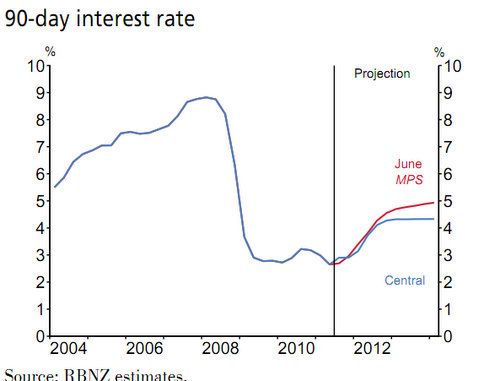
The Reserve Bank of New Zealand announced on Thursday morning it had held the Official Cash Rate (OCR) at 2.5% as expected, but had lowered its forecast track for the 90 day bill rate by around 60 basis points (0.6%) to a peak of 4.3% by the end of next year. This would imply a peak OCR of 4%. See the chart below.
That means the Reserve Bank is now expecting floating interest rates to rise around 140 bps (1.4%) over the next 12 months, rather than the 200 bps (2%) it forecast in June. See the chart below for more detail.
The New Zealand dollar fell from 83.5 USc before the announcement to 81.8 USc by late morning. See our interactive chart below. The big four bank economists shifted their forecasts for the first OCR hike out from December to January or March next year and some reduced their peak OCR forecasts to around 4-4.75% by the end of next year.
Floating mortgage rates have been around 3% above the 90 day bill rate since the Global Financial Crisis, meaning floating mortgage rates are expected to rise over the next couple of years to around 7.15% from around 5.75% now. Term deposit rates would also rise to around 5.5% from just above 4% now.
This forecast of lower interest rates for longer makes floating relatively more attractive than fixing.
The Reserve Bank said the risks of a sharp global economic slowdown had increased since its last forecast in June and the rebuild of Christchurch had been delayed. See more here on the Christchurch earthquake rebuild delay here in Alex Tarrant's article.
It also said it now expected a higher New Zealand dollar and lower commodity prices to do some of the work of lowering inflation pressures, which meant it could keep interest rates lower than it previously forecast.
Reserve Bank Governor Alan Bollard also noted that international funding costs for banks could increase if financial market turmoil in Europe and America did not settle in coming months. See more on that here in Alex Tarrant's article.
“If conditions do not improve, these pressures will see monetary conditions tighten, and banks would be likely to increase lending and deposit rates relative to the OCR,” the Reserve Bank said in its September quarter Monetary Policy Statement.
That raises the possibility that banks could raise mortgage rates and term deposit rates even though the Reserve Bank left of the OCR on hold. The Reserve Bank said actual bank funding costs had not risen yet, but there was a risk they could if the global financial turmoil does not settle in coming months.
What the economists said:
BNZ Economist Stephen Toplis said he now expected the Reserve Bank to hike the OCR by 25 bps on March 8 and eventually hike it to 4.75% by the end of 2012. Previously he had forecast a 50 bps hike on December 8 and a peak of 5%.
We, as has the Reserve Bank, have now abandoned the idea that the Reserve Bank will remove the emergency cut imposed for Christchurch following the February earthquake. For all intents and purposes the Reserve Bank has, in its own mind, replaced the Christchurch emergency with the European emergency. This is probably inappropriate because if you pose the question to RBNZ officials that had they hiked the cash rate to 3.0% in July would they now reduce it, the answer would be no. Nonetheless, that’s the approach that seems to have been adopted.
This is important because the removal of the Christchurch emergency cut implied the first rate increase would be 50 basis points. Potentially, changes in the European situation do not. It is for this reason we have plumbed for 25 as the next move.
There is an outside chance that the Reserve Bank will still need to move this year but outside it is. Importantly, the Reserve Bank’s pick for Q2 GDP, to be published on September 22, is 0.6%. Our view is that the number will be just 0.2% and, conceivably, could even have a negative sign in front of it. If we are right, this will keep the Reserve Bank well and truly on the back foot. Also keeping the RBNZ on the back foot is what is happening to pricing in fixed interest markets and its flow on impact to bank funding.
Currently, global tensions are adding cost to longer term funding for the banking system. At this stage, the quantum of funding being done is sufficiently small that this is having a negligible impact on the Banks’ average cost of funds. However, there is a heightened likelihood that it soon will. That being the case, raised lending charges could yet result in tighter monetary conditions anyway. Any further strength in the NZD would create even greater tightness.
ANZ Economist Cameron Bagrie said he expected the Reserve Bank to raise interest rates, possibly from early next year, before reaching a peak of around 4.5%.
Picking the timing of the tightening cycle looks more problematic. Domestic interest rates still look too low relative to the local inflation and growth outlook. The profile of the RBNZ’s 90-day interest rate track implies an early 2012 start to the tightening cycle. In addition, the RBNZ has stepped away from talking about the “insurance cut” in March, which we take to mean a 50bps unwind is off the table (for now). Even if the global scene settles, it will hardly be stable, so some caution will be warranted when unwinding policy support.
We see stabilisation and improvement in offshore funding markets as a prerequisite to higher interest rates (i.e. the RBNZ will not want to be hiking when funding costs are going up at the same time). Given the scale of Europe's challenges, it seems heroic to think things could be improving by year-end, though policymakers could yet pull a rabbit out of the hat. In this situation the risk profile is clearly tilted towards a March 2012 hike over December 2011.
We strongly suspect inflation indicators will favour the earlier start, with upcoming data such as the Q3 unemployment rate, Q3 CPI and the next inflation expectations readings supporting this. However, tail-risks in the global scene will urge some chance being taken on the inflation trajectory.
ASB Economist Jane Turner initially said she expected the RBNZ to hike the OCR by 50 bps on December 8 and then pause until April next year, before resuming with 25 bps hikes until a peak of 4%.
Then ASB changed its view in a fresh late morning research note, saying it now saw the first 50 bps hike delayed until March 8.
With concern about the escalating debt crisis in Eurozone dominating RBNZ’s outlook, we now expect the RBNZ will leave the OCR on hold until March next year. While there is much uncertainty about both the timing and size of the first OCR increase, for now we see a 50 basis point OCR increase in March as the most likely scenario.
Beyond that, we continue to expect 25bp increases at the subsequent meetings until the OCR reaches a peak of 4%.
Westpac Economist Dominick Stephens changed his OCR hike forecast to a 25 bps hike on January 26 from a 25 bps hike on December 8.
The bottom line is that domestic conditions already warrant higher interest rates, and at some point the RBNZ is going to have to hike into a less-than-ideal global environment. However, that environment has become much more perilous in the last few months, and the complex interaction of financial markets and policymakers makes it impossible to anticipate just how this will be resolved. For now, we believe the most likely start date for OCR hikes is January next year (the RBNZ’s projections suggest March, but we believe emerging inflation pressure argues for a slightly earlier move).
But like markets, we will take our lead on New Zealand monetary policy from developments in Europe over the coming months, and will adjust the short-term outlook accordingly. Markets barely responded to the central bank’s missive. Two-year swap rates fell around 2 basis points, while the NZD fell to a low of 81.77 from 82.55 before. We regard today’s swap rates as too low. New Zealand’s interest rates will have to rise at some point – the mammoth reconstruction task in Christchurch will make sure of it.
HSBC Economist Paul Bloxham said he expected the Reserve Bank to hike the official cash rate by 25 basis points on December 8 and then by a further 125 basis points to 4% next year.
With global markets in disarray, it was no surprise that the RBNZ kept rates on hold today. The Governor reminded us that, purely on domestic grounds, the RBNZ would be hiking, but that concerns about a possible weakening in demand for exports and increase in bank funding costs were enough to keep them benched, for now.
RBNZ is clearly in wait and see mode on global scene, but with a bias to tighten. We still expect rates to rise before year-end.
JP Morgan Economist Helen Kevans said she expected the Reserve Bank to lift the OCR by 50 bps on December 8 and then by a further 100 bps through the rest of 2012 as long as the global economic and financial situations improve.
The statement accompanying the decision, not surprisingly, flagged officials’ concerns about heightened offshore risks. That said, the central message was that, provided recent global developments have only a “mild” impact on the New Zealand economy, the official cash rate (OCR) likely would need to increase.
Indeed, we maintain that the next tightening cycle will commence in December with a 50bp hike to the OCR; this call, though, is heavily contingent on a normalization in market sentiment and ebbing of risks around the US and Euro area fiscal situations. Provided such risks “recede”, and the domestic dataflow stays on its current trajectory, a rate hike before year-end still appears likely.
(Updated with reaction from Finance Minister Bill English, video, chart above showing forecast 90 day bill track, links to articles on bank funding costs and earthquake rebuild delay, NZ$ fall, Bill English video; Full news conference video; Economists comments from HSBC's Paul Bloxham, JP Morgan's Helen Kevans, ASB's Jane Turner, ANZ's Cameron Bagrie, BNZ's Stephen Toplis and Westpac's Dominick Stephens)
Here is the full news conference video here:
Here is the full statement from the RBNZ below:
The Reserve Bank today left the Official Cash Rate (OCR) unchanged at 2.5 percent.
Reserve Bank Governor Alan Bollard said: “The New Zealand economy has performed relatively well while headline inflation has increased somewhat since the June Statement. At the same time, however, global economic and financial risks have increased.
“Domestic economic activity has surprised on the upside and capacity usage appears to have increased. Continued high export commodity prices and, in time, reconstruction in Canterbury are expected to provide impetus to demand over the projection horizon.
“However, the outlook for New Zealand’s trading partners has deteriorated markedly. There is now a real risk that global economic activity slows sharply.
“Global financial market sentiment has also deteriorated. Sovereign debt concerns in Europe and the weakened global outlook have caused international bank funding markets to tighten. If conditions do not improve, New Zealand bank funding costs will increase.
“Largely because the New Zealand economy has been doing better than many others, the New Zealand dollar has appreciated since the June Statement. The high level of the New Zealand dollar is having a dampening influence on some parts of the tradable sector and on imported inflation.
“Annual headline CPI inflation continues to be above the Bank’s 1 to 3 percent target band. However, much of the current spike in inflation has been driven by last year’s increase in the rate of GST, and will therefore be temporary. Wage and price setters should focus on underlying inflation, which, while rising, is currently estimated to be near 2 percent.
“If recent global developments have only a mild impact on the New Zealand economy, it is likely that the OCR will need to increase. For now, given the recent intensification in global economic and financial risks, it is prudent to continue to hold the OCR at 2.5 percent.”
No chart with that title exists.
We welcome your comments below. If you are not already registered, please register to comment
Remember we welcome robust, respectful and insightful debate. We don't welcome abusive or defamatory comments and will de-register those repeatedly making such comments. Our current comment policy is here.