
By Alex Tarrant
Councils will soon only be allowed to increase core expenditure in line with inflation and population growth, but will have exemptions for spending incurred from natural disasters, and possibly from regulatory requirements placed on them by outside sources such as the Environment Court and Government.
Councillors will also get greater power over the rates of pay of staff, and amounts of staff their councils employ, as part of a government shake up of the local government sector.
Local Government Minister Nick Smith today released a paper detailing the government's plans to reform the way local government operates. Smith said these were aimed at keeping rates rises down and controlling the amount of debt councils take on.
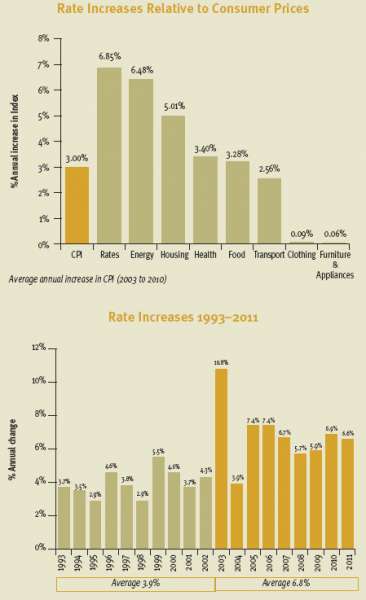
Local authority rates across New Zealand rose at an annual average of 7% in the decade since the Local Government Act 2002 was passed, compared to average annual rises of 3.9% the decade before that, Smith said on Monday afternoon when releasing the paper titled Better Local Government.
“The reforms will help keep rates affordable and debt at prudent levels by focusing councils on their core roles, setting clear fiscal responsibility requirements and giving councils more tools to better manage costs. The package rebalances the changes made in 2002 that have seen average rates increase by 7 percent per annum and council debt quadruple from NZ$2 billion to NZ$8 billion,” Smith said.
Speaking to media in the Beehive on Monday afternoon, Smith said there would be a component of annual council expenditure growth which would be set at the rate of inflation and population growth. There would be an exemption for expenditure stemming from natural disasters, such as that faced by the Christchurch City Council.
“There may also be provision for exemptions around situations where, for instance, the Environment Court may require a council to proceed with a major investment, say in the [area] of sewerage or other infrastructure," Smith said.
"They are details to be worked out through regulation with Local Government New Zealand, and I am confident that we can come up with a set of regulations that most councils will say is a pretty reasonable set of fiscal responsibility requirements,” he said.
Control wage bills
Meanwhile, the Local Government Act 2002 would be amended to empower councillors to set policy on the number of staff to be employed by their council, and overall renumeration policy. Councils' annual reports would be required to include information on staff employed by salary bands.
Smith said the largest component of council cost increases over the last was in salary bills.
“There has been quite a growth in that area. That is why in this package we’ve provided them with some specific tools in this regard," he said.
‘In terms of the overall picture, what we do know is that prior to the 2002 Act – for the decade previous – rate increases were going up at 3.9% per year. In the decade since, they’ve been going up at 7% per year. I think the only fair conclusion to come to is both the bureaucratic requirements, and the expansion of the purpose of local government have cost councils and ratepayers considerably more," Smith said.
“If rates had continued to increase at a similar rate as the previous decade, the average household today would be spending NZ$500 a year less on rates, and the economy as a whole would be spending NZ$1 billion less on rates,” he said.
Councils needed to provide local public services, which would include firework displays and arts festivals. But they should not be providing services that overlaped ones which were the responsiblity of central government or the private sector, such as trying to improve NCEA pass rates in their region.
'Limit spending growth'
"Fiscal responsibility is the issue of our age with the global financial crisis, and the debt crisis engulfing some financial companies, banks and countries. Local authorities in some overseas jurisdictions have gone bankrupt but thankfully this has never occurred in New Zealand," it says in the paper.
"Previous local government legislation placed limits on council borrowing but was repealed. The rapid rise in council expenditure and borrowing over the past decade has seen some councils reach unsustainable levels of debt. The government is proposing new tools for encouraging financial prudence," it says.
"The government has agreed to changes to the Public Finance Act, as part of the confidence and supply agreement between ACT and National, to introduce a fiscal responsibility requirement for central government. This will limit expenditure growth to no faster than inflation and population growth excluding extraordinary items such as disaster recovery expenditure. The government is proposing a parallel requirement on councils.
"The Local Government Act 2002 will be amended to introduce a provision that enables fiscal responsibility requirements to be set by regulation. The law will require these to be developed in consultation with Local Government New Zealand. These will set benchmarks in respect of income and expenditure, and prudent debt levels. It will include the capability to exclude extraordinary expenditure such as disaster recovery costs," it says in the paper.
"The new fiscal responsibility requirements will be linked to councils’ development of their fiscal strategy. These will be ‘soft’ caps that are linked to the new graduated powers of intervention requiring information and reports, appointing a crown reviewer, observer or manager, or in extreme circumstances a commissioner or an early election," it says.
See the reforms in the Better Local Government paper here.
The reforms are:
 1. The Local Government Act 2002 will be amended to replace references to the ‘social, economic, environmental and cultural well-being of communities’ (the four well beings) with a new purpose for councils of ‘providing good quality local infrastructure, public services and regulatory functions at the least possible cost to households and business.’
2. The Local Government Act 2002 will be amended to provide, by way of regulation, fiscal responsibility requirements in respect of income and expenditure, and prudent debt levels to be developed in consultation with Local Government New Zealand.
3.1 The Local Government Act 2002 will be amended to empower councils to set policy on the number of staff to be employed and overall remuneration policy. Councils’ annual reports will be required to include information on staff employed by salary bands.
3.2 The Local Government (Auckland Council) Act 2009 mayoral powers in respect of appointing deputy mayors, establishing committees, appointing committee chairpersons and proposing plans and budgets will be extended to all mayors from October 2013.
3.3 The Local Government Act (2002) is to be amended to provide a simpler, graduated scale of intervention linked to new fiscal responsibility requirements ranging from the request to provide information, to have a crown reviewer, observer or manager; or in extreme circumstances, commissioners or an early election.
4.1 The Local Government Act 2002 will be amended to streamline consideration of reorganization proposals and to extend the criteria to specifically include the benefits to be gained from simplifying planning processes and efficiency improvements.
4.2 The Local Electoral Act 2001 will be amended to give councils and the Local Government Commission greater flexibility in the determination of ward boundaries in rural areas to take into account communities of interest.
5. A Local Government Efficiency Taskforce will be established in consultation with Local Government New Zealand to review the planning, consultation and reporting requirements of the Local Government Act 2002 to report to Government by 31 October 2012
6. The Productivity Commission will undertake a review of the balance of functions allocated to local government by central government and ways to improve regulatory performance in the sector by April 2013. The Government will then, in consultation with Local Government New Zealand, develop a non-statutory framework for guiding decisions on which regulatory functions are best undertaken by local and central government.
7. Local government infrastructure provisions will be investigated by an expert advisory group to look at how good quality infrastructure to support a growing economy can best be delivered at least cost.
8. The Government will undertake a review of development contribution policy following the publication of the Auditor-General’s report on councils’ long term plans later this year.
See the announcement from Local Government Minister Nick Smith:
The ‘Better Local Government’ reforms announced today by Prime Minister John Key will provide clarity around the role of councils, stronger governance, improved efficiency and more responsible financial management said Local Government Minister Nick Smith.
“These reforms are part of the Government’s broader programme for building a more productive, competitive economy and better public services,” Dr Smith says.
“The reforms will help keep rates affordable and debt at prudent levels by focusing councils on their core roles, setting clear fiscal responsibility requirements and giving councils more tools to better manage costs. The package rebalances the changes made in 2002 that have seen average rates increase by 7 percent per annum and council debt quadruple from $2 billion to $8 billion.”
“The ‘Better Local Government’ reforms include eight specific initiatives; the first four will be introduced to Parliament in May and be passed in September. They will refocus the purpose of local government, introduce fiscal responsibility requirements, strengthen council governance provisions and streamline council reorganisation procedures.”
“The balance of the reforms which include; a local government efficiency taskforce, a framework around local and central government regulatory roles, an investigation into efficient infrastructure provision and review of Development Contributions, will be undertaken in consultation with Local Government New Zealand. These work streams will also link with the Productivity Commission’s investigation on regulatory roles between central and local government and the Auditor General’s inquiries into Development Contributions. This work will feed into a second reform bill proposed for 2013.”
“I look forward this week to meeting with the Mayors and Chief Executives from New Zealand’s 78 councils in Auckland, Tauranga, Wellington, Christchurch and Dunedin to advance these reforms. We want to work with local government in these challenging financial times to deliver efficient and affordable council services for New Zealand,” Dr Smith said.
(Updated with video from post cabinet news conference and detail from Smith)
We welcome your comments below. If you are not already registered, please register to comment
Remember we welcome robust, respectful and insightful debate. We don't welcome abusive or defamatory comments and will de-register those repeatedly making such comments. Our current comment policy is here.