


GDP expanded more than 3% and employment gains were plentiful; the jobless rate has fallen to 5.3%. The housing market-led consumption growth drove the economy, with house price gains averaging 7.8% in 2014 and 2015.
Driven by higher population growth, consumption will continue its pivotal role in buttressing growth, and GDP will likely expand 2.8% in 2016.
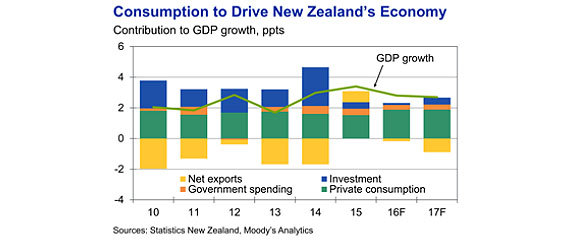
But risks are downwardly skewed, and the untethered growth is unlikely to last. The tailwind from the Canterbury earthquake reconstruction is nearly over, as the rebuilding activities likely peaked in 2015. Elsewhere, given low dairy prices and suppressed farm incomes, external headwinds will sting more than in previous years. The economy is expected to come out relatively unscathed but not without a helping hand.
Inflation, growth and exchange rate risks
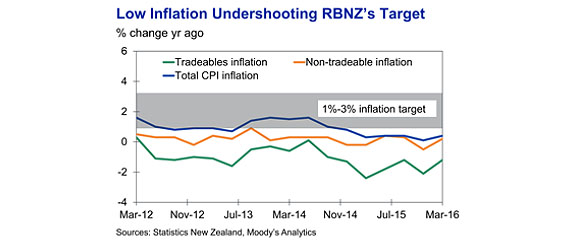
The Reserve Bank of New Zealand is set to undershoot its inflation target in 2016, setting the stage for further monetary easing. On the back of low oil prices, CPI growth - rising 0.4% y/y in the March quarter - has been subdued.
Outside the hot housing market, disinflation seems entrenched because of lower costs of global imported goods. With commodity prices falling further, imported inflation is unlikely to rise in coming months.
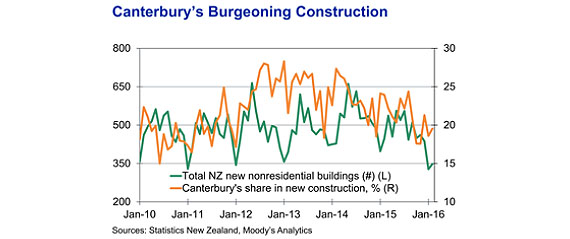
Domestic demand is also approaching its peak. The post-earthquake rebuild of Christchurch has buttressed economic activity, particularly in the Canterbury region. Building construction there still outweighs that in the rest of the nation, and that trend will likely continue for the remainder of 2016.
However, with most of the investment pipeline filled, we are unlikely to see a further boost from reconstruction in 2017. Indeed, business investment in nonresidential building fell 2.63% y/y in the September quarter of 2015. This follows double-digit growth in 2014.
Low external demand is expected to persist. Though drought conditions haven’t intensified, low dairy prices will have added pressure to farm incomes.
To add to the weak external demand, the kiwi has risen again in 2016. This has been a common trend for the antipodean currencies, as global interest rates have fallen further. A firming kiwi erodes New Zealand’s international competitiveness.
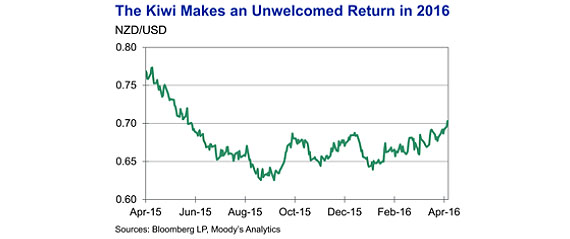
On the back of the subdued developments - low inflation, weak external demand, and high exchange rate - we expect the RBNZ to cut the official cash rate to a low of 1.75% by year’s end. The RBNZ has already cut the rate by 125 basis points since the start of its easing cycle in 2015. However, more rate cuts could fan the housing market further, increasing speculative investment activity.
More housing market momentum
The RBNZ is attempting to douse the housing market with macroprudential measures. These measures, designed to curb investor-driven speculation, include restrictions on loan-to-value ratios, forcing banks to hold more capital, and adding penalties to purchasers selling within two years.
Thus far, the efficacy of these measures is questionable, as house prices continue to climb at prodigious rates. Despite adding extra measures to cool the Auckland property market, median house prices rose more than 13%.
Initially, the Auckland market was flagged as troublesome, as house prices rose more sharply there than in rest of the nation. However, in recent times, housing activity across the rest of the country also has risen. Nationwide house prices increased more than 4% y/y in March, while Wellington (up 7.1%) and Waikato (up 22.4%) also had strong gains.
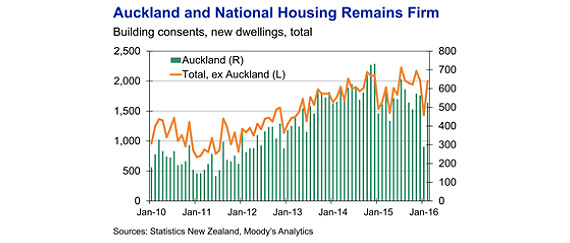
With the household-debt-to-income ratio in excess of 150%, risks to the housing market are simmering. The RBNZ will likely announce additional macroprudential measures in 2016, though the details are sketchy.
Growth engine’s hidden truths
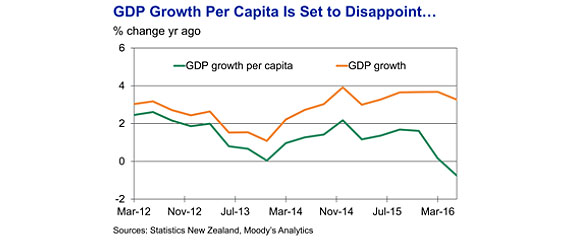
Strong net migration - more than 68,000 people in 12 months to February - has driven population growth. New Zealand’s population grew around 2% per quarter in 2015.
Assuming this population growth continues in 2016, we are likely to see GDP per capita fall or remain flat. This is also based on current GDP year-ago growth rates of around 3%.
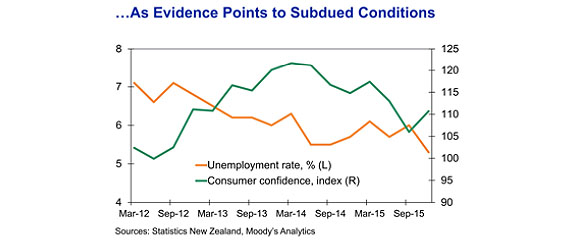
Indeed, the rising unemployment rate throughout 2015 was indicative of the runup in the labour force participation rates. Though the jobless rate dropped to 5.3% in the December quarter, a further population increase is unlikely to be offset by a similar amount of jobs. Job-adds and other consumer confidence indicators suggests that overall employment conditions have softened.
While the economy continues to fly high, we believe the increased risks will likely see GDP growth step down a notch in the coming years.
Faraz Syed is an associate economist in the Sydney office of Moody’s Analytics. He covers national and metropolitan economic issues across the Asia-Pacific region.
To read more on New Zealand’s economy please visit Economy.com

We welcome your comments below. If you are not already registered, please register to comment
Remember we welcome robust, respectful and insightful debate. We don't welcome abusive or defamatory comments and will de-register those repeatedly making such comments. Our current comment policy is here.