
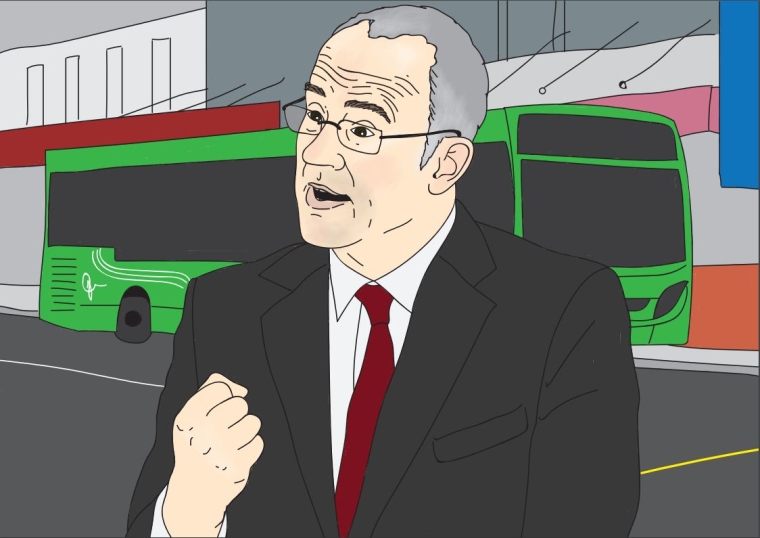
Trackless trams appear to be under consideration for Wellington as part of a $6.4 billion new transport package announced by Transport Minister Phil Twyford.
The package includes roading upgrades to address traffic movements around the Basin Reserve ($190 million), including the option of a second Mount Victoria Tunnel ($700 million), integrated ticketing and improved technology across the city’s public transport system ($80 million), new cycleways and walkways ($135 million), upgrades to bus and rail services ($360 million), and a new rapid transit system ($2.2 billion).
Twyford says the proposal, which expected to be rolled out over the next 20 years, will now go out for public consultation and will improve transport for the city’s residents.
“We’ll reduce congestion by integrating modern rapid transit, walking and cycling upgrades, and better public transport with the city’s motorways and roads,” Twyford says. “Better public transport infrastructure and more services will encourage people out of their cars – freeing up the roads for those that have to drive.
“By unlocking the Basin Reserve and making streets more pedestrian and bicycle friendly, we’ll have a more liveable city that’s safer to get around.”
He says the next step is for the Wellington City Council and regional council to endorse the proposal and commit to funding their share of the $6.4 billion plan.
Twyford says the total cost of the package would be split 60:40 between central government and local government to reflect the “wider local benefits of the package”.
A document outlining the Government package says the rapid transit system, which is expected to cost $2.2 billion, would provide high frequency services every 10 minutes as part of the wider public transport network and would have the “characteristics of light rail or similar”. The release says it would run from the Wellington Railway Station, through Newtown to the airport. According to Twyford the type of technology that will be used has not yet been decided.
But the press statement includes a link to the video on the Let’s Get Wellington Moving website, which has helped the Government develop the transport package for Wellington, and has a video on of what a trackless tram, or Autonomous-Rail Rapid Transit (ART) system would look like. It states:
“Connecting the central city to Newtown, Miramar and the airport, supporting urban regeneration Mass transit will improve travel choice through the city with attractive public transport on a second spine along the waterfront quays. Mass transit will help shape a more compact and sustainable city and region. Further work is needed in LGWM’s next stage to investigate mass transit, and determine the most appropriate mode and route, and how best to integrate it with other programme elements.”
Let’s Get Wellington Moving is a joint initiative between Wellington City Council, Greater Wellington Regional Council and the NZ Transport Agency.
A Treasury briefing paper for Twyford last year outlined the Autonomous-Rail Rapid Transit (ART) being trailed in China at the time as an option for Auckland’s light rail network. The vehicles combine a light rail train with road wheels and use an optical guidance system. They can carry higher numbers of passengers than a traditional bus and can be driven from both ends like a train. Each vehicle can carry between 300 and 500 passengers.
“To illustrate the potential opportunities, we note a light rail solution being developed by the China Railway Rolling Stock Corporation (CRRC). This solution, named Autonomous-Rail Rapid Transit (ART), combines a light rail vehicle with road wheels, high passenger capacity and an optical guidance system.
“The ART system is still in development and will be trialled in China in a city environment commencing this month. It has the potential to offer a ride quality that is as good as, or even better than, the ride quality of conventional light rail. Its major advantage is that it enables the vehicle to run on ordinary roads by following distinctive painted markings (see pictures below), thereby avoiding the cost of building rails and the major disruption this causes to street life and to businesses along the route. It also avoids the high costs should a light rail route require adjusting or expanding in future. However, it would benefit from some investment in smoother and stronger road surfaces.”
It says the other main benefit from such a system is that routes can be adjusted without the cost of having to dig up the road and lay new rails. And they also allow for greater ability to mix all-stops and express services, as vehicles can overtake each other more easily.
Their autonomous features mean they are programmed and optically guided with GPS and LIDAR technologies to follow along an invisible track. If there is a road accident the driver can take control of the vehicle and drive around it because it isn’t following a track. They can also be driven to a normal bus depot for overnight storage and battery recharging. One of the benefits of such systems is aside from minor road works to establish lanes for them to operate on, they don’t require the installation of tracks like a traditional light rail system.
But like the Auckland light rail project it will take time. According to Twyford if the package is endorsed and funded by the relevant councils, the components of the Wellington package will go through the normal NZ Transport Agency project business case process. More details of the individual components will be announced in the future.
50 Comments
A tram without a track is called a bus
Buses aren't optically guided and can't carry 300 plus passengers. Watch the video link from China.
An optically guided bus is still a bus. Even on tracks, trams are actually more akin to bus rapid transit routes than heavy rail in many respects.
https://sydney.edu.au/business/news-and-events/news/2019/01/21/debunkin…
Steel-on-steel wheel/rail interface isn't all that necessary either -- metros in Paris and Mexico City (and many others) run on rubber tyres.
I talked with an Auckland Transport planner a couple of years ago, and they told me that the biggest benefit to running light rail downtown in Auckland would be that they could just reverse out instead of having to circle the block. Maybe two driver's seats is more important than fixed track... (Higher passenger capacity -- as you suggest -- is probably closer to the mark though.)
Plus dedicated right of way, as the sibling comment says.
Agree, it's just semantics.
A "trackless tram" does kill my main argument against trams though.
I've always been a bigger fan of Bus Rapid Transport because it doesn't need tracks.
Seems like a good solution - something that doesn't need a while lot of expensive, dedicated (archaic) infrastructure.
With all the push for cycling (obviously due to lower size/footprint) why not instead move to safer, enclosed single person electric micro-cars available out of china for about $3-4k? About the same footprint as a motorbike/quadbike, but enclosed so protected from wind and rain, and offering significantly more crash protection. They can handle hills happily and can also fit 3-4x as many in in same parking space. In a few years they can also be made autonomous for a few $k more.
Autonomous vehicles may well be the new public transport in a decade.
Why is Auckland paying 50/50 but Wellington only pays 40/60? This is a question of billions of dollars, and especially relevant given the higher proportion of new migrants that Auckland takes on over Wellington.
Auckland is being bailed out by all tax payers as the Council and the ratepayers have failed to act responsibly. Perhaps I would consider this a valid point if Auckland rates weren't half the amount based on valuation compared to every other Council. Although shifting Auckland to paying 90%+ would be a good idea.
"Perhaps I would consider this a valid point if Auckland rates weren't half the amount based on valuation compared to every other Council"
This is so cynical. You know Auckland property has been inflated to levels where people wouldn't be able to afford the rates if they were raised to match other councils by percentage. Auckland may have twice the property prices, but it doesn't have twice the wages.
Of course, you know all of this, it's just a stupid, cynical and meaningless jab.
Auckland's rates are still, in absolute terms, cheap compared to other cities.
I've paid rates in both Wellington and Auckland.
Wellington's rates are extortionate by comparison.
I couldn't understand the incessant wailing about rates when I first moved up here - especially from those who are old enough to have absolutely creamed the property cycle!
Rates based on valuation.. err no, rates based on what it costs to provide services (well, vaguely). It doesn't cost twice as much to get water, rubbish collection etc to a 3 bedroom house in Auckland as it does in wellington. Just because the sticker price on the hosue is twice as much doesn't mean that the owner can afford to, or should need to pay twice as much in rates. in fact it should probably be cheaper.. with economy of scale.
It is completely pointless ( and misleading ) to compare level or rates in relation to property values across cities/ councils . Property price level has little bearing on the cost of providing services - which is what rates are collected for. Rates are NOT a wealth tax .
But in absolute terms the cost of rates should be similar, assuming the same services are being delivered.
The only difference should be funding capital expenditure projects and the Council pet-projects as most of them are Tin-pot Emperors (or at least behave like they are).
Auckland has under-funded required capital expenditure spend for decades (a generation?) and so you'd expect that rate-payers should have to play catch up.
"But in absolute terms the cost of rates should be similar, assuming the same services are being delivered."
Big - and largely incorrect assumption . Physical environment and economies of scale matter a lot.
Auckland is shouldering the bulk of migration and suffering as a result, and now we have to disproportionately bail out the less productive public sector town that overpays staff with cheques written on the backs of labour from the rest of the country.
See, I can make sweeping generalisations too.
"See, I can make sweeping generalisations too."
and it was a good one - but we knew you could already.
I guess I'd feel a bit more charitable if the Govt offered to stump up an extra $100m for the CRL overrun caused in no small part by the Central Govt of the day arguing about whether it was even needed at all. Yet that as divvied up 50/50 too. Hard to see why Wellington should be any different. Perhaps a regional fuel tax might help.
Right...but they can't really run the transport system they have now. Should they not concentrate on operational excellence before committing to scale?
Trackless Tram ?
Could someone please explain the difference between these and trolley busses ?
Watch this link from China on their Autonomous-Rail Rapid Transit (ART) system and how it works. It was included in the article.
So, as the video title says, it's a *bus*.
I guess the main thing is that it looks and rides more like a tram/train than a bus. Everything else is a technicality.
Nice to see some future planning for new modes of public transport instead of taking a giant leap back to the good old days of where ever that previous National government were sourcing their transport policy from? I suspect it was the 1920s....The folly of Nationals RONs seem more obvious by the day doesn't it. The rise and rise of autonomous public AND private transport will make everything we are building today obsolete. The auckland central rail loop may as well be closed up and filled back in for all the use it will actually be.
Check out Tesla's self-driving from a recent demo: https://www.youtube.com/watch?v=tlThdr3O5Qo
Within 3-5 years (Tesla claim 2020) these cars will be able to drive basically everywhere, and system is easily retrofitted to taxis, mini buses and buses to allow cheap high frequency service all day every day.
many car makers now claiming roll out in 2020-2021: https://youtu.be/sRxaMDDMWQQ?t=794
Investment in railed public transport systems at this point is foolish given how close this game changing tech is.
So the trackless trams could be fully autonomous?
So no Tramways Union stinking up public transport in the city?
Oh, happy days!
Two points. A) Tesla will almost certainly be bankrupt within 3-5 years. B) Autonomous vehicles do nothing to alleviate congestion as they take up the same road space - driverless or not.
in fact they will probably add to congestion - in the absence of steep congestion charges.
As it stands the cost of parking in downtown Auckland helps motivate me to cycle to the office .
If I had an autonomous car now I would drive to work - and send it to park itself just outside the CBD for the day , adding to the traffic.
Why wouldn't you send it back home, or indeed to hire itself out as a taxi for the day?
could do that to .. depends on how far "home" is etc. either way it would add to the traffic , not reduce it .
My personal take is that Tesla might go bankrupt (guess ~30% chance) as competitors start to bring product to market. But if that happens it would certainly be sold off/refinanced for $100-200/share given the Brand and tech they have developed. But more likely they continue to grow organically, and strong (guess >30%) chance they go up to Apple type value if their Autonomous driving works out (they seem to have an unassailable lead in their Neural Net development approach if it proves to have been the best choice, and so far it is looking cheapest and most capable of all contenders).
Tesla is aiming to make it's cars able to function as robotaxis starting 2020-2021, each car can carry 4 commuters, so no reason that it must cause more congestion. And it can act as feeder to bus routes. Their tech can also easily be applied to vehicles of all sizes from 1 person micro-cars to Buses, to massively increase the carrying capacity of existing roads.
Yup I can't wait till 2017 when Tesla roll-out fully autonomous driving as a software update as promised https://futurism.com/elon-musk-every-tesla-car-will-be-fully-autonomous…
I think they could actually reduce congestion. They could eliminate human errors and traits that add to congestion.
A Japanese scientist has studied traffic jams for years and he believes that if everyone travelled at 60km with a 4 second gap between cars during peak hours traffic would flow, albeit at a slower pace but still faster than jams.
Yes! I used to analyse my log books etc when I drove heavy transport and figured my optimal speed to be around 70kmh open road, gave me enough time to anticipate without having to drop below 50 kmh hardly ever got above 90 due to erratic driving of vehicles in front. Verrry efficient!
So in 5 years they may exist (I think I heard that 5 years ago), maybe in 10 years they will be somewhat affordable, and in 15 years a similar price point to a normal car. The average NZ car is 13 years old, so after 28 years the average car will be automated. I imagine there is another 10 years after that before humans are not allowed to drive so maybe in 38 years time. Its only at that point that most of the supposed benefits occur (driving bumper to bumper side by side, no traffic lights, etc).
Then how do you cross the road? Its hard enough now with four lanes of traffic, what if there are tons of these things all driving around side by side? What about cities like London and New York and Tokyo - are they really going to turn off their subways and fill their streets with cars?
The release says it would run from the Wellington Railway Station, through Newtown to the airport. According to Twyford the type of technology that will be used has not yet been decided.
Wellington is going to have a light rail network that will run through actual residential areas, where commuters live and can get on/off the thing. Auckland Transport and their "we will build light rail adjacent to motorways to make it distant from housing, because it is cheap" planning looks awful in comparison.
The NW Branch of the LRT is not "distant from housing" in that it passes through several residential suburbs and ones that are currently being built already. This is not up for negotiation, it's not something you can fudge your way around. Massey, Westgate, Huapai etc are all places where people live. This wasn't true yesterday and I don't know why you keep repeating it.
It is designed to maximise the distance from housing in an urban environment. They have literally looked around an urban area and decided the "best" place to put mass transit is with a motorway blocking access from one side. What level of stupid do AT run to? Wellington can work this basic sort of stuff out.
Light rail should go through the residential areas of Westgate, but since these are 400-700 m away from the motorway on the other side of the shopping precinct it doesn't. It doesn't go onto the Te Atatu Peninsula, but it should because of a high degree of dense living that would benefit from mass transit.
Trams on the street ! Just another way to screw up the streets. And will suffer the problems the streets already have.
Wellington airport needs a direct connection to the city (actually to the central station). A separated track is needed especially to give speed. Plenty of hills in Wellington, provide plenty of choices as much of the track could be underground.
It also assumes that Airports will be viable transport hubs within the 30-50 year planning horizon...Not sure I'd bet the farm on That....
This vertical takeoff and landing 5 seater electric air taxi with 300km range at 300km/hr flew a few days ago: https://youtu.be/8qotuu8JjQM?t=116
20km in 5 minutes, energy consumption similar to a car (yes really), and eventually once there is competition per-km operation costs are probably going to be similar to a private car, and cheaper and faster than commuter jets to get around the country (do a couple of hops or use a hybrid version with longer range). So yeah don't bet on existing answers being best in 5-10years, and think very hard about investment in inflexible transport infrastructure.
Trams on the street ! Just another way to screw up the streets. And will suffer the problems the streets already have.
Wellington airport needs a direct connection to the city (actually to the central station). A separated track is needed especially to give speed. Plenty of hills in Wellington, provide plenty of choices as much of the track could be underground.
Maybe this is harsh, but I just can't take anything that comes out of PT's mouth seriously anymore.
Going against Treasury advice:
https://www.rnz.co.nz/news/national/389353/let-s-get-wellington-moving-…
That tells us he's on the right track. Treasury are slowly changing, but it's still old-school economists in there. We have to do things now, irrespective of dollar return, just because we have to. The window of opportunity is closing fast. I sense from this that Twyford understands. Sure, looking ahead is never 100% clear. But looking backwards (the only tool economists have, and through a narrow window at that) has much less chance of being correct.
Put simply, for a short period of human interaction, 'stacking up financially' fitted with 'stacks up socially and sustainably'. But the former has diverged from the latter to the point where it threatens our physical existence. So the former had to be abandoned. Hence 'wellbeing'. Hence 'against advice'. I'd be worried it it were anything else.
the lack of detail is the worry, just to announce we are going to spend is very concerning
do not worry - it is just another Kiwibuild.
Seems this whole announcement is a farce:
No money allocated for the next financial year, No money allocated for the rest of this govt's term, No money allocated for 2nd term (if they get one), $600million allocated for 3rd term (if they get one).
Twyford continues to deliver nothing, making promises designed to be broken. All mouth and no trousers.
Yay, $6.4 billion funding = more jobs for consultants doing the sweet FA.
I am going to watch some youtube videos and called myself an expert in Public Transport Planner.
We welcome your comments below. If you are not already registered, please register to comment
Remember we welcome robust, respectful and insightful debate. We don't welcome abusive or defamatory comments and will de-register those repeatedly making such comments. Our current comment policy is here.