
By Chris Trotter*
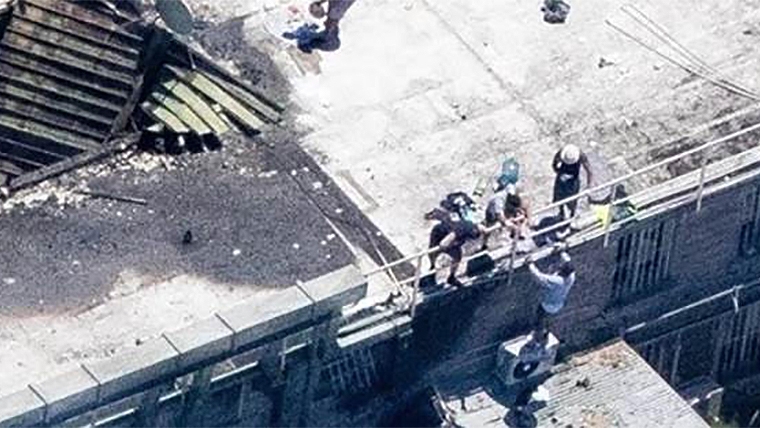
As word of Rawiri Waititi’s successful intervention in the Waikeria Prison stand-off spreads, the Maori Party’s mana will grow significantly.
It is difficult to think of a better metaphor with which to illustrate the party’s political mission than its co-leader, under the disdainful gaze of the authorities, leading 16 parched, burned, bleeding but unbroken prisoners out of danger and into safety. Surely, somewhere in New Zealand, a young Maori musician is already composing a song to celebrate Waititi’s success. He’s earned one.
It is difficult to imagine anyone bothering to write a song for the Corrections Minister, Kelvin Davis. Throughout the six days of the crisis at Waikeria, the Minister maintained an obdurate silence. The resolution of this crisis, New Zealanders were given to understand, was an “operational matter” – something best left to the public servants and corrections officers on the spot. The very same public servants and corrections officers whose actions – and failure to take action – were responsible for sparking the uprising in the first place.
The Ombudsman’s report of August 2020 made it very clear that conditions at Waikeria Prison left a great deal to be desired. Had the authorities responded to that report swiftly and decisively, then it is highly unlikely the uprising would have occurred.
It is very difficult for those who know nothing of life behind bars to fathom the degree of degradation required to make prisoners risk an extension of their sentences by violating the rules of their confinement. When you’re in jail, all you want to be is out. You’ll suffer an awful lot in silence before raising your voice in protest. That’s why any form of prison protest is a sure and certain sign that something very rotten is festering within its walls.
How rotten may, perhaps, be gleaned from the following passage, taken from the media release sent out by the protesting prisoners’ to (among others) Action Station and Hone Harawira:
“Our drinking water in prison is brown. We have used our towels for three straight weeks now. Some of us have not had our bedding changed in five months. We have not received clean uniforms to wear for three months – we wear the same dirty clothes day in and day out. We have to wash our clothes in our dirty shower water and dry them on the concrete floor. We have no toilet seats: we eat our kai out of paper bags right next to our open, shared toilets.”
If even half of these complaints are true, then New Zealand should hang its head in shame. Conditions such as these are what we associate with the hellholes of Central and South America – prisons wracked by riots, uprisings and mass escapes, and quelled by tear-gas, rubber bullets and (all too frequently) live rounds.
The pall of black smoke which, at the time of writing, still hung above Waikeria is a signal. A signal that we’re not doing it right. That we’ve got it wrong. That we have to stop listening to the people who have presided over these institutional failures for far too long. Most of all, however, it is signalling the importance of ceasing to react to the vicious messaging from our nation’s amygdala.
Crime and punishment are not issues that can be resolved successfully by our instinctive “flight or fight” reaction. They are matters for the national cerebellum, the seat of reason in the human brain. We must not leave them to the violent reptilian lunges of the Kiwi limbic system.
At times like these, however, the first political responders are almost always reptilian. Why are the authorities waiting? Where are the Police? Why aren’t we seeing the deployment of armed tactical units? Is there no pepper spray? No tear gas? No long batons? Are there no automatic weapons?
When a human-being is convicted of a crime, he or she does not cease to be a human-being. Imprisonment does not, contrary to the punitive expectations of many New Zealanders, permit the extinguishment of all the rights to which human-beings are entitled. This country is a signatory to a raft of international treaties and covenants affirming the fundamental human right to be treated decently.
These documents should have made it unthinkable for servants of the New Zealand state (which, presumably includes the authorities at Waikeria Prison!) to refuse water and food to protesting inmates. If our soldiers refused to give prisoners water they would be guilty of a war crime.
What does it say about us as a people, that we are willing to treat the soldiers of a foreign foe with more respect than our own citizens? What does it say about our Minister of Corrections that he did not publicly repudiate the inhumane tactics of the Waikeria authorities?
More importantly, what does it say about the government of Jacinda Ardern? Why is her Cabinet so unaware, seemingly, of the acutely dangerous politics of the Waikeria Prison uprising? Yes, it’s holiday-time. And yes, Kiwis are taking full advantage of their success in defeating Covid-19. Very few people (including most of the mainstream news media) are paying much attention to events at Waikeria. But that does not excuse the Prime Minister for not noticing just how big a “win” her government has gifted the Maori Party.
Because that metaphor: the Maori Party leading the victims of the system out of danger and into safety; will speak with great force to the thousands of New Zealanders who cannot afford an expensive holiday in Queenstown. Those paying extortionate rent for substandard accommodation. Those parents working two jobs but still not making enough to keep their families fit and healthy. The New Zealanders who hear their leader talking about “kindness” and a “Team of Five Million”, but who just can’t see any evidence of it at work in their lives and neighbourhoods.
Dylan Asafo, a lecturer at Auckland Law School, put it like this:
“Contrary to popular belief, the ‘centre’ isn’t a place for reasonable, measured minds who can see valid points on both sides and find a just and fair compromise. The ‘centre’ doesn’t actually exist. It’s an imagined safe space for people who are deeply invested in inequality in a settler-colonial, capitalist state but still want to be perceived as kind and decent people.”
A left-wing Labour government would have reacted very differently to the uprising at Waikeria. It would have reassured all those members of the Maori working-class with fathers, brothers and sons locked away in hellholes like Waikeria, that Labour was committed unequivocally to their fair and humane treatment. Under a left-wing Labour government, it would have been the Corrections Minister leading those prisoners out of danger and into safety – and making sure every one of the Ombudsman’s recommendations was implemented.
By preferring to put their faith in an illusory political centre, Labour has ceded a crucial swathe of electoral territory to a Maori Party unafraid of placing itself at the head of an uprising much bigger than the one Rawiri Waititi just helped to end at Waikeria.
*Chris Trotter has been writing and commenting professionally about New Zealand politics for more than 30 years. He writes a weekly column for interest.co.nz. His work may also be found at http://bowalleyroad.blogspot.com.
We welcome your comments below. If you are not already registered, please register to comment
Remember we welcome robust, respectful and insightful debate. We don't welcome abusive or defamatory comments and will de-register those repeatedly making such comments. Our current comment policy is here.