

Here are my Top 10 links from around the Internet at 10 to 9 pm, brought to you in association with New Zealand Mint for your reading pleasure.
My apologies for lateness tonight.
The South Canterbury/Allan Hubbard thing is blowing up big time.

I welcome your additions and comments below, or please send suggestions for Monday's Top 10 at 10 via email to bernard.hickey@interest.co.nz. Remember that registered commenters can more easily include links out in their comments. Use the box in the right hand column to register. We're turning off unregistered comments from September 12. I'll pop any surplus suggestions I get into the comment stream under the Top 10.
1. A cunning plan - America's banks are being bailed out in slow motion through the recession.
It's almost as if they don't want a recovery.
Economist Andy Harless explains on his blog.
How does the Recession allow the government to bail out banks? With the recession going on, people are afraid to do anything risky with their assets, so they keep them deposited in banks, earning no interest. Banks can then invest these deposits in Treasury notes and credit the interest on those Treasury notes to their bottom line, thus improving their balance sheets. So the government pays to recapitalize banks while receiving nothing in return. Now this bailout program is not without its risks.
The biggest risk is that the economy will recover, which would be a disaster for the program. Suddenly, not only would banks be holding losses on their Treasury notes, but their cost of funds would go up, as depositors realized that there were more attractive investments available than zero-interest bank deposits.
2. Americans are worried - Here's what Bill Bonner at The Daily Reckoning is saying will happen in US financial markets.
The US economy will become a Zombie Economy, with more and more activity dependent on government spending and government support. Banks are already Zombie Investors. Rather than lend to viable businesses that expand the world’s wealth, they borrow from the feds and lend the money back to them. We’ll see private investors become Zombie Investors too – putting nearly all their savings into US Treasury paper, just as the Japanese did.
The Dow will sink down towards 5,000. The feds will announce program after program to boost up the economy. Household savings rates will head to 10%. Unemployment will go to 12%…maybe 15%. Bond yields will collapse to new record lows. Ben Bernanke will threaten to drop money from helicopters…but as long as the US remains in an orderly decline, he will not dare to do it.
Eventually, the whole system will blow up in a spectacular fireball. But not until America’s investors are fully committed to US paper. Then, after having suffered huge losses in stocks and real estate, they can be finally ruined in what they thought were the safest investments in the world – dollar-based US Treasury bonds.

3. An entertaining theory - Gonzalo Lira writes at Zerohedge how record low interest rates and near deflation can turn into Hyper-inflation. Essentially Gonzalo reckons an almighty bust is likely in US Treasuries that will undermine faith in the US dollar and we're all going to a hell in a hand cart shortly after that.
It all reads in a sensible fashion and is certainly entertaining. It seems bit too convenient and tidy for my liking. Life or the markets are never that well organised...
Here the panic phase of the event begins: Asset managers—on seeing this massive Fed buy of Treasuries, and the American Zombies selling Treasuries, all of this happening within days of a largish Treasury auction—will dump their own Treasuries en masse. They will be aware how precarious the U.S. economy is, how over-indebted the government is, how U.S. Treasuries look a lot like Greek debt.
They’re not stupid: Everyone is aware of the idea of a “Treasury bubble” making the rounds. A lot of people—myself included—think that the Fed, the Treasury and the American Zombies are colluding in a triangular trade in Treasury bonds, carrying out a de facto Stealth Monetization:
The Treasury issues the debt to finance fiscal spending, the TBTF banks buy them, with money provided to them by the Fed. Whether it’s true or not is actually beside the point—there is the widespread perception that that is what’s going on. In a panic, widespread perception is your trading strategy. So when the Fed begins buying Treasuries full-blast to prop up their prices, these asset managers will all decide, “Time to get out of Dodge—now.”
4. The big deleveraging lie - Jim Quinn from the Burning Platform writes at Zerohedge that deleveraging hasn't really started in America yet and the scale of the deleveraging to come is ginormous.
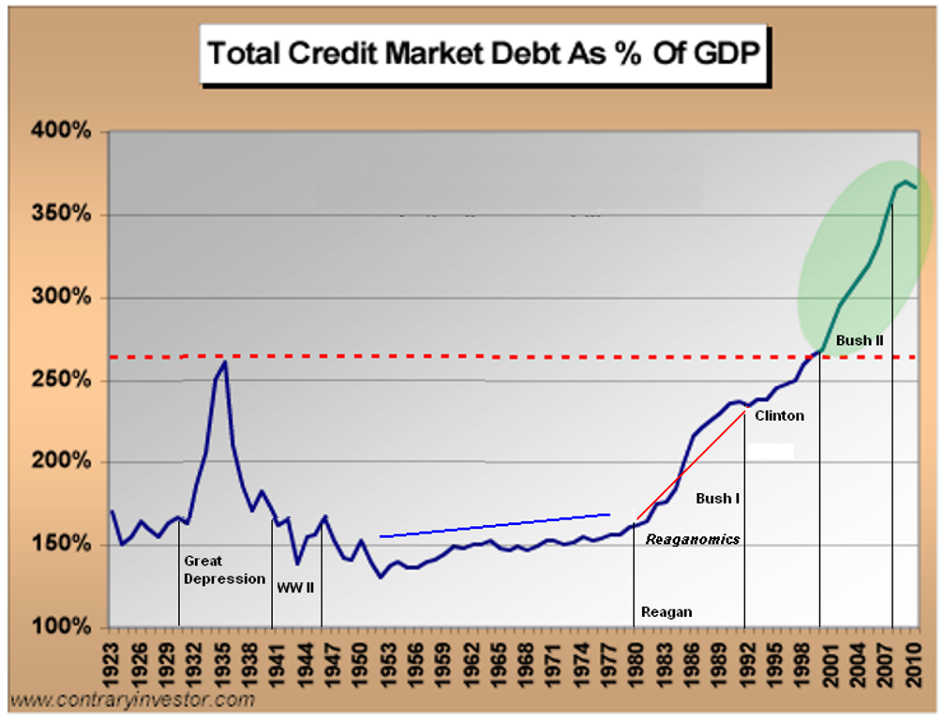
Here's the killer chart below that everyone should learn off by heart and Quinn's thoughts. HT Troy via email.
Consumer spending as a percentage of GDP is still above 70%. This is well above the 64% level that was consistent between 1950 and 1980. Consumer spending was entirely propped up by an ever increasing level of debt. The American economy will never recover until consumer spending drops back to the 64% range that indicates a balanced economic system. For the mathematically challenged on CNBC and in the White House, this means that consumers need to reduce their spending by an additional $850 billion PER YEAR.
Total credit market debt peaked at $52.9 trillion in the 1st quarter of 2009. It is currently at $52.1 trillion. The GREAT DE-LEVERAGING of the United States has chopped our total debt by 1.5%. Move along. No more to see here. Time to go to the mall. Can anyone in their right mind look at this chart and think this financial crisis is over?
The consumer hasn’t cut back at all. They are still spending and borrowing. It is beyond my comprehension that no one on CNBC or in the other mainstream media can do simple math to figure out that the deleveraging story is just a Big Lie.
5. An ugly mood - The fear of some sort of upheaval or revolution is growing among the richest of the rich in New York. Here's Yves Smith from Naked Capitalism talking about it.
The conversation turned to whether the US was going towards revolution or fascism. One argued for the a continuation of trends underway: that the continuing weakness of the Obama Administration (and the discrediting of other members of the elite) meant there was a power vacuum. The obvious group to exploit it is the most strident, uncompromising opportunists, an area where the extreme right has a monopoly.
The other, who has ben reading up on the French Revolutions. took issue with the conventional idea that a revolution is impossible in America: “In France, the trigger was that people were hungry. We are close to that point than most think.” He stressed the desensitization to violence (video games, more and more violence) plus widespread gun ownership.
The U.S. Commerce Department developed 14 proposals to crack down on illegal import practices and require parties to pay the full amount of any duties, according to a statement today. The process to adopt the plan, which the department said is especially aimed at countries where the government has control over markets, will begin later this year.
“Generally, this is targeted at China, and China will see it as such,” said David Spooner, a former Commerce Department official in the Bush administration and now a trade lawyer with Squire Sanders in Washington. “The aim is to raise the price of goods from China.” The plan is part of the administration’s effort to double exports in the next five years to spur job growth, a goal President Barack Obama set in his State of the Union speech in January.
7. New global currency? - The FT is reporting that large banks are now offering to settle deals with large corporate customers in Renminbi rather than US dollars.
A number of the world’s biggest banks have launched international roadshows promoting the use of the renminbi to corporate customers instead of the dollar for trade deals with China.
HSBC, which recently moved its chief executive from London to Hong Kong, and Standard Chartered, are offering discounted transaction fees and other financial incentives to companies that choose to settle trade in the Chinese currency.
“We’re now capable of doing renminbi settlement in many parts of the world,” said Chris Lewis, HSBC’s head of trade for greater China. “All the other major international banks are frantically trying to do the same thing.”
8. 'It was the war what did it' - Italian economist and journalist Loretta Napoleoni argues on Australia's ABC that the US-led war on terrorism was a major cause. Here's another interview on BBC.
In launching military and propaganda wars in the Middle East, America overlooked the war of economic independence waged by Al-Qaeda.
The Patriot Act boosted the black market economy, and the war on terror prompted a rise in oil prices that led to food riots and distracted governments from the trillion-dollar machinations of Wall Street. Consumers and taxpayers, spurred by propaganda fears, were lured into crushing global debt.
9. Totally irrelevant video - A man takes his clothes off and jumps into a haybaler. Looks painful to me. Or a hoax. Sort of fun to watch. HT John via email.
10. Totally irrelevant video - My Wife Knows Everything vs. The Wife Doesn't Know. It's a horse race. Guess which horses are in the running at the end. The announcer has a ball. Miss Tallahassee is third.
34 Comments
Celente again:
http://www.trendsresearch.com/SubscriberArea/gerald-celente-on-goldseek-radio-14-aug-2010
……..recommended for everyone.
Yeah - I'm not sure, if us Kiwis are listening to the "outside world" enough.
The “Three NZ-Pillar Industries” Tourism, Agriculture (Dairy/ meat) and Real Estate are unhealthy bloated, without a clear concept and long term not sustainable. Downscaling, but far more diversity in our secondary sector economy, adapting to the worldwide economic, social and environmental situation is essential.
Listening to Celente and others in tough times tendency to protectionism is likely, but only one of many unpredictable scenario. Therefore economies need to be flexible, fast to react and more self-sufficient - I think.
Cracking Listen Kunst..........ta very much...............it's both sad and strange the pig feeders became pigs and forgot how to care for themselves......let us hope it's not just a voice in the wilderness.....
Gonzalo has a part two on the Hyperinflation including some fascinating stories of his own experiences during the Chilean and Argentine Hyperinflation. Both are well worth reading. More than once.
Another true story: A banker friend of mine manages the assets of a fabulously wealthy 70-something gentleman, whom I'll call Alfredo. In 1973, Don Alfredo was a youngish man, just starting out, with a degree in engineering but no money—until he inherited US$3,000 from a deceased aunt. Alfredo realized that the $3,000 were in a sense worthless: He couldn’t buy anything with them, and it wasn’t enough for him to leave the country and start over someplace else. After all, even then, $3,000 was not that much money.
So he took those $3,000, went down to the stock exchange, and spent all of it on Chilean blue-chip companies: Mining companies, chemical companies, paper companies, and so on. The stock were selling for nothing—less than penny stock—because of the disastrous policies of the Allende government. His stock broker at the time told him not to buy stocks, as Allende’s government, it was thought, would soon nationalize these companies as well.
Alfredo ignored his broker, and went ahead with the stock purchases: He spent all of his $3,000 on buckets of near-worthless equities.
On September 11, 1973, the commanders in chief of the four branches of the Chilean military staged a coup d’état. Within a year, Alfredo’s stock had rebounded about ten-fold. Since then, they’ve multiplied several thousand-fold—yes:Several thousand-fold. Don Alfredo has lived off of that $3,000 investment ever since—it’s what made him a multi-millionare today.
http://www.zerohedge.com/article/guest-post-hyperinflation-part-ii-what-it-will-look
Here's how a US sovereign default migh happen
http://ftalphaville.ft.com/blog/2010/08/27/327471/how-to-think-about-a-sovereign-debt-crisis/
cheers
Bernard
Discussion on how US and UK debt risk are misvalued.
http://blogs.reuters.com/great-debate-uk/2010/08/25/waiting-for-the-oth…
A lot of things .,.....might.....happen......there is always and end game....and the road fraught with inconvenient potholes...... but I'd still bet these boys are working to a plan that is not digestible for the taxpayer and so sugar coating and mock concern become the order of the day .......
on any other playing field it would be outright fraud and theft......but for the greater good..! hah.
A worth overview here from PIMCO's Mohamed El Irian
"This worrisome trio of increasingly ineffective national and global policy stances, intense political polarization and growing social pressures speaks to the risk that the economy's recent soft patch will evolve into something even more troublesome and sinister."
http://www.washingtonpost.com/wp-dyn/content/article/2010/08/26/AR2010082605262.html
cheers
Bernard
"The Elites Have Lost The Right to Rule"
Banana Ben's Big Speech and where we are headed right now. From one of the best; Mike Krieger. Follows on quite nicely from the Gonzalo Lira articles also on ZH "As far as the speech itself, it confirms something I mentioned several weeks ago. Banana Ben absolutely wants to do a massive QE2 program. The only thing holding him back is gold is near an all time high. What he wants is gold much lower and stocks much lower to give him cover. Gold has not cooperated so he is in a bind. He cannot print a massive amount of money with gold here and stocks at 1055 because what happens if gold soars and stocks sell-off in the days that follow such an announcement? What if the response in the treasury market is not as desired? He is scared to do it here and he is right to be scared because such a reaction would be the end of the Fed right then and there. The Fed will be gone anyway within a few years in my opinion but it’s going to fight hard to survive and if you want to make money in this market you need to understand that. The most powerful institution in the world is fighting for its survival. Never forget that. So what is he going to do? I believe that the Fed and government are doing a lot more than people think to manipulate all markets behind the scenes. After all, they have publicly announced their manipulation in many other ways so does it make any sense whatsoever to assume they aren’t doing a plethora of other things behind the scenes? Of course not. I think that with the Fed in a bind they will accelerate and become ever more aggressive in behind the scenes games. This will make markets even more volatile and extraordinarily challenging. This is financial war make no mistake about it. The only way in my opinion to survive this is to buy all dips in precious metals, agriculture and oil. It is in these three areas that I expect to see the most price inflation as money eventually figures out the end game." http://www.zerohedge.com/article/elites-have-lost-right-rule
US GDP came in at 1.6 % , not as low as 1.3 % , which many had predicted . Clearly the recovery is slowing . But it will probably regain some momentum in 2011 .
Bernard : You got egg on your face for the 30 % fall in NZ house price prediction . Have you turned the other cheek ? Your constant promotion of a double-dip recession has been noted here , on TV1 , RadioLive & Radio National ................. Hope it aint a salmonella American egg you eventually wear !
If everything is as rosy as you claim why is Bernanke laying the groundwork for QE2?
http://www.calculatedriskblog.com/2010/08/analysis-bernanke-paves-way-f…
Everything points to 3rd and 4th quarter US growth being pathetic at best (sub 1% annualised) and very likely negative.
Please dont become a stranger when the US double dip arrives, I'd hate to think you'd run off and not offer your apologies.
Now then , Andy Hamilton : I did not say everything was all rosy . But neihter is it the doom & gloom that Bernard keeps promulgating . Him , Roubini & Faber ............ what a grand trio they'd make at a party !
There's a slow deleveraging to work through . But aenemic growth is still growth , it ain't recession . The Hickster even announced on Radio National that America was in a depression ! Exaggerating .............. ooooooooooops , gotta run , swimming lessons for the kiddie ............ catcha later ............
Back into the fray : Hardly a rant , Wolly ; nor swallowing the Bloomberg spin ( don't follow them , KiwiDave ) .
Hickey completely ballsed up the 30 % house price fall prediction . Now he's trotting out the " double-dip " prediction as if it is a fact . It isn't , it is merely a possibility . But if you sit on the side-lines waiting for his prediction to come true , you risk being wrong .
Perhaps I'm a " glass-half-full " sort of Gummibar . ............... Hmmmmmmmmmmm , a half full glass of Coonawarra shiraz may be just the thing ........... Good luck team . Prosperity to all ..... shirazzzzzzzzzzzzzzzzzzzzzzzzz !
Swallowing the spin there don'tcha think GBH?
Bloomberg:
"The economic recovery in the U.S. weakened in the second quarter more than previously estimated, highlighting the risks of a prolonged slackening in growth.
The world’s largest economy grew at a 1.6 percent annual pace, exceeding the median forecast of economists surveyed by Bloomberg News and down from an estimate of 2.4 percent issued last month, revised figures from the Commerce Department showed today in Washington."
So a month ago the prediction was 2.4%, last week 1.3%, actual 1.6%.
Apart from showing that most economists predictions shouldn't be taken seriously, how is this good news? They need 5% to make inroads into the UE rate.
That was a good rant GBH!...so you think all is well in Noddy..property is not price bloated by cheap credit and ponzi politics?...then go and buy property...I'll stay in cash for the meantime until the Fed and BIS get down to driving the price of gold down...probably an orchestrated "sell" that involves no money...no gold...just fraud.
I'm not one of those expecting the US fiscal arse about face economy to turn into a super prince anytime in the next 100 years. It's shite from start to finish. I do expect China to toy with Washington for the fun to be had. I do see a Q of national leaders lining up to brown nose the Beijing powerbrokers.
As for Noddy's property sector...only the Auckland market is holding out against the deflation tide. No doubt Harcourts will entice some very hot munny in Beijing to rush on down...and Bayleys will manage to offload some marginal land on a few silly poms...but this economy is still in a recession and about to enter an election year of lies and BS...of pork slicing on a grand scale...and in the end, we will still have the recession...the rising taxes and falling real incomes.
Damien Grant at the NZ Herald has written " Wily fox snaps up his chance ."
Seems there is at least two of us in this fair land who don't buy into the Hickey spin of the world nose-diving into an irreversible hell pit of depression .
Who the hell is damien grant?...5 ways to failure!
bloody computers!
Fair go Gummy Bear...Damien sure is one hell of an economist...with the crap he posts who needs govt spin!
Liam Dann................ Jim Hopkins ............... Lincoln Tan ................... so many econo-journalists who have written upbeat articles on NZ , in the last few days . On the NZ Herald for all to see ................. And if you're in dire need of your dose of disaster & doom , Hickey writes there too .
Gosh , wotta bunch of happy campers they are down at the Herald !
Trader Dan Norcini
The equity bulls were salivating over the prospect of watching another episode of “let’s take the shorts out and slaughter them all” as the world eagerly awaited the giving of the law from Mt. Jackson Hole. With claps of thunder in the background and with flashes of lightning interrupting his keen observations upon the state of the US economy, (some swear that they saw the angelic host), the prophet of Monetary religion sounded forth his prognostications and then looked upon his handiwork. He then saw that his work was good and sat down and rested on the seventh day.
Yessiree folks – Chairman Ben uttered his incantations making all well with the turbulent world and bringing light and order to darkness and chaos. I do not know about you, but I feel so much better today after Ben told us all that he is going to make sure that the recovery is safeguarded from harm. When you combine that with news that instead of the economy slowing from a growth rate of 2.4% down to 1.3% as expected, it only slowed down to a 1.6% growth rate, well, it just doesn’t get any better does it?
I mean, the first thing I immediately thought of is, “Why don’t I rush out and buy lots of copper because things are really getting better in a hurry”. Already forgotten are the abysmal housing stats of less than a week and the further rise in foreclosures and delinguencies, not to mention the clogged condition of the bankruptcy courts. Chairman Ben has whisked all of that out of the minds of investors with one mere pronouncement.
The fact that it has taken gazillions of conjured-into-existence-out-of-no-where dollars (some call that stimulus) to produce this pitiful growth rate number for the quarter, seems to have escaped the attention of the equity perma bulls who have yet to come to grips with the consequences of all of this. My own view is that it should be a relatively easy matter to get that growth rate up to double the figure given us. All we would need to do to get to 3.2% growth rate is to print twice the number of Dollars and double the rate of government indebtedness. That should be good for another 100 point rally in the Dow. If anyone knows the number that comes after quadrillion, please send that on to Ben and company. They are going to more than likely be needing it.
Seriously, it is hard to hide my contempt of this disgusting scene. This band of fools somehow believes that prosperity can be created by printing money without any consequences whatsoever. The US is sinking under a mountain of indebtedness and the Fed chairman tells us that it stands ready to engage in even more QE should the need arise. Flash to Ben – the need shall arise. China is already balking at buying US debt meaning you are going to have to buy it all yourself Ben.
What we are witnessing is the death throes of a debt-based monetary system of which those presiding over it apparently have come to believe their own delusions. The US public is learning what our grandfathers learned as a result of the Great Depression – Debt is something to be avoided – not heaped up and accumulated. That the borrower becomes the lender’s slave and that living beyond ones own means is inherently foolish and dangerous. That saddling one’s children and grandchildren with a debt burden that they did not create is immoral and wicked. Yet, all of this is lost upon the monetary lords who have their noses so close to the ground sniffing out the scent that they cannot see the path ahead leads off the edge of an abyss from which there is no escape. Or perhaps they do see and are attempting to secure their own parachutes before leading the rest of the masses over the edge.
I repeat – if lasting prosperity could be created by printing money and giving it away, previous generations that were wiser and more frugal than ours would long ago have stumbled upon this axiom.
http://jsmineset.com/2010/08/27/hourly-action-in-gold-from-trader-dan-324/
Good post KD and mostly irrefutable......... followed by terminal.......... unless the bast%#ds change the playing field and the rules at the point of implosion.
Because we are talking survival here.... and that is a long forgotten skill to the self indulgent lazy easy money society we have become in the west...( and elsewhere's)
No I think........... recovery will be scooped by the foulest means possible and the catch cry will be .........At any cost..Rome must not burn again.
No one involved is.... not.... aware that printing money in QE fashion does not have consequences......... and that's right where you have to stop and wonder...... if it's a plan..it's a shit one aint it...? So why.... in whose interest ... to what end.
The dissection of the economy by number crunchers and their associated mega brains will do little to change the ultimate outcomes of the desired goal...dictated by Human desire.
As I have said in the past the numbers are rearranged to fit the policy objectives ...not the other way round.
And never rule out ................WAR.
Have a good Saturday night...to all
As I posted on a number of occasions looking to the end game an orchestrated plan to steal the wealth of a Gen or two and find a new ground zero.
I really see the U.S. treasury involving itself in an end justifies the means scenario.
I also said a year back that I thought the U.S.may return to protectionism if the environment was right for it............... hmmmm .
The one overtone right through the collapse of the financial markets is that they could not have mismanaged it better if they tried................. well just maybe they did.....
I liked the guy's take on it and think he has a right to be cynical on the matters of the Fed and whose interests they serve ultimatley.
"Leaked notes from a speech Michael Cullen plans to make this week, contain derogatory comments about the Royal Family"tvnz.....and that will be the end of him...right John Key!
It will be impossible for Cullen to keep his cosy state appointment!
Just a realist anonono...you replace a history with what....a republic!..so you replace the waste of a gov gen plus flunkies with a president plus other flunkies!...what's the bloody gain....oh sorry I see what you mean...we could have a new flag...so bloody what?
The system is just a paper process with some faces in the middle...it's meaningless drivel except to those prone to thinking being a republic means more than nothing!
One day King Charles will be our head of state !... You want that ? ..................... There's more than enuff charlies here to run our country............. . Why choose a pommy tosser 'like " chuckles " !
He might snuff it before Mummy!..then we could have Tall Willie!
Referring to Q & A this morning on TVone:
I’m sure Donkey & English Inc. will consider, wait and see and then ask for advice on that.
"Governed by"...stone the crows....like JK takes instruction from the GG...!
So why change at all?...or are you afraid of the current system? If you don't like it...go somewhere else. You cannot produce one sound reason for the change. What is it about your history that you don't like?
Wolly : Finally found something where I strongly agree with Cullen : Bugger !
Thats only part of the scam....the whole global warming is the real scam !!! Sure am glad my power bill is going up when the money goes to such good use and the best part is we have no say on it !
It's possible that the Chinese government is trying to increase the liquidity of the RMB by allowing it to be come globally tradable. This will make it easier for them to reduce their USD Treasury holdings.
Remember the mortgage backed securities..yes that garbage....
http://www.theage.com.au/business/regulator-warns-banks-off-mortgagebased-bonds-20100827-13w46.html
"THE bank regulator has stepped up warnings about the way banks treat their holdings of mortgage-backed bonds, after a review found that some might be understating their exposure to risky loans. Securitisations are loans, mostly mortgages, bundled up into bonds then sold to investors. Before the financial crisis, Australia was one of the most active securitisation markets. Securitisations also benefit banks, because they do not have to set aside as much capital to cover losses resulting from loans turning sour. However, in recent years, regulators have taken a dimmer view of the instruments amid concern the banks packaging the instruments could still end up with the underlying credit risk"
But we are different in Noddy....
We welcome your comments below. If you are not already registered, please register to comment
Remember we welcome robust, respectful and insightful debate. We don't welcome abusive or defamatory comments and will de-register those repeatedly making such comments. Our current comment policy is here.