

What a day. The biggest corporate collapse in over 20 years and I had to get a tooth extracted two hours after it happened. Fantastic job by Gareth and Alex to cover this story. But it does mean Top 10 was later today than usual. My apologies. Here we go.
Here are my Top 10 links from around the Internet at 10 past 8 pm, brought to you in association with New Zealand Mint for your reading pleasure. I welcome your additions and comments below, or please send suggestions for Tuesday's Top 10 at 10 via email to bernard.hickey@interest.co.nz.
Remember that registered commenters can more easily include links out in their comments. Use the box in the right hand column to register. We're turning off unregistered comments from September 12.
I'll pop any surplus suggestions I get into the comment stream under the Top 10.

1. Singapore tries to prick housing bubble - Singapore, which is seeing a boom in its economy as Chinese investors pump their money into the Island state, has announced further plans to try to cool its housing market, Airreview reports. HT Rob via email.
The Singapore government said yesterday that it will levy a seller’s stamp duty on all residential units and land sold within three years from the date of purchase, compared with the current one year term, and make it tougher for buyers with an existing mortgage to take out a second mortgage.
The Ministry of National Development said in a statement yesterday that buyers who already have more than one mortgage can now only borrow up to 70% of a purchase and must pay 10% of the property's value in cash, up from 5% previously. The moves are among a range of measures to address local worries that an influx of foreign workers and immigrants will create more competition for housing, education and jobs.
Hong Kong said earlier this month that it will tighten mortgage lending rules and increase the supply of land to try and suppress strong rises in home prices.
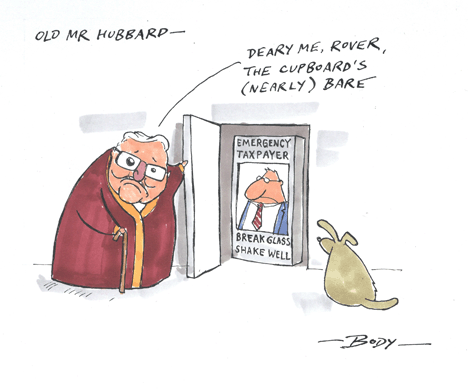
2. Has the boss of the People's Bank of China fled the country? - Stratfor reports rumours that the head of China's central bank has fled the country. It's not clear if it's true, but it could be explosive if confirmed. HT Gertraud via email.
Rumors have circulated in China that People’s Bank of China (PBC) Gov. Zhou Xiaochuan may have left the country.
The rumors appear to have started following reports on Aug. 28 which cited Ming Pao, a Hong Kong-based news agency, saying that because of an approximately $430 billion loss on U.S. Treasury bonds, the Chinese government may punish some individuals within the PBC, including Zhou.

3. More Japanese quantitative easing - Ambrose Evans Pritchard at The Daily Telegraph reports on Japan's latest moves to try to get more money flowing around its stagnating economy. HT Andrew via email.
Japan has launched a fresh monetary and fiscal boost to shore up its faltering recovery and stem the slide into deflation, becoming the first major country to inject further stimulus since the Great Recession ended.
The Bank of Japan agreed at an emergency meeting to boost its special loan facility by ¥10 trillion to ¥30 trillion (£220.7bn). "We need to watch out more carefully for downside risks to Japan's economy," said Governor Masaaki Shirakawa, who cut off his trip to the Jackson Hole forum in the US.
4. Ireland's Zombie hotels - Bloomberg has a useful piece on how many of the 200 new hotels built and opened during the Celtic Tiger's boom are now shuttered.
Many hotels that opened as Ireland’s economy tripled in size between 1997 and 2007 were given tax breaks provided they remained open for at least seven years. Such hotels are slashing prices in a bid to stay open, undermining longer-established venues, said Joe O’Flynn, owner of the Rathsallagh Country House Hotel, south of Dublin.
“It’s a zombie plague,” O’Flynn said.
“I can’t compete. If that happens do I join the zombies?”
In other cases, banks are keeping alive hotels to avoid crystallizing losses on loans, hoteliers said. Ireland’s National Asset Management Agency, created by the government to purge banks of risky real-estate loans, has taken control of 48 loans secured on hotels. In the latest batch of loans, hotels accounted for 23 percent of the assets bought by the agency.
5. Getting ready for European crisis 2.0 - Zerohedge reports on how the IMF has just extended the duration of its flexible credit line in preparation for the next European financial crisis, which feels close at hand as demand for safe haven Swiss francs and Japanese Yen rises to record levels.
Back in April, when we discussed the inception of the IMF's then brand new New Arrangement to Borrow (NAB) $500 billion credit facility, we asked rhetorically, "If the IMF believes that over half a trillion in short-term funding is needed imminently, is all hell about to break loose."
A month later the question was answered, as Greece lay smoldering in the ashes of insolvency, and the developed world was on the hook for almost a trillion bucks to make sure the tattered eurozone remained in one piece (leading to such grotesque abortions as Ireland, whose cost of debt is approaching 6%, funding Greek debt at 5%).
Well, if that was the proverbial canary in the coalmine, today the entire flock just keeled over and died: today the IMF announced it "expanded and enhanced its lending tools to help contain the occurrence of financial crises." As a result, the IMF has as of today extended the duration of its existing Flexible Credit Line (FCL) to two years, concurrently removing the borrowing cap on this facility, which previously stood at 1000 percent of a member’s IMF quota, in essence making the FCL a limitless credit facility, to be used to rescue whomever, at the sole discretion of the IMF's overlords.
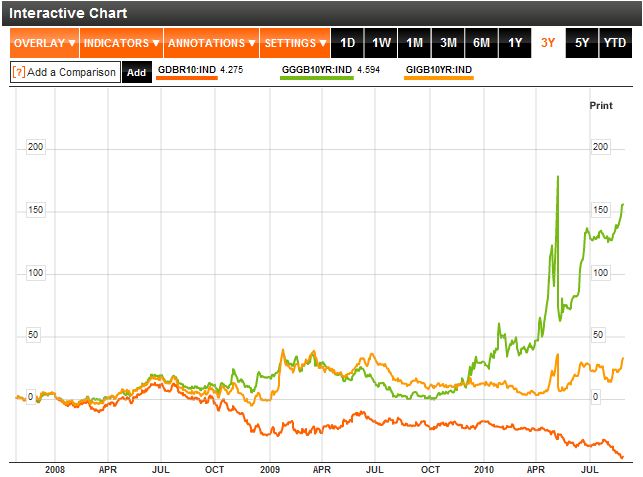
6. Europe's sovereign debt problems in a chart - Bloomberg have an excellent chart tool that allows you to chart German vs Irish vs Greek vs Spanish vs Portugese government bond yields to work out the level of stress in the system there.The green line is Greece, the light orange line is Ireland and the dark orange line is Germany. Greek yields are back near crisis record highs. Calculated Risk has the useful link.
7. Nothing in the middle - The rich in America are getting richer and spending more, while the middle and underclasses are losing their jobs and spending less. That's the conclusion in FT.com's piece about a tale about two groups of spenders. HT Troy via email.
Consumer spending in the US has turned into a tale of two cities in 2010, with an entire segment of consumers splurging confidently on the finer things in life, while another segment, concerned about unemployment and with little or no discretionary income, spends only on bare necessities. This bifurcation of the US consumer has become apparent across the spectrum, from restaurants and grocery stores to products such as coffee and beer.
In each case, a consistent trend has emerged: people who have survived the worst of the economic downturn of 2008-2009 with secure jobs are spending the way that consumers normally spend at the tail end of a recession. But unlike the circumstances after previous US recessions, where spending rebounded across the board, an entire segment of American consumers has been left behind. Steven Burd, chief executive of the Safeway supermarket chain, described the situation in an earnings call with analysts last month.

8. Australian housing market fears - Australian bank bonds took a hammering in credit markets today, Bloomberg reports, as investors fear the fallout from any collapse in Australia's housing market. This will cost us all more in the end because so much of the Big Four's funding is from these wholesale foreign debt markets.
One to watch for us over here on this side of the Tasman. Gerard Minack says it best: 'We dodged the prick'.
The spread between Australia & New Zealand Banking Group Ltd.’s $500 million of 2.4 percent three-year notes and similar- maturity Treasuries widened to 109 basis points from an 87.5 basis-point issue price in January, according to Royal Bank of Scotland Group Plc.
The cost of credit-default swaps tied to Melbourne-based ANZ and its three largest peers jumped at least 71 percent since the sale, outpacing the benchmark Australia Markit iTraxx index’s 55 percent increase, CMA prices show.
House values in Australia surged 18.4 percent this year, causing Nobel-winning economist Joseph Stiglitz to say this month that the nation’s property inflation gives “cause for concern.” Westpac Banking Corp., National Australia Bank Ltd., Commonwealth Bank of Australia and ANZ accumulated A$798 billion ($713.4 billion) of mortgage debt, almost 66 percent of their combined loans, according to their banking regulator.
“We don’t have the same type of bets on we would have had four years ago,” said Tom Farina, a director at Deutsche Insurance Asset Management in New York, who helps manage $188 billion. While Australian homeowners may not be facing a U.S.- style meltdown, “we’re certainly hitting some lofty leverage levels from a valuation perspective,” he said.
“I’m not persuaded by arguments that houses are sustainably priced, I’m not persuaded by the view that debt is not a problem, and I’m not persuaded that policy-makers could prevent collateral damage to banks,” Gerard Minack, chief strategist for global developed markets at Morgan Stanley’s Australian unit, wrote in an Aug. 17 report. “Dodging the worst of the global financial crisis didn’t demonstrate that there’s no bubble, in my view it just showed we dodged the prick.”
9. Money out of thin air - NPR reports how the US Federal Reserve created money out of thin air (through a spreadsheet) to buy mortgage bonds last year. HT Troy via email.
In the face of the financial crisis, the Federal Reserve decided to buy $1.25 trillion of mortgage-backed bonds as part of its effort to prop up the economy. .... [Julie Remache] and her team worked in a plain room with four small cubicles, [and] spent six weeks coming up with a plan of attack, and 15 months actually buying mortgage-backed bonds, all of which came with a government guarantee that they’d be paid back even if the borrowers defaulted.
The program’s intent was to keep interest rates low, and slow the decline in housing prices. The team ended up buying more than a fifth of all of the government-backed bonds on the market. ... In the end, they came very, very close to their target: They told us they were just 61 cents short. (In other words, they bought $1,249,999,999,999.39 worth of mortgage-backed bonds.)
The Fed was able to spend so much money so quickly because it has a unique* power: It can create money out of thin air, whenever it decides to do so. So, [the New York Fed's Richard] Dzina explains, the mortgage team would decide to buy a bond, they’d push a button on the computer — "and voila, money is created."
10. Totally irrelevant video - Jon Stewart does his thing on the Glenn Beck rally.
| The Daily Show With Jon Stewart | Mon - Thurs 11p / 10c | |||
| I Have a Scheme | ||||
|
||||
30 Comments
Here's Kunstler with One lump or two on the Tea Party mood brewing in the US HT Kiwidave via email
http://kunstler.com/blog/2010/08/one-lump-or-two.html
"Financial markets are getting ready to puke, the housing market has yet a million frauds left to unwind, the commercial real estate and retail sectors are crashing, the projects in Afghanistan, and Iraq, too (despite the current hype about the end of the combat mission there), are set to suck a few billion a day out of the system, indefinitely, and the season leading into the holidays is taking shape as a major amplification of all the converging clusterfucks that make these such interesting times. The tea-bagger faction will only get more desperately crazy as a result."
cheers
Bernard
That's the whole point of going to Church isn't it? Go to confessional, get absolved and you're right for the coming week
Massive changes in most aspect of life are just around the corner – be prepared. The world is and will be badly influenced by economic, social and environmental events. The economic system as we know it is on the verge of collapsing.
New Zealand build a flexible divers and adaptable economy aiming for self- sufficiency. Forget about free trade and globalisation.
Hi Jesus – how are your broccoli and tomatoes doing in your garden – with a prayer probably ready for harvesting.
Jesus - doesn't hate.
Yes - I met him briefly we talked about NZ and it’s economic future. He told me it doesn’t look good. But he also said: “NZ wins the Rugby WC” - that's promising.
Money is getting dear. I think that the banks will pass on that extra cost to Home Buyers unless the government comes up with some sort of stimulus that absorbs the higher yield... I am sure that Australia can do that till the Housing Market cools down.
For a minute I thoght it said he defecated
That comes naturally .............prior to defection.
In 2007 the chinese PM said " I think we are sitting on a pile of liabilities"... refering the USD holdings
I thought he said it was a liability of piles!
Here is a woppa on coppa:
http://www.marketoracle.co.uk/Article22329.html
and not a peep about the monster mine being developed in Mongolia.....I wonder why they left that out!
"Rio Tinto has signed a multi-billion-dollar deal to develop a massive copper deposit in Mongolia.
In Mongolia's Southern Gobi Desert, about 80 kilometres north of the Chinese border, lies the site of the Oyu Tolgoi mine, one of the World's richest copper deposits.
A deal has been signed for Rio Tinto to exploit the site along with Canada's Ivanhoe Mines.
The project, said to be worth $4.5 billion, will produce 450,000 tonnes of copper and 330,000 ounces of gold every year for the next 35 years".ABC aus
Funny how they left out the report on Mongolia!
That's a spin article, Wolly, but an underlying truth.
"There is no question that the current production numbers are to some degree validating that there is an issue starting to manifest itself on the supply side.” Mark Liinamaa, vice president of market research with Morgan Stanley.
And those Mongolian numbers look suspiciously linear. On average, yes, but no resource develops straight-line yoy.
That's not what the crystal ball mob at Goldman et al told me pdk....shortage in 2011 predicted but all bets off into 2012 and beyond. The mongolian deposit is gargantuan and high quality. Beyond that we have the Crapistan deposits and as yet undiscovered ore bodies. Guess which nation will be invited in to do the digging!
That mongolian figure divides into world yearly production 33 times.
Hardly a graph-changer, Wolly.
Copper conforms to Hubbert - peak discoveries were 1996, just like world oil discoveries were 1964.
You can't produce what you haven't discovered. Fact.
The cornucopians (and economists) will tell you that there is centuries-worth of copper in the planet, and they are right, but:
It's at less-and-less ppm, less-and-less concentrated. Like all resources, it takes energy to extract. At low ppm's, the game will never be worth the candle, and it's riding on the back of energy which is in the same boat.
Also, as with all global resources, we've cherry-picked the best/cheapest/most concentrated - so the returns get compoundedly worse from here on in. Kind of like sour crude on the bottom of the ocean not being worth the stuff from Jed Clampett's backyard gusher.
Soon they will be teaching RROEI, to go with EROEI.
(Resource Return on Energy Invested , vs Energy Return on Energy Invested.
Not in economics degrees, though.
#9 "created money out of thin air " .. errr ... why is this so unusual ? ALL money is created out of thin air, where do you think it comes from exactly? Where I work we create "new money" each and every day .. few key strokes on a computer and boom.. money loaned into existence. Simple.
When banks "borrow" money, the "money" they borrow is also just created out of thin air by another central bank.
And, by and large, done by the same types who are in denial about making the air thicker.
It would be good to think it makes you think, dunnit?
But it sunlikely.
Yes Steven - I think there's two things going on - the rich trying to get richer, even as the pool is draining.
There wouldn't be the 'stuff' on the planet, as you and I know, to be bought if all the promisory notes were cashed-in (at what everyone expects to be 'current value').
A little like a run on a bank, but physical. (Or like the angry crowd ourside Wardell's in 1932).
Hardly surprising, when you think it through. If we did it on debt, we going to be in overshoot when we hit the limits.
That is why so many of the idiot-brigade deny there are limits - they have to - they're essentially denying that the game may finish before they get 'enough', or 'win', or whatever it is they do.
So the debt has to unwind, but this time there isn't growth/inflation to devalue it. You can stave off the day by lowering the interest charged (Fed, anyone) but that's the end of the tools.
The danger is that they'll have a Bretton Woods and attempt a re-boot. That would render our planet uninhabitable - it would just override the only brake there is.
So frustrating to watch mass stupidity.
Kirsty - fair question.
It's easy for me, I saw it early (1975), and am already there.
I think I'd look at going shares in a block - more hands make lighter work and more fun. You only need 1-2 acres per head, done right.
The trap to dodge is to drift into it like they did in the late 60's, early 70's. Too loose, nothing on paper, and just like flatting, some pull their weight and some drag the chain. Recipe for disaster.
Put it all down in an agreement. Shares in, obligations to, and what happens on a partner selling (best is only allow it to someone approved by a majority of the remainder, or no sale).
Number of dewllings per acre might be a prob, but housebuses, trucks and wagons have got pretty sophisticated. Then there's shipping containers.........
Building is the cheapest part.
I'd look at 3-5 parties, no more. I know folk who are taking along their 'olds', who did the funding, and in return will be cared for.
It's a lot more fun than the daily grind, I 'll give you the tip!
yes, if you have children and/or a conscience, 2 and/or 3 are not for thee.
Steven is right - if they don't let a lot of warlords in, this is the place to be. I think I disagree with him on the 'boonies' thing, though. Most urban neanderthals think food comes from the supermarket, they may be a little annoyed at some point.......
Well said.
I wonder what some of the rip/shit/bust types around here make of our prognostications?
Yep, village is the best size, and I'm with you on the tech crash. Just when we need the net most, it won't be there. Sadly, we are a generation late no for another reason - specialisation.
My era is the last of the build your house/car/whatever Jack of all trades. I guess they'll learn quick, but it's going to be a steep curve.
Cuba is indeed a working example of where we ar going, sans war. And on a less-than-20-year timescale, as you well know.
The unwind is the interesting bit. May you live in interesting time......oh, that's right, you do!
There will be a Bretton Woods II, the question is whether it will again be preceeded by world war. If the latter, we might well make ourselves an endangered species even before the resources run dry!
Chuckle. Too true.
More chuckles. He was an intelligent man, of course. The trouble with the human race is that half of it is below average.
Where's Tolley when you need her?
You gotta get rid of that Cohen collection.................... I'm off to stick and stone practice.
Can't do. My raincoat is yellow, and not particularly well-known
Wow ..................this is big....bigger than big....Zhou's hiding out in Bollard's room in Jackson Hole with a load of moist towelettes ............and a large box of Treasuries
So now I wan't my money............. you can send it care of Int.co.nz.
I'll commission a cartoon from Chris Slane.
Thanks for the laugh Christov
cheers
Bernard
Hey Anon...I think some of your meaning got lost in translation.....But I posted a reply to Gertraud on a topic that contains some of what I think your saying.
Pop over the Property thingy Bernard's doing a wind-up with today could be some interesting thoughts or not as the case may be.
on the matter of blaming others I think that's a Global condition not just privi to us.
We welcome your comments below. If you are not already registered, please register to comment
Remember we welcome robust, respectful and insightful debate. We don't welcome abusive or defamatory comments and will de-register those repeatedly making such comments. Our current comment policy is here.