

Here are my Top 10 links from around the Internet at 10 to 1 pm, brought to you in association with New Zealand Mint for your reading pleasure.
I welcome your additions and comments below, or please send suggestions for Monday's Top 10 at 10 via email to bernard.hickey@interest.co.nz. Remember that registered commenters can more easily include links out in their comments. Use the box in the right hand column to register. We're turning off unregistered comments from this Sunday September 12.
I'll pop any surplus suggestions I get into the comment stream under the Top 10.

1. 'Methinks thou doest protest too much' - Reserve Bank of Australia Deputy Governor Guy Debelle said yesterday that international investors and creditors were increasingly asking whether Australia's housing market was set for a big fall that woud damage its banks. This followed comments by GMO's Jeremy Grantham and others that Australia's housing bubble was about to pop.
Now the biggest home lender, Commonwealth Bank of Australia, has come out with a detailed rebuttal of the housing bust fears. It prepared a powerpoint presentation for a road show it is taking to investors globally to respond to these fears. No wucking furries mate.
It included NZ stats alongside the Australian ones. Our numbers are just as bad good.
Our housing markets are not in bubble territory.
No way.
Absolutely not.
Please look the other way.
Please.
Here's what CBA said:
Concerns of a potential residential housing price bubble in Australia are often based on a superficial/incomplete analysis of the Australian market. Taking into account geographic differences, the ratio of house prices to income in Australia is not that much different to most other comparable countries.
Population growth and excess demand relative to supply has been a key driver of Australian house price appreciation –these factors are unlikely to reverse in the near term. Other factors driving house price appreciation are structural, rather than cyclical, in nature, including the broader accessibility of credit and larger average house sizes.
The household debt ratio in Australia is similar to many other developed countries, and debt increases have largely been taken up by customers in the strongest position to service it. The strong fundamentals of the Australian economy provide a firm underpinning to the housing market, reducing the risk of a sudden and dramatic collapse in house prices.
Historically, home loan losses have been very low notwithstanding house price movements, reflecting strong portfolio credit quality. Given the high quality of the CBA mortgage book, even under the most highly stressed scenario, potential losses would be modest (~0.2% of total home loan balances).
2. 'No worries then' - The Basel III global banking capital reforms have been watered down so broken US and European banks don't have to raise as much fresh capital and so the Northern Hemisphere can continue to extend and pretend. Under these new watered down capital reforms the Australian banks are also ok, David Walker writes at Banking Day.

Australian banks are unlikely to face any problems meeting Basel III capital hurdles after several key capital ratios were eased in Tuesday’s meeting of the Basel Committee.A proposal taken to the committee on Tuesday was reported to have set a minimum level of 6.0 per cent of risk-weighted assets for banks’ Tier 1 capital.
However, Banking Day understands that the meeting compromised on a lower figure of 5.5 per cent, under pressure from nations including Germany, France, Italy and Japan. Those countries all want to reduce the pressure on their troubled banks.
The Australian Prudential Regulation Authority said this week that Australian banks had reported an average tier one ratio of 9.2 per cent in their 2009 financial statements. Under the new rules that ratio would fall to 8.6 per cent, comfortably above the 8.0 per cent set to be required by the new Basel III rules.
For Australian banks, the sole remaining issue in the Basel III discussions is how the planned liquidity ratios will be dealt with in Australia and other countries (Singapore, Hong Kong and Saudi Arabia among them) whose low debt limits the likely future supply of government bonds.
3. The United States of Inequality - Timothy Noah writes with authority at Slate about the great divergence in America's society between rich and poor. He points out that America is now more unequal than it was at the beginning of the 1900s when many worried about a communist style revolution.
Where have all the Marxists gone? The chart below says it all. Here's a useful series of slide shows too.
Noah writes how at the beginning of the 1900s around 18% of the nation's income was concentrated in the hands of the richest 1%. HT Eric via twitter.
This was the era in which the accumulated wealth of America's richest families—the Rockefellers, the Vanderbilts, the Carnegies—helped prompt creation of the modern income tax, lest disparities in wealth turn the United States into a European-style aristocracy. The socialist movement was at its historic peak, a wave of anarchist bombings was terrorizing the nation's industrialists, and President Woodrow Wilson's attorney general, Alexander Palmer, would soon stage brutal raids on radicals of every stripe.
In American history, there has never been a time when class warfare seemed more imminent. That was when the richest 1 percent accounted for 18 percent of the nation's income. Today, the richest 1 percent account for 24 percent of the nation's income.
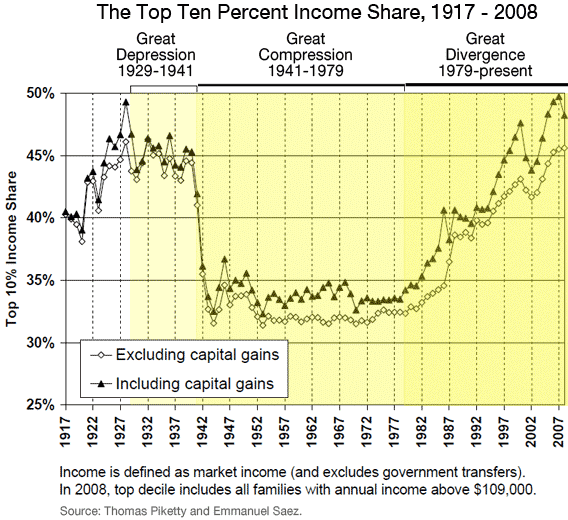
Noah has a series of articles looking for the causes of this inequality. He concludes firstly it's not because of the change of the role of women or racism, or because of the growth of immigration. or because of the rise of the computer.

4.. A poem about Allan Hubbard - This came in from a reader. HT Garry via email.
Allan Hubbard went to the cupboard
down there in Timaru
but the cupboard was bare
there was nothing there
and the taxpayers are in the pooh.
Poor Hubbard in the cupboard
is now starting to blub
"its not funny
I have no money
all that's left is my old VDub".
But JK also has plenty to say
from the PM's podium
"there was no other way
but the depositors to pay
to avoid voter odium "
Hubbard in the cupboard
was asleep at the wheel
he is on dialysis
for financial paralysis
with no chance of an appeal.
SCF Finance has no chance
of a Resurrection
Hubbard is broke
was a pig in a poke
No chance for re-election.
5. 'Please don't buy our stuff' - Japan is now begging China to stop buying its bonds so the Yen will stop rising and killing its exporters, Bloomberg reports. This is the problem with China's massive trade surpluses and underconsumption. It can move it around the world, but wherever it turns it causes damage. Let's hope the Chinese don't try to buy our bonds.
China said its purchases of foreign bonds including those of Japan are based on its needs at any given time. “Our management always adheres to security, liquidity and good value,” Jiang Yu, a spokeswoman at the Foreign Ministry, told reporters in Beijing today.
“We will decide whether or not to buy one country’s bonds according to our own needs.” While Japan has sought to boost foreign purchases of its government bonds, such a shift would erode its advantage over countries such as Greece, which have seen bond yields soar as external investors fled. Less than 10 percent of Japanese debt is held by foreigners.
The banks mostly dismissed concerns about risks building up on their balance sheets following an unprecedented credit boom over the last two years. Mr Liu said financial institutions needed to improve the design, implementation and application of "stress tests" conducted recently to assess how vulnerable they are to a downturn in the economy or a crash in the property market
"The risk management system in the Chinese banking sector still has many weaknesses," Mr Liu said in comments published Wednesday. "We must not ignore the hidden systemic risks and dangers."
Like a drunk at a party, the bond market is starting to bump into tables, telling off-color jokes, talking too loudly and spilling drinks. The smart guests will steer clear before he starts screaming at his shoes and wanders off to pray to the porcelain.
Next week, it will be the two-year anniversary of the collapse of Lehman Brothers Holdings Inc. Sadly, the bond market suggests the investment community has learned none of the lessons of the misguided adventures of recent years that prompted the biggest bankruptcy in history.
The problem with hangovers is that once they fade, the prospect of getting drunk all over again starts to seem like a great idea. This fixed-income party will end badly.
8. A Vulcan death grip - Albert Edwards from Societe Generale reckons global stock markets are in denial about the economic pain still to come. Zerohedge as the full version. V.entertaining.
"The current situation reminds me of mid 2007. Investors then were content to stick their heads into very deep sand and ignore the fact that The Great Unwind had clearly begun. But in August and September 2007, even though the wheels were clearly falling off the global economy, the S&P still managed to rally 15%!
The recent reaction to data suggests the market is in a similar deluded state of mind. Yet again, equity investors refuse to accept they are now locked in a Vulcan death grip and are about to fall unconscious."
9. Totally irrelevant video - Wile E Coyote gets his man. Finally. But then what?
10. Totally irrelevant video - There's a whole lotta rockin' and rollin' goin on this Pacific Sun Cruise liner on its way to Auckland.
38 Comments
"Australia's housing bubble was about to pop"....nothing to see here...move along please..........piss off Ok!
On a slightly different thread...how much taxpayer dosh has Stephen 'walter mitty' Wilce, been collecting for work he clearly is incapable of doing and who are the idiots that employed him?
I look forward to somebody doing that.
Interesting yarn here about the poker mad owner of the Kabul Bank who is a buddie of Shane Warne's - http://www.businessday.com.au/business/dont-bet-on-kabul-bank-20100909-…
God I love that Coyote......should have been the mascot for the Democrats since the get go.
Never short on ideas....but just can't seem to nail the bird...(.Clinton aside)
I see Chris Lee is $80K lighter as of today
http://www.stuff.co.nz/business/4116449/Bob-Jones-to-get-80-000-in-defamation-case
Its a wonder some of his clients dont also take him to the cleaners for putting them in now failed Finance companies.........
It seems incredible the guy is still in business.
i've never met bob jones but going on some of his expolits - running against muldoon, punching that journalist, sueing the stockbroker - he's certainly one of the more entertaining tycoons our wee country has produced
is that you Bob...?
christov you cynical old buzzard. or should i say, i that you chris?
Tee Hee....
Bernard ........Bernard ,,,,,,,,,that poem was appalling.......I know I should probably not critique,
but you chose to offend my eyeballs with it .........
and if Garry dances with anything like the rhythm that he composes ........well it's gonna
get ugly out there is all..
Ok ok it's Friday.........yay...!
Old Father hubbard went to the cupboard to get a cookie.................. from the Jar the SFO who were in the know said ..got you now ..............you Bar........... ............................................................stard.
Bernard, your arrogance knows no bounds. I would think by now you would learn to practice some modesty, considering we're all still waiting on those 40% property value drops you were so sure were inevitable.
@ # 3 and income inequality.
Its a really interesting issue.....there has to be some income disparity to encourage hard work and innovation, but at what point does it become counterproductive?
There is real data out there to indicate that we have gone too far in the last few decades but I'm starting to think that it's going to take some really massive social disruption to get us to shift our thinking or even have a real discussion about it. maybe things like what Noah writes there and that Spirit level book are a sign that the discussion is starting....
I think, all these bloody “Gloom & Doom Bloggers” fantasising reality should be banned for a while.
How go the preparations for my instalment...Nov 26....my dear Kunst.......Norman the flag-bearer has cancelled.... said he had something else on...typical Greens ...turn yellow in the light....G.B.H. is having problems with the fire-starting thing...wet matches from the pool or some such.
Ah well just us then Viva the Revolution
El Presidente'
P.S. any sign of that donation from MattS yet...? I'm a little light on cash and there a nice little one piece zip up camouflage I put on the lay by at the A.S.
If you're going to post poetry, please find some better stuff than that! For example:
A Woman's Poem I want a man who's handsome, smart and strong,
One who loves to listen long.
One who thinks before he speaks
One who'll call, not wait for weeks.
I want him to be gainfully employed,
When I spend his cash, be not annoyed.
Pulls out my chair and opens my door,
massages my back and begs to do more.
Oh! For a man who makes love to my mind
And knows how to answer "how big is my behind?"
I want this man to love me to no end,
And always be my very best friend.
A Man's Poem
I want a deaf-mute nymphomaniac with huge boobs who owns a liquor store and a fishing boat. I know this doesn't rhyme and I don't give a rats ass.
The Man's poem made me cry....so touching and sensitive....truly this was written by a person who understands my very being.
The woman's one was a bit ho hum and in character went on a bit.
But a big thank you...!
Women don't actually ask much in a man. Just someone who is sensitive and understanding, and knows how to listen. A man who isn't afraid to show emotion and even cry. A man who is attentive to your needs. A man who can relate to children, and pay them proper attention. Plus perhaps someone who will share the cooking, and looks as tho he enjoys it. Someone who will do his share of the flower gardening. And enjoys good theatre and music. Is that too much to ask??
The problem is, all the men like that already have boyfriends.
Cheers to all.
"5. 'Please don't buy our stuff' - Japan is now begging China to stop buying its bonds so the Yen will stop rising and killing its exporters". The Chinese have not forgotten the Rape of Nanking and the other atrocities commited by the Japanese against the Chinese before and during World War 2. Trade battles are war- and a chance to settle old scores. My guess is that China will bring the Japanese to their knees, and eventually incorporate Japan into China- as a satelite or province. They will do it with their massive foreign exchange holdings- just the way any massively rich person can manipulate the world to their liking. Why rape when a few hundred dollars will do the trick?
When you are in debt, you are a slave or potential slave. China is just looking after its own national interests. New Zealand should be focused on our national interests and the interests of our citizens. We need to protect our boarders, protect our markets, protect our dollar, protect our farms, protect our industry, protect our intellecrtual property. I am a protectionist
"protect our boarders". True, the way things are going, all property will soon be owned by a few, and the rest will be boarders in their own country. Even JK was concerned about it. I appreciate your altruism.
So true ! They pay good munny to come and study in NZ . The very least we can do is to take better care of foreign students .
Protect our boarders ........... So very true .
If you let the Chinese in they will prop up your currency because they are looking for a good deal on their investment... If you let them out they could still "punish" you buying your currency pricing you out of everything like Japan.
Wow ......lose..... lose with a bit of spite to boot.
Some people think the Aussie commodities boom is overprices
http://www.theaustralian.com.au/business/top-global-investor-warns-on-m…
HT Chris
Cheers
Bernard
Hi Bernard: The pricing of everything is determined by the market, but in the case of BHP,Rio Tinto and Valle do Rio Dolce they decided at closed doors meeting to hike the price of iron ore to the clouds, the Chinese found out about this in the press once it was a done deal. They agreed to pay because I don't think they had an alternative. But now they have a "green" posture and are threating with no more iron ore purchases while the government is cuting power suply to the smelters and mills untill they decide to purchase again, is this the answer to that closed door meeting ?.
Almost three-quarters of the Irish public believe Anglo Irish Bank will bankrupt the country and bring down the Government, according to a Sunday Independent/Quantum Research poll.
http://www.independent.ie/national-news/anglo-will-bankrupt-country-say…
HT Andrew via email
cheers
Bernard
Yeah but which three quarters would that be paddy...?
And what do the other half reckon
Re. #5 - Japan has created this problem itself. It can be easily solved, Japan just has to stop selling bonds - voila!
This is from the Micael Lewis article which cracked me up!
"After about two hours I work up the nerve to ask him. To my surprise he takes me seriously. He points to a sign he has tacked up on one of his cabinets, and translates it from the Greek: the smart person accepts. the idiot insists.
He got it, he says, on one of his business trips to the Ministry of Tourism. “This is the secret of success for anywhere in the world, not just the monastery,” he says, and then goes on to describe pretty much word for word the first rule of improvisational comedy, or for that matter any successful collaborative enterprise. Take whatever is thrown at you and build upon it. “Yes … and” rather than “No … but.” “The idiot is bound by his pride,” he says. “It always has to be his way. This is also true of the person who is deceptive or doing things wrong: he always tries to justify himself. A person who is bright in regard to his spiritual life is humble. He accepts what others tell him—criticism, ideas—and he works with them.”
NUPLEX is considering relocating it's HQ to Austrailer . This is sad . Another stellar Kiwi company clearing off .
Under Mark Weldon's watch the NZX has continued to lose companies of long-standing . Replaced only by candle makers and ex-finance company re-constructions .
Local shareholders of Nuplex ( NZX : NPX ) will not receive dividends which are fully imputed , if the shift occurs .
Bugger !
Have any of these listed public companies that have moved to Australia actually done any good? Off the top of my head I can't think of any. In fact the reverse seems to be the case.
I remember Goodman Wattie (and Goodmans before that), once an outstanding and consistent performer on the NZ stock exchange in the 1980s. Merged with Feilders, an Aussie crowd became Goodman Feilder, headquarters moved to Oz and it’s been a baying donkey (in terms of its share price performance) ever since!
I think that you are right , David . But my initial grief is with the ongoing loss of good quality companies from the NZX . Our's is a thin sharemarket . Still half the number of companies listed than in 1987 . What other country has such an appalling loss of publicly listed firms ?
This suggests to me some deep seated problems in the Kiwi financial markets . Why do so few companies choose to list on the NZX ?
When will Weldon be biffed out !
But ... but ... Dean Leftus has made a career of fooling total retards. You'd think he'd be better at it.
more numbnutish behaviour by a r/e [agent?]i would have thought proof of ownership would be 1st cab off the rank---or maybe signs of desperation on the agents part---get the sale at any cost
thttp://news.ninemsn.com.au/national/7959910/scammer-sells-house-in-perth
5 France Telecom employers took their lives over last 2 weeks. Company is in problems and trying to cut costs. However, government is part owner and as a such no redundancies are possible. Work harassment is way to force staff to leave and more than 50 (!) people committed suicide since 2008
Christopher Joye ( Rismark Int'l ) has a shot at " legendary " US investor Jeremy Grantham's claim that the Ozzie house market is the mother of all bubbles , about to implode , due to its' 7.5 times the value of household incomes . Joye argues that home price to disposable income ratio is only 4.6 times , as at June 2010 . And as such , is in line with long term trends .
Based on Grantham's prognostications , hedge funds have been shorting the Ozzie banks .............. So much so , if they get it wrong , it'll be a crowded exit when they all try to bail . POP ! Up go the stock prices of the NAB/ ANZ/ Westpac /CBA .
We welcome your comments below. If you are not already registered, please register to comment
Remember we welcome robust, respectful and insightful debate. We don't welcome abusive or defamatory comments and will de-register those repeatedly making such comments. Our current comment policy is here.