

Here are my Top 10 links from around the Internet at 10 to 7 pm, brought to you in association with New Zealand Mint for your reading pleasure.
I welcome your additions and comments below, or please send suggestions for Monday's Top 10 at 10 via email to bernard.hickey@interest.co.nz.
I'll pop any surplus suggestions I get into the comment stream.

1. The China worry - What might happen next year with China?
Could some sort of slowdown there affect demand for exports from New Zealand and Australia?
Could any Chinese slowdown burst the bubble in the Australian housing market?
The key will be when and how much interest rates are tightened there.
Bloomberg reports it might be quite some series of hikes.
One to watch.
China may raise interest rates up to six times by the end of next year as inflation becomes more entrenched in the economy, according to Mizuho Research Institute Ltd.
China’s central bank has relied on reserve-requirement ratios to help control liquidity, and with levels near 20 percent there’s little room for increases, said Takamoto Suzuki, a senior economist at the unit of Japan’s third-largest bank.
“A rate hike will be inevitable,” Tokyo-based Suzuki said. “It wouldn’t be surprising if the central bank lifts interest rates by about 1.5 percentage points by the end of next year.”
Let's face it. America is a corrupt plutocracy.
Mortgage firms are pressing the Federal Reserve to curb homeowners’ right to invalidate loans based on flawed documents -- a right consumer groups say is one of the few weapons borrowers have to battle unfair lending. Consumer groups and industry lawyers say a rule under consideration by the central bank would make it harder for borrowers to exercise their right of “rescission,” which forces a lender to relinquish a lien on a mortgaged property.
Lenders are pressing the Federal Reserve to act on the issue now because starting in July, rescission rules will come under the purview of the new Consumer Financial Protection Bureau, industry lawyers said.
“I cannot understand why the Fed is rushing through this voluntary gift to the banks unless the Fed is afraid that if it doesn’t curtail the rights of rescission now, it will never happen,” said Kathleen Engel, a professor at Suffolk University Law School in Boston.
The right of rescission was established by the 1968 Truth in Lending Act. Borrowers who can show a material misstatement in loan documents have three years to issue a rescission notice to the lender, who must revoke its lien on the property.
3. Coming down the line - Bloomberg reports that new international bank capital rules from the Basel committee would have forced banks to raise a further US$797 billion in capital if they had been in place from last year, rather than the 2019 that they are supposed to be phased in from.
All this money has to be raised at a time when governments and everyone else is raising or rolling over enormous amounts of debt.
There is just too much debt in the world.
The more I look at it, the more I wonder about the debt jubilee idea.
It seems the only way out of all this debt is restructuring or inflation. Neither of which are attractive.
Lenders would also have had a 2.89 trillion-euro shortfall in the funds needed to guard against a run on deposits had the planned Basel Committee on Banking Supervision’s rules been in place at the start of 2010, the panel said in a statement on its website today. The committee agreed in July to phase in the capital and liquidity rules by 2019 in a bid to mitigate their effect on banks emerging from the credit crisis.
The shortfall projected by the Basel committee is a “vivid demonstration of the sheer impact of the new liquidity standards,” said Etay Katz, regulatory partner at law firm Allen & Overy LLP in London.
“There is a considerable concern about finding an effective way of bridging such a shortfall -- bar drastic changes to business plans and business disposal programs which may be unfeasible or imprudent.” Lenders would have had a 2.89 trillion-euro liquidity shortfall against a net stable funding ratio at the end of 2009, the Basel committee said. That ratio, slated to be put in place in 2018, aims to limit the mismatch between the duration of loans and deposits to ensure banks don’t face funding shortages.

4. 'The quiet before the storm' - The Germans are still feuding with the rest of Europe about how to deal with the Sovereign Debt Crisis there. Here's Bloomberg's take on the crucial meetings happening this weekend.
European Union divisions widened over how to contain the debt contagion that threatens the euro, limiting a summit that began today to an agreement on a crisis- management mechanism that takes effect in 2013.
German Chancellor Angela Merkel balked at boosting or making more flexible use of the EU’s 750 billion-euro ($1 trillion) emergency fund, as leaders neared an accord on the tool to contain future debt shocks and the European Central Bank armed itself with more capital. Strife among Merkel, the ECB, Luxembourg Prime Minister Jean-Claude Juncker, and the German domestic opposition intensified on the eve of the Brussels summit, marring confidence in Europe’s handling of the fiscal woes that forced Greece and Ireland to fall back on financial handouts.
“There is a situation of European gridlock again with Germany blocking actions to make progress,” said Nick Kounis, chief euro-region economist at ABN Amro NV in Amsterdam and a former U.K. Treasury official. “There is a high risk of the crisis re-escalating and maybe now it’s the quiet before the storm in markets.”
5. A wicked rant - Joe Bageant rants here about why Americans are so dumb and why America is so ...er ... fornicated. HT Rob via email. A really good laugh with an uncomfortably truthy feel to it (in parts).

6. What the boomers will do to prices - We ain't seen nothing yet. Glen Asher writes that retiring baby boomers who try to sell their houses to scarce and poor young people will drive down prices further ahead of themselves. All around the developed and ageing world.
That includes us people.
Here's the thinking.
According to the study, sales of existing homes make up 85 percent of the homes sold today. Senior citizens are by and large the suppliers to the housing market as they downsize, move into senior's residences or pass away. Those over 65 years are proportionately more likely to own their own homes in comparison to younger adults so they are more likely to have houses to sell.
The first baby boomers are slated to reach their retirement years at the age of 65 in 2011 and the last will pass through the "gate" to seniorhood in 2029 so it seems likely that the effects of this demographic change on the real estate market will be seen sooner rather than later. As well, a decrease in the number of younger, first-time home buyers means that the housing market will feel additional stress from shrinking demand at the same time as it faces rapidly growing supply.
This does not bode well for prices since the supply of available housing will be increasing at the same time as the demand for that housing is decreasing.

7. Zerohedge speaks - 'Tyler Durden' of Zerohedge fame explains his philosophy in a discussion with Chris Martenson.
Two bears have a good old moan. Fun to read. HT Jeremy via email.
We fail to see how an unwind to a previous “restore point” to borrow a computer analogy, is possible at this very late stage in the global Ponzi scheme. We tend to simplify the world: When everything else is stripped, the only two things that matter are a) where is the money coming from? and b) where is it going? And never in the history of the world have so many assets created so little cash flow.
To a big extent, this is due to the fact that a bulk of asset purchases in the past three decades have been due not to asset turnover, but as a result of cheap credit resulting from an explosion of credit money through the quadrillion dollar derivative boom. As a result, most incremental dollars go not to organic business growth and economic output, but to satisfying what has become the biggest debt burden in the history of the world, whereby the labor and intellectual output of most goes to fund the living standards of a very few.
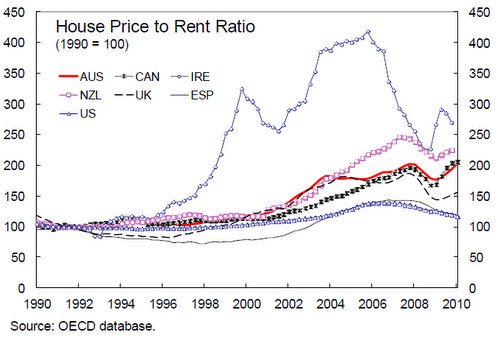
8. The IMF speaks - House prices in Australia and New Zealand might be over valued, it suggests in this 25 page paper. Fair enough. HT Rob.
Price-to-income ratios appear to be above 10-year averages at end-June 2010 by about 20 percent in Australia, 15 percent in Canada, and by 26 percent in New Zealand at end-March 2010. these ratios were good indicators of overvaluation in house prices in countries that subsequently experienced a correction.
In Ireland for example, at the peak of the housing boom in mid-2006, the house price-to-income ratio and house price-to-rent ratio were respectively about 40 percent and 30 percent above their 10-year average. Since then real prices in Ireland have declined by 35 percent in real terms, and ratios of house prices to rents and income have fallen from historically high levels.
9. Some serious rioting - Here's the video of the very ugly riots in Greece this week. Worth watching and listening to. This is ominious.
10. Totally Jon Stewart with Michael Steele as a Muppet.
| The Daily Show With Jon Stewart | Mon - Thurs 11p / 10c | |||
| The Great Gaffesby | ||||
|
||||
We welcome your comments below. If you are not already registered, please register to comment
Remember we welcome robust, respectful and insightful debate. We don't welcome abusive or defamatory comments and will de-register those repeatedly making such comments. Our current comment policy is here.