
Bernard Hickey details the fifth in this series of Top 10 charts for 2010 in association with Bank of New Zealand.
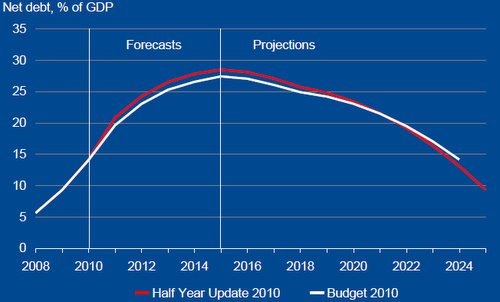
This chart from Finance Minister Bill English's presentation of the government's fiscal and economic update on December 14 shows how the government's debt is forecast to almost double from around 15% of GDP now to almost 30% by 2015/16.
But it is forecast to start falling back after 2015/16.
However, this assumes GDP growth over the next three to four years of around 3% per annum.
That looks a tad optimistic given the near double dip recession seen in the June and September quarters, although the boost from the Christchurch earthquake rebuild and the Rugby World Cup is yet to have an impact.
The government debt peak forecast in the December update (red line) is slightly higher than in the May 2010 budget forecast (white line) because of weaker GST and corporate tax revenues in the last year due to the slower than expected economic recovery.
This may be a factor Standard and Poor's takes into account as it assesses the outlook on New Zealand's AA+ sovereign credit rating.
It currently has the rating on review for a possible downgrade with typically a one third chance of a downgrade.
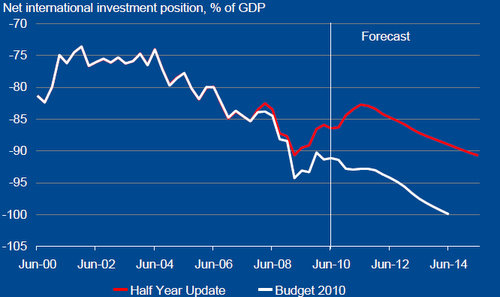
Meanwhile, total net foreign debt (chart below), which includes both private and government debt, was actually forecast by Treasury to have improved in the December update from the May update.
That's because the slower economic growth softened demand for imports and stronger commodity prices boosted export returns. Also, weaker profits from foreign owned companies reduced the outflow of dividends.
However, this improvement is seen as temporary before New Zealand's national savings problem eventually starts driving the debt up again as a percentage of GDP to over 90% again, putting New Zealand in the same vulnerable position as Greece, Ireland and Portugal. This is not as bad as forecast in May because of the factors mentioned above, the long term trend is disturbing for foreign investors.
New Zealand may not have the same government debt problem as these three PIGs countries do, although it's notable that neither did Ireland in 2008 before the Global Financial Crisis.
Ireland's mistake was to guarantee its banks, which then collapsed and forced the Irish government to take on much more debt because of it.
New Zealand also guaranteed its banks and finance companies. Luckily for the government, the banks have not collapsed, although the collapse of the guaranteed finance companies has already cost more than NZ$2 billion.
We welcome your comments below. If you are not already registered, please register to comment
Remember we welcome robust, respectful and insightful debate. We don't welcome abusive or defamatory comments and will de-register those repeatedly making such comments. Our current comment policy is here.