

Here's my Top 10 links from around the Internet at 10 to 8pm in association with NZ Mint.
As I publish we're seeing reports of an 8.8 earthquake in Japan and a Tsunami.
It looks horrendous. All our thoughts go out to everyone in Japan. Here's the Reuters report.
I welcome your additions in the comments below or via email to bernard.hickey@interest.co.nz.
1. The fallout has only just begun - Seumas Milne at The Guardian hit a nerve this week when he wrote that politicians are clinging to a broken economic model and are failing to realise that the real fallout from the crash of 2008 has only just begun.
The comments by Mervyn King to The Telegraph last week are reverberating in Britain where the pain from budget cuts is now biting deep just as the Too Big To Fail bankers award each other a big new round of bonuses.
David Cameron is on an austerity drive.
He should be careful.
The public might actually revolt in Britain.
It has taken the Bank of England governor Mervyn King of all people to nail the endlessly repeated falsehood that the deficit is the result of Labour profligacy – rather than the breakdown of an unregulated and unreformed financial system enthusiastically endorsed by the entire political class.
King blamed the bankers for the cuts, and warned of the threat of further crises unless the financial behemoths were brought to book. And it was Richard Lambert, the outgoing head of the employers' CBI, who took the government to task for absurdly relying on the ruthlessness of its cuts to deliver growth.
Mervyn King expressed surprise last week that the "degree of public anger has not been greater than it has" over the costs of the system's failure. But as those costs are rammed home, both in Britain and across the world, it will become clearer that the fallout has only just begun.
2. Preparing for higher interest rates - This is extraordinary really. The world's biggest bond fund, PIMCO, has just sold out of all its US Treasuries, Bloomberg reported.
Yet still people buy US Treasuries.
Or at least the Fed does...and the Chinese...even though they don't trust the Americans any more.
Longer term interest rates, at the very least, are headed north.
Yet our central bank just cut its rates....
Some of the biggest private investors in the bond market, from fund managers to insurers and pensions, are preparing for an end to the three-decade Treasury rally, as interest rates near zero and unprecedented spending by the U.S. government and the central bank threaten to fuel inflation. Their strategies range from reducing the longest-dated holdings and shifting to higher-yielding corporate debt, to investing in stocks, commodities, non-U.S. bonds and even holding cash.
“U.S. government bonds are not a safe haven,” Jim Rogers, the global investor who predicted the 2007-2009 housing-market crash, said in a telephone interview from Singapore. “I cannot conceive of lending money to the U.S. government for 30 years.”
Pacific Investment Management Co. said yesterday that Gross, who runs the $237 billion Pimco Total Return Fund, eliminated government-related debt from his flagship fund last month as the U.S. projected record budget deficits. Gross, who has overseen the expansion of Pimco into a $1.2 trillion bond shop over four decades, predicted a year ago that “bonds have seen their best days.” Last month, he said Treasuries may have to be “exorcised” from model portfolios.
These comments from Chinese observers are most interesting.
“China has kept on lending money to the U.S. to keep its export machine going, and to prevent losses” on its existing holdings of Treasuries, said Yu Yongding, a former Chinese central bank adviser. “Perhaps it is too late to do anything about the existing stock without causing a serious political and financial backlash. But at least China should stop continuing building up its holdings.”
China’s currency’s de facto peg to the dollar limits its ability to diversify away from Treasuries even while its policy makers are “very, very bearish” on the dollar, said Andy Xie, formerly Morgan Stanley’s chief Asia economist in Hong Kong. China’s probably trying to diversify by increasing purchases of euro-denominated bonds and buying bonds with shorter maturities to minimize risk, Xie said.
“China’s faith in the Fed broke a few years ago,” said Xie, now an independent economist based in Shanghai. “China used to be enamored of people like Greenspan and Bob Rubin even though at that time the dollar was coming down. QE2 destroyed whatever faith was left.”
3. An Egyptian song for all - The CEO of PIMCO (that very same bond fund mentioned above) is Mohamed El Irian, the son of an Egyptian diplomat. Here in a blog at Reuters he picks out a popular Egyptian music video celebrating the revolution. It's well worth a watch on Youtube below if you want to understand what is going on in the Middle East.
For centuries, songs have provided populist narratives of historical movements. And, every once in a while, a song comes along that also succeeds in capturing forcefully the raw emotions of the moment. This is the case today with “Sout el Horeya,” or the “Voice of Freedom,” sung by Hany Adel and Amir Eid.
Coming out of Egypt, this song skillfully encapsulates the strong drivers behind the ongoing transformations impacting the Middle East and North Africa. It is a “must hear” for all those trying to understand previously-unthinkable developments in the region, including western governments whose sophisticated intelligence services have been caught flat-footed and are now playing rapid catch up.
4. Show me the hole in your Caja - Here's one of the reasons why there is so much nervousness around Spain's sovereign debt market at the moment. Moody's has cut its rating, but also a hole in the accounts of Spain's savings banks is about to be revealed, Bloomberg reports.
The numbers are mindboggling. 100 billion euros of loans are 'problematic' and only a third have been provided for.
The Bank of Spain will publish each lender’s capital shortfall and the overall amount, which the regulator has already estimated won’t exceed 20 billion euros ($28 billion), or 2 percent of Spanish gross domestic product. The government wants most of that to be raised privately even as central bank Governor Miguel Angel Fernandez Ordonez said Feb. 21 that some lenders will ask the state-rescue fund for help.
Spanish banks, mostly savings institutes called “cajas,” have recognized losses equivalent to 9 percent of GDP since 2008, the Bank of Spain said on Feb. 21. Cajas’ exposure to the real-estate and building industry amounts to 217 billion euros. About 100 billion euros of that is already classified as “potentially problematic,” of which 38 percent is covered with provisions, the regulator said.
5. Peak coffee - The New York Times reports on how global warming might be creating peak coffee. It seems to be boosting prices.
The shortage of high-end Arabica coffee beans is also being felt in New York supermarkets and Paris cafes, as customers blink at escalating prices. Purveyors fear that the Arabica coffee supply from Colombia may never rebound — that the world might, in effect, hit “peak coffee.”
In 2006, Colombia produced more than 12 million 132-pound bags of coffee, and set a goal of 17 million for 2014. Last year the yield was nine million bags.
Yet as stockpiles of some of the best coffee beans shrink, global demand is soaring as the rising middle classes of emerging economies like Brazil, India and China develop the coffee habit.
“Coffee production is under threat from global warming, and the outlook for Arabica in particular is not good,” said Peter Baker, a coffee specialist with CABI, a research group in Britain that focuses on agriculture and the environment, noting that climate changes, including heavy rains and droughts, have harmed crops across many parts of Central and South America.

6. Keep an eye on Europe - There are meetings this weekend and nearer the end of the month where the immovable object (German public opinion) meets the unstoppable force of out-of-control budget deficits in the rest of the euro zone. The New York Times reports that many are sceptical about the prospect of any agreement.
Essentially the Irish, the Portugese, the Spanish and ultimately the Italians want to keep running deficits and not have the Germans looking over their shoulder at every turn.
The Germans, meanwhile, hate the idea that the ECB is buying all this toxic European paper with their German money, devaluing it as it goes. That's why Axel Weber left the ECB in a huff. The euro is a couple of bad election results away from destruction.
Berlin sees a deal on the “pact for competitiveness” as a precondition for bolstering the €440 billion, or $608 billion, backstop fund for euro zone countries and making it permanent – and possibly more flexible – at another summit on March 24. However, after a rebellion by smaller countries, the initial French-German plan for the pact has been softened, leaving only one contentious issue: moves to bring Europe’s corporate tax systems closer together.
Without tough and binding commitments to tackle structural problems across the euro zone, the German government will find it more difficult to persuade its public that it is right to increase in the bailout fund or to allow it to be used more flexibly.
The latest version of the proposals states that countries should announce concrete commitments to improve several aspects of their own economic performance within the next 12 months. These targets should be announced on March 24 if possible or, for countries unable to do so, in June this year. But by giving countries the ability to choose the detail of their own measures, the latest draft of the pact has made it difficult to use the agreement as a vehicle to impose rigid, Germanic, fiscal discipline on the euro zone.
“It’s not worth the paper it’s written on,” said one E.U. official speaking on condition of anonymity in accordance with policy.
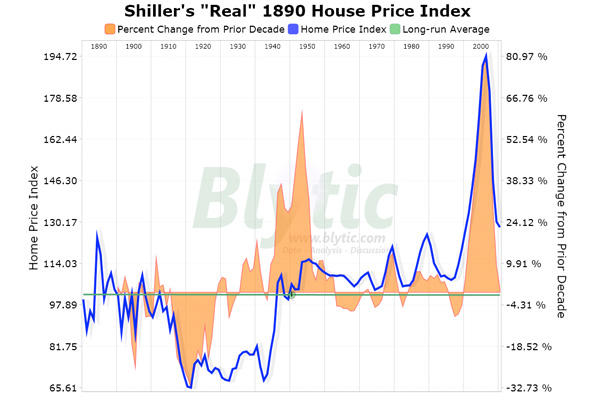
7. Really long term poor performer - Rotten Apple at MacroBlog in Australia picks out a long term chart of real house prices in America and finds it's not so good and on its way down from a big blowout.
8. 'My big fat Greek bond issue' - Greece is planning to sell 'diaspora' bonds to rich emigrants living in America, Canada and Australia to get itself out of its fiscal mess. I kid you not. Here's the WSJ with the story....
Mr. Arvanitis, who immigrated in 1974, said he would be willing to buy about $10,000 of the bonds, after getting his wife's approval. "I'm proud of Greece—we gave the world democracy and history and art, everything," he says.
"Greek people are smart people, but they don't know how to run a government."
Greece also has indicated it will reach out to expats in Australia and Canada, both also home to large Greek populations. The so-called diaspora bonds will be marketed to U.S. investors of Greek descent during the first half of 2011, a senior Greek finance-ministry official said Wednesday, after the financially strapped Mediterranean nation filed shelf-registration with U.S. regulators to proceed.
The Greek government official said the country is aiming to pay a yield of less than 5% on the debt, which would mature in between three and 10 years. That is far below what Greek bonds fetch on the open market. Two-year Greek debt has a yield of 15%. And many worry that those who lend money now may not get it all back.
9. 'Proud to be British' - Sir Fred 'The Shred' Goodwin, the guy behind the Royal Bank of Scotland debacle, has succeeded in taking out a 'super injunction' in a British court to stop newspapers there publishing details of an ... ahem... marital issue. It seems Fred was very, very busy during the Global Financial Crisis. Richard Smith has this very British tale at Naked Capitalism.
In what will be seen as another blow to free speech, judge Mr Justice Richard Henriques sided with the married banker. The banker, who is paid a substantial six figure sum, began the illicit affair before the credit crunch erupted and plunged the country into recession, The Sun reported.
One bank insider told the paper: ‘Given what was going on at the time they got together, I’m surprised either of them had the time or the energy.’
In the words of Prime Minister Winston Churchill, informed that an MP had been caught sodomizing a Guardsman under a tree, on the coldest night of the decade: "Makes you proud to be British."
This is what happens when a truck carrying printer ink crashes. Details here at Gawker.

10. Totally regular weekend video of Clarke and Dawe
11. Totally black and white movie with a song about Steve Jobs and the need for flash on the iPhone. There is swearing. It's a bit rude in a geeky sort of way.
We welcome your comments below. If you are not already registered, please register to comment
Remember we welcome robust, respectful and insightful debate. We don't welcome abusive or defamatory comments and will de-register those repeatedly making such comments. Our current comment policy is here.