

Here's my Top 10 links from around the Internet at 10 past 8 pm in association with NZ Mint.
I welcome your additions in the comments below or via email to bernard.hickey@interest.co.nz.
I'll pop the extras into the comment stream.
See all previous Top 10s here.

1. The amazing never-ending real estate crash - This piece in theendoftheamericandream.com about the housing crash in America is full of 27 juicy factoids.
Including these:
Since the real estate peak, U.S. home values have fallen by US$6.3 trillion (a third of GDP).
Deutsche Bank is projecting that 48% of all U.S. mortgages could have negative equity by the end of 2011.
According to Zillow, U.S. home prices have already fallen further during this economic downturn (26%) than they did during the Great Depression (25.9%).
As of the end of 2010, 23.1% of all U.S. homeowners with a mortgage owed more on their homes than their homes were worth.
The United States has never had such a prolonged real estate slump in the post-World War 2 era. Unfortunately, there are a whole lot of indications that the real estate crash is going to get even worse.
The rapidly rising price of oil, the horrific crisis in Japan and instability in the Middle East all threaten to plunge the world into another major economic downturn. That is really bad news for the real estate industry. Already there are not nearly enough jobs for everyone in the United States and without good jobs American workers simply cannot buy homes.
In addition, many of those that would like to buy homes are finding that they cannot get approved for home loans. Before the real estate crash, lending standards were incredibly loose, but now the pendulum has swung very far in the other direction.

2. 'We haven't fixed anything' - Satyajit Das, the author of Traders, Guns and Money (and a commentator in Inside Job) talks here with Andrew Patterson at Sunday Business on Radio Live about the Japanese earthquake and Tsunami.
He makes some interesting points about the importance of Japan in the north Asian supply chain and the problem Japan's ageing (and falling) population will have servicing its monstrous public debt.
He says the world has just kicked the can down the road for the last 3 years.
"The problem the world has is too much debt and we have really done little to fix it in the three years since the global financial crisis," he said.
He also says Australian banks raise 20-25% of their funding from Japan....
3. So why aren't they rioting? - Here's a detailed table showing that 43 million Americans are now on food stamps, up 13.1% from a year ago.
And here's a chart showing America is much less socially mobile than it has ever been.
And less socially mobile than Europe even -- the old country. They really are kidding themselves with all these myths about rags to riches and 'anyone can do it'.

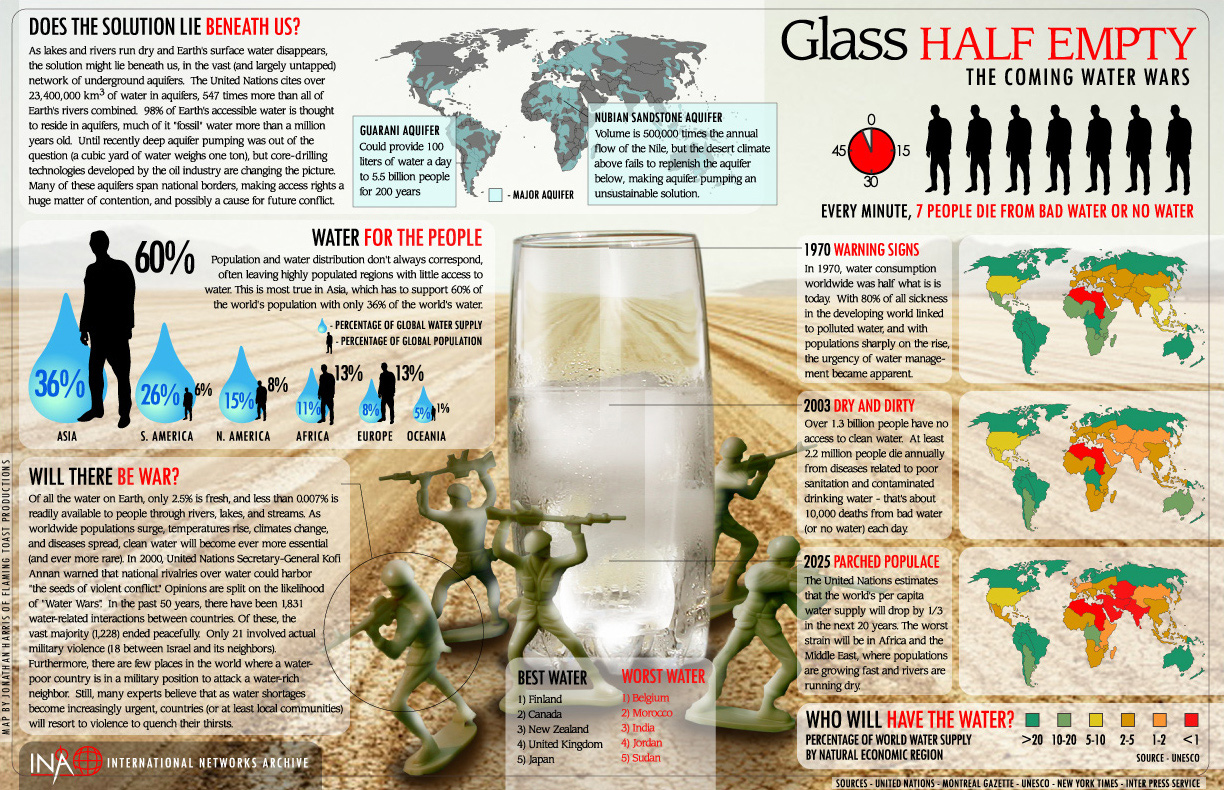
4. Invade us - We have the most and best water. According to this excellent Princeton graphic, New Zealand has the third best water in the world behind Finland and Canada.
5. What happens when interest rates rise - This is the elephant in the room for those who believe the financial crisis is over and the solution of adding yet more debt rather than restructuring the debt was a long lasting one.
It's only as good as the low interest rates around at the moment.
Here Merryn Somerset Webb at Moneyweek.com asks this question of Britain's housing market as the Bank of England begins talking about putting up interest rates. Remembering of course that many Britons are now on floating rates.... Sound familiar?
According to Legal & General Investment Management, a rise in the base rate and hence in variable mortgage rates will mean that huge numbers of consumers will see "a meaningful impact to their cash flow".
Shelter goes further. The Bank of England hasn't raised rates for 25 months, but when it does, says the charity, it could push those assuming that low rates are forever into a "spiral of debt and repossession".
6. 'We'd like to increase our insurance cover...' - Journalism student Samantha Ives reports at Newswire that Wellington City Council Chief Financial Officer Peter Garty (the guy at Telecom who received THAT Telecom tipoff from his cycling mate a while ago), is about to travel to Europe and is hoping to get some more reinsurance cover for Wellington.
It may not go well, apparently. Reinsurers are a bit nervous about earthquakes in Wellington now. HT Paul and Alex.
"I want us to achieve some more cover, but I don’t think we are going to be able to get there because of price and availability,” says Mr Garty, who will travel to London and Zurich in late April to pitch to the world’s biggest insurance companies.
He would like to increase council insurance from the current $300million to $400million on its $4 billion-worth of buildings and infrastructure over the next three or four years. He is concerned they may not even get the $300million again when they seek renewal from current insurers in London, so they intend to visit one of the world’s biggest re-insurers, Swiss Re in Zurich, as well.

7. 'Nuclear Power is truly Green' - The Guardian's George Monbiot is a hero of the green left. Maybe not for much longer. Here he says the Fukushima accident has convinced him of the merits of nuclear power to help reduce global warming. Really.
Good on him.
A crappy old plant with inadequate safety features was hit by a monster earthquake and a vast tsunami. The electricity supply failed, knocking out the cooling system. The reactors began to explode and melt down. The disaster exposed a familiar legacy of poor design and corner-cutting. Yet, as far as we know, no one has yet received a lethal dose of radiation.
Some greens have wildly exaggerated the dangers of radioactive pollution. For a clearer view, look at the graphic published by xkcd.com. It shows that the average total dose from the Three Mile Island disaster for someone living within 10 miles of the plant was one 625th of the maximum yearly amount permitted for US radiation workers. This, in turn, is half of the lowest one-year dose clearly linked to an increased cancer risk, which, in its turn, is one 80th of an invariably fatal exposure. I'm not proposing complacency here. I am proposing perspective.

8. Time for Ireland to default - As the size of the Irish banking black hole gets bigger, serious voices in Ireland are now talking about defaulting. Here's Daniel McConnell at the Irish Independent on Sunday.
Once again the Irish taxpayer is being called on to bail out those banks which through their own hubris and insanity during the past decade have brought this country to its knees. Let us never forget that the actions of 100 people or so at the top of Irish banks have brought this country to the point of financial ruin.
Former NTMA boss, Dr Michael Somers, said Ireland was now caught in a classic debt spiral.
"There is no way we will ever pay this stuff back, it will just be refinanced. The awful thing is that I know there are figures going around showing virtually no growth for the next three years and you ask yourself what comes after that, further tax hikes and you ask yourself how are we ever going to get out of this. We are in a downward spiral," he said.
David McWilliams, Constanin Guerdiev and former Chilean finance minister Andres Velasco argue defaulting on our bank debt is now Ireland's only viable option. Velasco said: "If you look back in history, many, many countries have defaulted including some in Europe. It is not the end of the world and can be beneficial."
It's like the old saying, if you owe the banks €40,000 they have you by the balls, if you owe them €40m, you have them by the balls. This is how Ireland needs to start dealing with the ECB.
8. 'What's so different in the west?' - Matthew Klein at the Council on Foreign Relations wonders what is so different between unemployed youth in the Middle East who are revolting and unemployed youth in America and Europe who are (yet) to revolt. Jobless rates are similar for both...
As governments across the developed world balance their budgets, I fear that the young will bear the brunt of the pain: taxes on workers will be raised and spending on education will be cut while mortgage subsidies and entitlements for the elderly are untouchable. At least the Saudis and Kuwaitis are trying to bribe their younger subjects.
The uprisings in the Middle East and North Africa are a warning for the developed world. Even if an Egyptian-style revolution breaking out in a rich democracy is unthinkable, it is easy to recognize the frustration of a generation that lacks opportunity. Indeed, the “desperate generation” in Portugal got tens of thousands of people to participate in nationwide protests on March 12. How much longer until the rest of the rich world follows their lead?
And here's a chart showing the top 1% of income earners in the United States earned nearly 60% of the capital income in 2003. It's much worse now. Riots anybody?

9. Totally wonderful pictures in a BBC trailer for a documentary on The Human Planet.
10. Totally sweet and fun animation about a shell with shoes on.
We welcome your comments below. If you are not already registered, please register to comment
Remember we welcome robust, respectful and insightful debate. We don't welcome abusive or defamatory comments and will de-register those repeatedly making such comments. Our current comment policy is here.