
By Bernard Hickey
New Zealanders learned this week that our output did not increase in the second half of last year.
Yet our spending in total and our wages rose over that period, as did our population and spending per capita. So how did we manage that? How did we spend more per person than we earned per person? Essentially, we borrowed the money from offshore or we sold assets to foreigners.
Figures also out this week showed we ran a current account deficit of 2.3% in the December quarter. That's much less than the 8.8% hit in the December quarter of 2008, but it's still a deficit and means we imported capital equivalent to 2.3% of GDP and spent it. Importing capital is another way of saying we borrowed money or sold assets.
That 2.3% also looked better than it was because of all the reinsurance money flowing in after the earthquake on September 4.
Yet again, we engaged in a national delusion that we could afford to spend more than we earned.
It's worth working out how long we have been deluded as a nation.
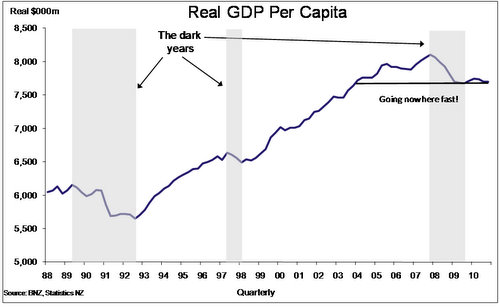
New Zealand's real GDP per capita is now actually below where it was in 2004. For at least the last 8 years New Zealanders have engaged in a national delusion that, as the advertisement from L'Oreal says, we were worth it.
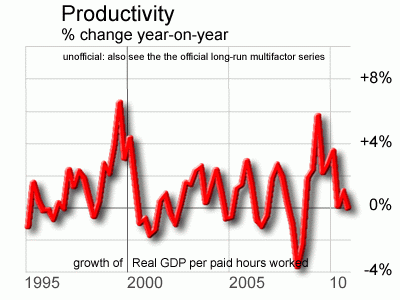
Over the 10 years of the 'naughty oughties (2000s), New Zealand borrowed or sold off a total of NZ$350.3 billion. That's about two times GDP. We used that money to increase our wages and income. We didn't use that money to reinvest in new equipment or skills to boost our ability to produce more in the future. The proof of that is our appalling record on productivity or output per hour worked (see attached chart). It has gone nowhere for a decade, largely because we have not reinvested profits or saved.
Virtually no one was guiltless in this national delusion. Households deluded themselves first by borrowing heavily against the value of their houses between 2004 and 2008. That has stopped now and households are saving. Corporates have been less profligate, but they're borrowing offshore again too because they can get very low interest rates.
Now government has taken over as the borrower in chief. On Thursday the Treasury's Debt Management Office took advantage of a gap in the financial market turmoil to borrow NZ$950 million in one week on international markets. The immediate reaction was a rise in the New Zealand dollar as foreigners bought New Zealand dollars to buy the bonds.
This is another side effect of continued heavy borrowing. These capital inflows push up the value of the New Zealand dollar and punish exporters, the very people the government wants to encourage.
The upshot of all this borrowing is that now whenever our economy does look like recovering the benefits of any growth are shipped offshore in the form of profits and dividends from now foreign-owned assets here and in the form of interest payments on the debt incurred over the last decade.
In 2010 New Zealand paid NZ$15.5 billion in profits and interest payments to foreign investors and creditors. Only NZ$3.3 billion was reinvested.
That is the size of the drag on the New Zealand economy. It is unsustainable. We have to stop spending money we aren't earning.
If we don't, we will get poorer and poorer until either there is nothing left to sell or we can't pay the interest on the debt any more.
It's time we stopped kidding ourselves.
Here's a chart showing the stark truth that our real per capita GDP is still below where it was in 2004.
We welcome your comments below. If you are not already registered, please register to comment
Remember we welcome robust, respectful and insightful debate. We don't welcome abusive or defamatory comments and will de-register those repeatedly making such comments. Our current comment policy is here.