
Here's my politico-economic blogroll for the week. Have a great weekend all.
From the left
1. Ironbridge stong-arming the govt over NZ$43 million licence fee. Idiot Savant at No Right Turn did some good OIA document digging on the government's NZ$43 million loan to Media-'I'm loaded up with debt'-works. He picked up on a Deloitte report refered to in a document in 2009 that said the two big boys, Mediaworks and The Radio Network, were financially viable enough to pay their fees and did not need the now-termed 'bailout' they received.
I love it also that the Ministry of Economic Development told Stephen 'I used to own them' Joyce that the upcoming Rugby World Cup was a positive risk for radio revenues. This government has done everything it can to push the benefits the RWC will bring to NZ (They even managed to connect a new recycling initiative to it), so why stay quiet on it this time...?
Deloittes did note that if revenue declined, the companies would be in trouble (a statement of the obvious), but that their underlying profitability was sound. They recommended a wait and see approach and reviewing the situation closer to when the payments were actually due. The Ministry noted that the companies had known about the need for these payments for a long time, that they had plenty of options available (e.g. asset sales, cost-cutting, or injecting capital) if they needed money, and noted a lack of evidence that such options had been explored before going to the government for a hand-out. They concluded:
Considering the above, the Ministry still does not see a strong case for the Government to accede to the RBA's request, a move which would place the Government in a credit-financing role in lieu of the existing market mechanisms. It is recommended that no further consideration will be given unless suitable evidence was provided by the affected broadcasters that all alternative avenues have been adequately explored.This advice was ignored. Two weeks after the briefing was given, Joyce wrote to John Key seeking permission to bring an urgent paper to Cabinet on the issue. The letter made no mention of the modelling at all, and accepted at face value the RBA's claims that its members were too poor to pay, despite their books showing that the opposite was the case.
I also loved this comment from the MED document (my emphasis):
The Ministry notes that the payment liability has been known to the broadcast industry for some years now, and the broadcasters have been able to build the payment into their cash-flow forecasts since late 2006 when Cabinet agreed the aggtregate sum of $96 million for payment in 2010. The matter was well-known when Ironbridge purchased the MediaWorks business. We understand that the Ironbridge purchase of MediaWorks was followed by changes to the capital structure of the company.
One word: Debt.
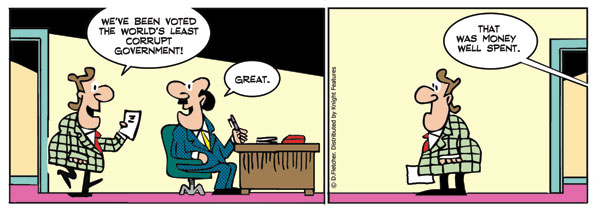
Loved this picture. HT Imperator Fish.

2. Where was Bob Parker for the Christchurch CERA hearings? Stephen Cowan at Against The Current asks why Christchurch Deputy Mayor Ngaire Button attended the Select Committee hearing for the Canterbury Earthquake Recovery Bill and not the Mayor himself this week?
The CCC submission said it accepted the need for a single government funded agency to coordinate recovery in Christchurch, but critised the lack of any clear statement about the roles of the Council in the recovery.
"The Council welcomes its role in leading the development of the CBD recovery plan, but is concerned that the legislation otherwise places on the same footing as any other organisation in relation to the recovery," it said in its submission. If it was that concerned, why did it not send the Mayor to convey the message?
At the submissions hearing , Ngaire Button, expressed concern about the 'extensive powers' that CERA was being given and appealed that the council be given a substantial role in the rebuilding of Christchurdh
There's, frankly, fat chance of that happening
It's inevitable that this authoritarian legislation will be used to prioritise the interests of capital over the interests of ordinary folk. Christchurch business interests are uniformly in support of this legislation.
It's disappointing but not surprising that the Labour Party did not vote against the Rcovery Bill. Indeed Labour MP for Christchurch East, Lianne Dalziel, has justified the legislation because of the Christchurch City Council's failure to deal with the September quake. She, and Labour, seem quite willing to expose local people to the machinations of CERA and Brownlee.
Sideshow Bob's failure to show up at the select committee meeting, once again, highlights that he is a 'captured politician', beholden to his political masters in Wellington and business interests in Christchurch.

3. Why was SCF allowed to continue in the guarantee? Frog at Frogblog asks why South Canterbury Finance was not cut adrift from the deposit gurantee scheme when it breached its covenants without telling Treasury.
It's hard to imagine exactly what would have happened if govt had suddenly said "SCF depositors are no longer guaranteed," months after reassuring everyone their deposits were safe. That would have triggered a run on the company which may have spread to other finance co's due to the confusion it would have created. Would they have had to still cover initial depositors.
If you look at then Finance Minister Michael Cullen's sparse initial announcement of the scheme, he said all depositors would be covered for two years. End of argument in my view. The documents show the company was an absolute mess obviously before the scheme was announced.
From Frogblog:
The taxpayer has to fork out $1.1 billion (and we’re still counting) to companies and individuals who knowingly made high risk investments in SCF. And the rest of us are going to suffer for that, come the Budget next month.
The buck has to stop somewhere, and in this case it should stop at
Karori’sDipton’s most prominent resident, Finance Minister Bill English. The Treasury documents show he was kept up with the play throughout the whole sorry debacle. Allan Hubbard even asks Treasury to thank English and John Key for their support at one stage.Why, upon becoming aware that the sheer incompetence of SCF’s business practices would place them in breach of their Deed of Guarantee, did English allow their guarantee to be continued?
And here is the announcement from Michael Cullen on October 12, 2008 after PM Helen Clark announced the guarantee in her election campaign speech. My emphasis in bold.
Finance Minister Michael Cullen has announced that, using his powers under the Public Finance Act, the government is to introduce an opt-in retail deposit guarantee scheme.
"The scheme will cover all retail deposits of participating New Zealand-registered banks and retail deposits by locals in non-bank deposit-taking entities. This would include building societies, credit unions and deposit-taking finance companies," he said.
The deposit guarantee scheme does not include related party liabilities.
The new scheme is an opt-in scheme and would take the form of a bilateral contractual agreement between the Crown and the individual institutions which take up the guarantee.
The scheme will be free for institutions with total retail deposits under $5 billion. A fee of ten basis points per annum will be charged on total deposits above $5 billion. This means that a bank with $20 billion in retail deposits would pay $15 million in fees per annum.
The government is offering this deposit guarantee to address the current situation of international financial market turbulence and it will be for a two- year term in the first instance. This will give time to see how well international financial markets stabilise in the months ahead.
"The deposit guarantee is designed to give assurance to New Zealand depositors. The New Zealand banking system remains sound. We want to ensure that ordinary New Zealanders feel that their deposits are safe in the current uncertain international financial market conditions," Dr Cullen said.
The Reserve Bank will be releasing further details later today.

From the right
4. Looney left don't understand economic theory. Adolf Fiinkensein at No Minister has a go at those attacking Finance Minister Bill English's comments last weekend that NZ having lower wages than in Australia was currently beneficial for us.
First, when Adolf's then employer set up a joint venture with a Victorian manufacturer in 1987 to open up a market in Australia, it very quickly became evident that it was more economic to manufacture in New Zealand and export to Australia than it was to manufacture in Melbourne. The reasons were exactly the same reasons as apply today and to which Mr English referred.
Lower wages in New Zealand and dramatically higher 'on costs' in Australia.
Nothing really has changed. Oh and by the way, care to remember which party was in power in NZ during the mid eighties?
Today, an Australian manufacturer paying $100.00 wages in Australia has on costs of +5% superannuation and 5% payroll tax, in addition to the ACC and Kiwisaver costs applying in NZ. With the exchange rate hovering around 75% it's not hard to see the attraction.
The real wage bill in Australia is actually $110.00 Aust currency.
He can employ the same labour in NZ for $100.00 NZ currency so his real cost is only A$75.00 and he has the big bonus of automatically gaining access to the Chinese market. (Rat Fucker Rudd never quite got around to organising a Chinese FTA. They don't like being called names by a smarmy sawn off lying little runt.)
But that's before we adjust the rate again by the 30% wage differential So in fact he pays only A$52.00 to buy the same quality labour which in Melbourne or Sydney would cost him $110.
5. People survived before Working for Families. Lindsay Mitchell responds to Susan St John's response to Bernard's article calling for WfF to go. Lindsay supports more focussed spending on reducing child poverty rather than the broader WfF scheme.
And if we retain Working For Families which, remember, people somehow managed without before they were bribed by Labour in 2005, how do we stop the exodus of childless young to Australia and further afield?
I have two children. When we decided to have a family we didn't expect any financial help to do so. People similar to me are also leaving for Australia. They don't immigrate looking for handouts. They immigrate looking for better incomes from work and less whining from Susan St John types.
I am so sick of the hand-out mentality, the we're-raising-the-next-generation-of New Zealanders crap. How the hell do people know if they are raising the next-generation-of-New Zealanders when so many will live and contribute elsewhere. Thanks to the continuing screwing over advanced by socialists.
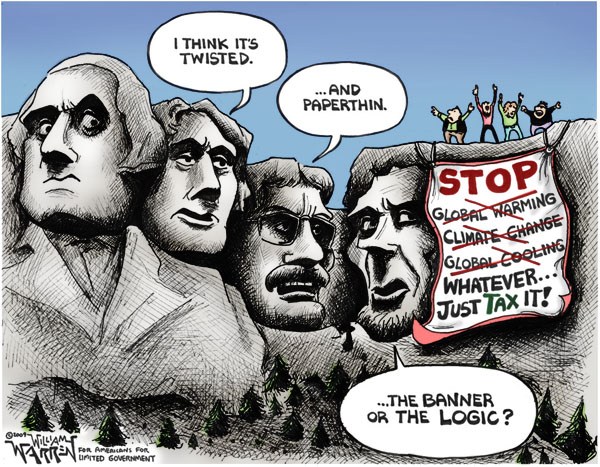
6. Greenpeace relies on mining. Busted Blonde says Greenpeace effectively needs governments like ours to allow companies like Petrobas to look for places to mine. It's a good advertising campaign.
Thing is Greenpeace is in the mining game. - Mining the hysterical and the tree lovers emotions to see if they can come up with enough guilt that they can turn into gilt.
Greeenpeace is fully of people who like swanning around on the sea on daring do holidays paid for by poor mis-informed people who thing all big companies and governments are bad.
John Key has signalled he is going to send in the Navy to ensure that Petrobas can go about their business. The Government is in a catch 22 situation. If it does nothing - it risks losing a real opportunity to map the potential resource in the area.
If it does send in the navy it risks the issue going global.
Greenpeace will be laughing all the way to the bank.
What is needed is greater education around just what Petrobas is actually doing.
Our economic future is as insecure as it has probably ever been in our history. We need to know what resources we have. We need to weigh up the opportunities and the risks rationally.We cannot afford to close our eyes to any economic possibilities.
Greenpeace's doe eyed warriors are out on the streets again, wanting people to sign up to their cause. A cause that keeps many people on a permanent holiday. They do not add to economic growth and quite frankly it is very difficult to see just how much of the planet they actually "save."
Economics blogs
7. The economic theory behind English's wage comments. Matt Nolan at TVHE presents the theory. Remember, the government did not say it would pursue a policy of lower-than-Australia wages...
He was talking about this in the context of “attracting capital”. He was saying that the labour quality was similar, the regulatory environment was similar, but because of a lack of investment wages were 30% lower.
How does this work? Well, capital increases the “marginal product” of workers, the higher the marginal product of workers the higher their wages will/can be. We know that Bill English believes that NZ hasn’t been investing enough – a point I find interesting, even if I don’t completely agree.
However, this is consistent with what he believes – he thinks investment in NZ has been too low, and that is why wages are too low. As a result, by saying “hey our workers are cheaper” he is in one sense telling people overseas that the return on capital in NZ is higher – and that they should invest here. If they invest, they will in turn push up wages helping NZ to “catch Australia” as he loves to say.
Now I don’t believe this – I think there are likely to be fundamental reasons we can’t “catchAustralia“. However, if Bill English believes that low investment has lead to lower wages, going out and telling investors about this IS consistent with their goal of catching Australia. [It is consistent with the long running productivity discussion in recent years (see here and here) - a discussion that has "morphed" into a focus on savings more recently]
I’m sure it doesn’t seem like a good statement to make in a “marketing/political” sense – but at least its honest and consistent. Surprising for a politician …

8. How the State can induce market failures. Eric Crampton is quite rightly amazed at the name suppression given to Mark Hatchin and Kerry Finnigan over the ponzi scheme they were caught up in.
I don't know about you, but I tend to expect that how somebody handles his own finances gives some information about how well he'd handle my money if I invested with him. And so I'd be spitting tacks at District Court judge James Weir were I one of the many who was burned by Hanover Finance.
Read the Herald and weep.
Mark Hotchin, director of Hanover Finance, and Kerry Finnigan, another director and CEO of Hanover, successfully were granted name suppression of that that they were among the victims of a Ponzi scheme
Simply amazing.
The state can induce market failures, when it tries hard enough.
10. And here's a lighter look at the PM. He's funny. And that's one of the reasons why people are going to vote for him. They like him.
We welcome your comments below. If you are not already registered, please register to comment
Remember we welcome robust, respectful and insightful debate. We don't welcome abusive or defamatory comments and will de-register those repeatedly making such comments. Our current comment policy is here.