

Here's my Top 10 links from around the Internet at 1 pm in association with NZ Mint.
I'll pop the extras into the comment stream. See all previous Top 10s here.
I welcome your additions in the comments below or via email to bernard.hickey@interest.co.nz.
Cracking Dilberts today.

1. The anti-(family) trust mood is growing - Rob Stock from the Sunday Star Times put some pointed questions about family trusts to the government in this exchange.
Peter Dunne tried to bat away the issue, but it's a real problem, particuarly as we try to balance a budget deficit exploding out of control.
The government's decision to abolish gift duty has brought it all to a head. Here's Rob's article from a few weeks back.
Here's Stock's view, which I agree with:
Trusts are being used for a wide range of illegitimate reasons – to avoid tax, debt repayment and family obligations. Why do we and our parliamentarians put up with it. A few months back, however, I went through the parliamentary interest register, and found 72% of MPs had a beneficial interest in one or more trusts. With so many members of parliament having interests in trusts (yourself excluded), it is perhaps hard to imagine much will change.
In that light, it is not hard to understand Mr Carmody's cynicism, and indeed, it does begin to look like some laws apply more to those who can't afford good lawyers and accountants than those who can.
And here's a Michael Coote piece on family trusts on our site from late March.

Our politicians, beginning with Roger Douglas and Richard Prebble, sold a large number of the country's strategic assets to overseas investors.
These politicians failed to realise they were establishing a domestic wealth destruction culture as wealth is mainly created through ownership rather than disposal. Bill Gates and Warren Buffet, who maintain substantial shareholdings in Microsoft and Berkshire Hathaway respectively, are good examples of this and the Australian Government also realised the importance of domestic ownership as the majority of its assets were sold to Australian investors through sharemarket floats.
Telecom was sold to overseas interests for $4.25 billion in 1990 and since then has made distributions to shareholders, in the form of dividends and capital repayments, of $14.6 billion.

4. Shifting goalposts - Brent Sheather does a nice job at NZHerald of fisking an NZX claim that shares have outperformed property in the last 20 years.
FundSource, the NZX division responsible for the research, has repeated a mistake that fund managers used to employ to make their unit trusts look good relative to a benchmark back in the 1980s.
The FundSource report suggests that over the past 20 years to June 2010 residential property has returned 5.9 per cent a year, whereas New Zealand shares have returned 7.3 per cent, NZ government bonds have returned 8.3 per cent and cash has returned 6.7 per cent.
Now this was all going along very nicely for me until I looked at the "investment computation methodology" used, which said all of the asset classes include income produced by the asset - except for residential property. So share returns included dividends and the returns for bonds and cash included interest income.
But when it came to residential property, rents were ignored, a hugely significant error, with rent minus costs likely to have averaged 2 to 3 per cent a year. Adding 2 per cent to the 5.9 per cent return on residential property gives 7.9 per cent, which is higher than the 7.3 per cent return FundSource arrived at for New Zealand shares.
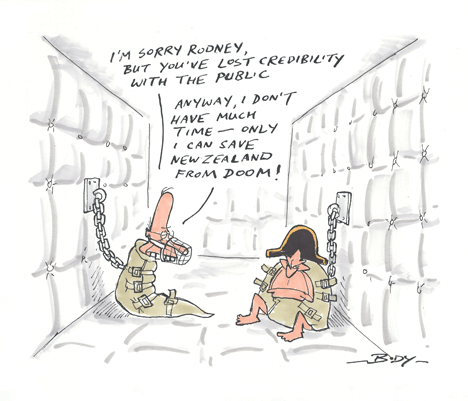
5. Questions for McDouall Stuart and the board of Allied Farmers - Tim Hunter writes at the Sunday Star Times about what went on at Allied Farmers when it pushed to buy Hanover Finance.
McDouall's firm McDouall Stuart has worked on deals for Allied several times and, according to public disclosures, from 2006 to 2009 it received $831,100 in fees for a range of services including several capital raisings.
Two weeks ago it emerged publicly for the first time that McDouall Stuart also had a pivotal role in creating the Hanover deal and received hefty fees for its efforts.
The question is – how much did the board know about McDouall Stuart's involvement?
And should more have been disclosed to investors?
6. The sheen is coming off Warren Buffett's shine fast - Reuters reported over the weekend Buffett told his big shindig annual meeting in Omaha, Nebraska he got it wrong by allowing his right hand man to do a spot of insider trading.
Buffett's performance during the crisis has been self-interested at best. He bet on Goldman knowing it would be bailed out by taxpayers.
Warren Buffett said he was wrong not to press David Sokol about purchases of Lubrizol Corp stock while his former top lieutenant was pitching the chemicals company as a possible takeover target for Berkshire Hathaway Inc.
It was the kind of answer investors had clamored to hear from Buffett at this year's Berkshire annual meeting, ordinarily a lovefest for tens of thousands of shareholders, and over which the Sokol episode had cast a cloud.
Buffett said Sokol had violated Berkshire insider trading rules by failing to disclose his January purchase of Lubrizol shares, less than four weeks after starting talks with Citigroup Inc bankers about the company.

7. Matt Taibbi and the Shadow Banking system - Matt Taibbi talks on MSNBC about the bailouts for the wives of Wall St. His Rolling Stone article was a cracker.
Here he is in person.
8. The endgame approaches - John Mauldin uses this chart to show that eventually America will suffer an 'endgame' default.
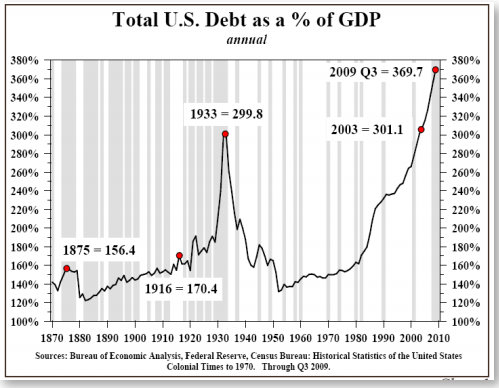
The US in particular and much of the developed world in general began a cycle of ever-increasing debt in the late ’40s, after World War II, both in the private and public sectors. Government began to grow as a percentage of overall GDP in the latter part of this cycle. In addition, politicians created large (well, huge) entitlement programs of pensions and health-care benefits that require significant taxes and, as we shall see, are unsustainable in the our present medium term. There is a limit to how much money an individual or country can borrow. We all intuitively know this. If you grow your debt faster than your income and your ability to service the debt over a long period of time, people will eventually stop loaning you money.
This is true for individuals, businesses, and nations. The end result is a restructuring of the debt (default by one of several means, including serious inflation) or a very reduced standard of living (by previous standards) for a period of time in order to service the debt. For individuals, that may mean cutting off the cable, no eating out, no vacations, etc. For countries it means reduced government programs and benefits, and higher taxes. And make no mistake. I believe that the situation in the US is becoming urgent all too quickly. We are risking the health of the economic body of the US. While the republic will survive the crisis, the shocks and burdens it will place on all of us will be very great. For those not prepared it will seem like the end of the world, as jobs and safety nets might evaporate without proper restructuring.
As I argue, the goal of fiscal sanity is to get the growth of the debt below that of the growth rate in nominal GDP. Failure to do so will result in the US suffering much as Greece or Ireland are today. Ugly .

9. Here's how the Americans write New Zealand laws - Canadian law professor Michael Geist has jumped on a bunch of wikileaks cables from US embassy officials in New Zealand that show just how deep and dirty they get in New Zealand's lawmaking process around Intellectual property.
We shouldn't be doing a Trans Pacific Partnership deal with America. Their lobbyists, and the government that does its bidding, will beat us up every time. We wouldn't get dairy access and we'd lose Pharmac.
Here's some detail.
An April 2005 cable reveals the U.S. willingness to pay over NZ$500,000 (US$386,000) to fund a recording industry enforcement initiative. The project was backed by the Recording Industry Association of New Zealand (RIANZ) and the Australasian Mechanical Copyright Owners Society (AMCOS). Performance metrics include:
"The project's performance will be judged by specific milestones, including increases in the number of enforcement operations and seizures, with percentages or numerical targets re-set annually. The unit also will be measured by the number of reports it submits to the International Federation of the Phonographic Industry (IFPI) on its contributions to IP protection and enforcement methodology."
The proposed budget included four salaried positions, legal costs for investigation and prosecution, and training programs. The RIANZ still runs an anti-piracy site, but does not include disclosure about the source of funding. It certainly raises the question of whether New Zealand is aware that local enforcement initiatives have been funded by the U.S. government

10. Totally Obama video - The president makes fun of Donald Trump's ridiculous birther campaign. The best bits are the cutaways to Trumps equally ridiculous hair in the audience. It's hard to know what's underneath the hair. Where was the hair born Donald?
We welcome your comments below. If you are not already registered, please register to comment
Remember we welcome robust, respectful and insightful debate. We don't welcome abusive or defamatory comments and will de-register those repeatedly making such comments. Our current comment policy is here.