

Here's my Top 10 links from around the Internet at 2pm in association with NZ Mint.
I'll pop the extras into the comment stream. See all previous Top 10s here.
I welcome your additions in the comments below or via email to bernard.hickey@interest.co.nz.
China knows how to grow an economy. Evidence below.

1. How China plans to dominate - David Abraham and Meredith Ludlow write at The Atlantic about how China has unveiled its five year plans to lead the world in seven important industries.
Here's an economy that actually plans its future.
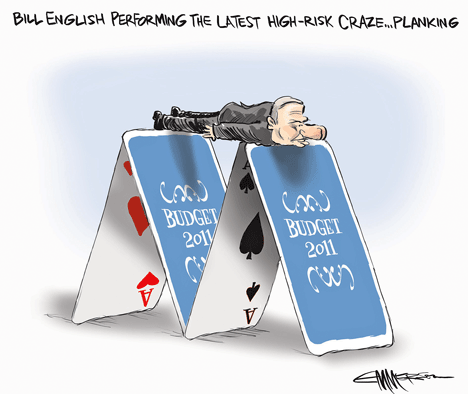
Having sat through the Budget yesterday it struck me how much of a 'kick and hope' strategy the New Zealand government has.
There is no strategy.
It is all about hoping the same old export sector will benefit from a commodity price surge.
Meanwhile the Chinese are planning to dominate the real and sustainable growth areas by choosing to invest rather than spend.
Our elite doesn't trust mercantilism. Instead it lauds financial engineering and doesn't invest in real engineering.
Here's what the Chinese are up to:
The economic blueprints focus on seven "Strategic Emerging Industries" that Beijing aims to dominate on a global level: alternative energy, biotechnology, new-generation information technology, high-end equipment manufacturing, advanced materials, alternative-fuel cars, and new energy technologies. Global firms that compete in everything from hydropower to flat panel display technology will have to account for stronger Chinese competition.
And for countries, such as Japan and Korea, with hopes of having their domestic firms lead these industries, these new Chinese plans may necessitate revamping their policies of state assistance for corporations.
To support its strategic industries, Beijing is set to provide accommodating fiscal, tax, and financial policies as well as to "reasonably guide mergers and acquisitions to increase manufacturing industry concentration," according to the published plans. This includes roughly $1.5 trillion in government spending (almost 5 percent of GDP) annually, the goal of which is to grow the strategic industries' contribution to China's growth from less than 5 percent today to 15 percent by 2020.
In other words, China plans to triple the role that these high tech industries play in its economy. By 2020, Standard Chartered estimates that China's economy will reach $25 trillion. At these levels, China intends that $3.75 trillion, or roughly the equivalent of Germany's annual GDP, will come from its seven strategic industries.
2. The festering Greek sore - FTAlphaville points out The European Central Bank has warned it will refuse to accept Greek bonds as collateral for Greek banks (or other banks) if the debt is restructured.
This just reinforces the dangers of wholesale runs on European banks, given how many are dependent on the ECB for liquidity.
These are the liquidity operations which have acted as a lifeline to Greece in recent months, with Greek bank borrowing from the European Central Bank still hovering around €87bn at the end of March.
Or as RBS’s Jacques Cailloux puts it, Stark’s warning is… :
“This is the last card in the hands of the ECB in warning about the implications of a restructuring.”
3. 'Open the taps' - The International Energy Agency has called on OPEC to urgently increase oil output to avoid 'derailing the economic recovery'.
But what if OPEC can't because they've already hit peak oil?
Here's the BBC on the IEA's call.
"The IEA Governing Board expressed serious concern that there are growing signs that the rise in oil prices since September is affecting the economic recovery" the IEA statement said.
The energy group said it stood ready to work with producers as well as non-member consumers, but it is "prepared to consider using all tools that are at the disposal of IEA member countries".

4. China now the biggest gold buyer - WSJ reports China is now buying more gold than India for the first time ever as consumers get richer and more nervous about inflation.
China's investment demand for gold more than doubled to 90.9 metric tons in the first three months of the year, outpacing India's modest rise to 85.6 tons, the World Gold Council said in its quarterly report on Thursday. China now accounts for 25% of gold investment demand, compared with India's 23%.
The report underscores the rising appetite for gold among the growing middle-class in China. Fears of the country's soaring inflation, as well as a search for new investments, is luring investors to gold, and marketing of the precious metal has also increased in recent months.
"I think people will be surprised by the strength in the Chinese demand, but we think this is a trend that is set to continue," said Eily Ong, an investment research manager at the gold council.

5. 'Just lift the ceiling' - Former IMF economist Simon Johnson says at Project Syndicate the US debt ceiling will definitely be lifted. Anything else would be unthinkable.
It is not difficult to identify who would bear what costs if the US did not pay – or if it disrupted markets by not increasing its debt ceiling. Everyone who borrows or interacts with the credit system in any way would suffer a shock that would make the crisis of 2008 look small.
Among others, the US corporate sector – big and small business – would be livid. To be sure, executives and entrepreneurs like to shake their heads over the current US fiscal deficit. And some of them engage constructively in debates about the real issues: how to control health-care costs, prevent future financial crises, and end America’s expensive foreign wars.
But these are the issues for the presidential election of 2012, in which one hopes for debates that will set a more encouraging fiscal agenda for the next 20-30 years. How and when America’s budget problems will be resolved is unknown, but US fiscal history is encouraging – the Republic has managed and survived crisis before.
Simply put, America will not score an own goal over the debt ceiling – and Boehner must know it. Symbolic gestures are to be expected, as with the threatened government shutdown earlier this year, which merely created fodder for political advertising by both parties. But any manufactured debt crisis now would deeply antagonize the corporate sector – and most of the electorate. In the wake of economic disaster, the party held responsible would presumably be exiled from power for a generation (the Great Depression kept the Republicans from the US presidency for 20 years).
6. Even Obama doesn't trust the stock market - Maybe he hasn't gotten around to his investment strategy because he's too busy running the world's most powerful country, but Barack Obama seems strangely reluctant to invest in the US stock market. He too, like so many, has his money stuck in the least risky assets.
Here's Greg Mankiw with the detail:
It looks like the president has only a small percentage (about 10 percent) of his personal financial assets invested in equities. This is far, far less than financial advisers would recommend. (If you are curious, I am at 60 percent equities.) Either the president is not very financially savvy, or he has reason to believe that the future of the U.S. economy is not very bright.
7. Britain's inflation nightmare - The FT's Martin Wolf paints a picture of the Bank of England's inflation rock and its economic hard place.
The news that the increase in the consumer price index was 4.5 per cent in the 12 months to April underlined the MPC’s failure. The compound annual rate of inflation has been 4.1 per cent over the past two years and 3 per cent over the past six. This is a dismal performance, particularly given the severity of the recession.
The economy has remained very weak, with a 0.5 per cent rise in gross domestic product in the first quarter of this year after a 0.5 per cent decline in the last quarter of 2010. GDP is still 4 per cent below its level in the first quarter of 2008. The fiscal squeeze is set to continue until the end of this parliament. Broad money has even been shrinking since early 2010. Unemployment has also been quite close to 8 per cent since the middle of 2009.
8. How Rajat Gupta came undone - This BusinessWeek piece on McKinsey Managing Partner Rajat Gupta is damaging for McKinsey.
Here's a sample.
By the time Gupta took over, however, McKinsey was under pressure from an increasingly competitive market, and under his leadership it underwent a massive change. He aggressively expanded the firm, nearly doubling its size, to 891 partners. He changed the pay structure, enriching partners relative to the younger members. He helped increase revenue 280 percent, to $3.4 billion, but in the process was accused of presiding over the watering down of McKinsey's vaunted principles.
In the '90s the firm began accepting payment from its clients in stock, which had once been regarded as tainting the impartiality of its advice. It was on Gupta's watch that Enron, a company closely tied to McKinsey, collapsed.
Some blamed Gupta for the tensions that arose during his tenure and for the fraying of the firm's standards.
McKinsey had a culture of superiority, says one longtime client, who declined to be identified, adding that consultants at the firm really seemed to think they were better than anyone else in the business world. This CEO is still shocked recalling an incident in the late 1980s, when a McKinsey team offered to provide him with a road map of what his competitors were doing. When asked how they could produce such information, he was told that McKinsey also worked with his competitors, but he could trust McKinsey to know what was confidential information and what was to be kept private. He says arrogance permeated the firm.
9. America the world's largest tax haven - Michael Hudson writes at iWatch news that America is the world's largest tax haven for corrupt money.
“We’re the biggest tax haven in the world,” says Robert Goulder, editor-in-chief of U.S.-basedTax Notes International . “People joke about the Cayman Islands. The biggest haven is an island, all right. It’s either Manhattan or Great Britain.”
Jack Blum , a former U.S. Senate investigator and an authority on offshore tax shelters, says U.S. bankers “sell tax evasion to citizens of Central America, the Caribbean, all over Latin America.” The U.S. government hasn’t put a stop to it, Blum says, because bankers and politicians don’t want to stop the flow of foreign cash into the United States.
Foreign depositors have placed an estimated $3.6 trillion with U.S. banks and securities firms, a Department of Commerce study reported. Much of the money isn’t disclosed to tax authorities in their home countries, according to Blum and other critics of U.S. tax haven practices.
The American government provides little help to Mexico and other poorer countries whose citizens have squirreled money in the United States. U.S. officials can’t tell these countries about their citizens’ bank accounts here because the government doesn’t collect the information.
10. Totally Clarke and Dawe - They do Tony Abbott on Australia's carbon tax.
We welcome your comments below. If you are not already registered, please register to comment
Remember we welcome robust, respectful and insightful debate. We don't welcome abusive or defamatory comments and will de-register those repeatedly making such comments. Our current comment policy is here.