

Here's my Top 10 links from around the Internet at midday in association with NZ Mint.
I'll pop the extras into the comment stream. See all previous Top 10s here.
I welcome your additions in the comments below or via email to bernard.hickey@interest.co.nz.
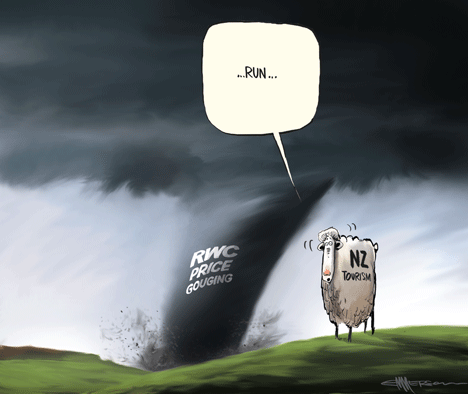
Muchos Cartoons today.

1. The Russians are coming - The Australian reports Russia's central bank has announced plans to invest US$5 billion in Australian dollar assets to help diversify its foreign reserves away from the US dollar.
Sound familiar?
The Chinese are doing this too, but seem keener on little old New Zealand.
This is what happens when the US Federal Reserve tries to print its way out from under its debt mountain and undermines the value of the world's reserve currency in the process.
It destabilises the global system of capital and currency movements.
And we pay for it with fall in the competitiveness of our exports.
The hypocrisy of the Americans is stunning. They complain about China's mercantilist approach to global trade and then procede to try to print their way to freedom.
None of this will end well.
Meanwhile, our currency remains above 81 USc despite us being in recession for more than 3 years... Does anyone (apart from John Key) really trust these high commodity prices.
A top economic aide to President Dmitry Medvedev, Arkady Dvorkovich, said Russia would continue to lower its US debt holdings. Its stock of US Treasuries has already gone down from $US176bn last October to $US125bn in April.
The comments by Russian officials come as Australian economists report increasing interest in the Australian currency by other central banks and sovereign wealth funds, amid uncertainty about the economic outlook in the US and Europe.
Increasing foreign interest has powered the Australian dollar's rise from parity with the US dollar earlier this year to around $US1.06 today.

2. Quarter acre paradise? - The Australian reports a new survey has found Australians still want to live in a stand alone house near the centre of Sydney or Melbourne.
But when pushed to decide on where they'd prefer to live given the outrageous cost of such housing, they often opt for apartments on the fringes, simply because of the cost.
It surprises those who always argue for sprawling suburbs. Maybe we actually want apartments on the fringes?
The study finds a 400,000-plus shortage of semi-detached homes and apartments in the middle suburbs and on the fringes of Sydney and a shortage of 200,000-plus for Melbourne, compared with the overall level of interest in living in them.
Yet the construction industry, hamstrung by government and local authority restrictions, isn't catering for these real-world choices, the paper finds.
"Construction of new dwellings in the last 10 years has not reduced the gap between the housing people say they want and the housing we have," it says.
"In Sydney, the volume of construction has contracted sharply. In Melbourne, detached homes in outer and fringe areas have predominated, a construction pattern that moves us further away from the city structure residents say they want."

3. Just Google tax haven - Stuff reports Google paid just NZ$230,000 of tax in New Zealand last year despite taking in well over NZ$150 million in revenues. I reckon Google's NZ revenues are actually closer to NZ$200 million.
When is the government going to crack down on Google's use of an Irish tax haven? It also doesn't pay GST.
This raises questions about the shift of many services into the 'cloud'. Where is it taxed? Is this a whole new part of the economy (accounting, legal services, advertising, media) that is about to be internationalised and taken out of the non-tradeable economy?
Google's income tax expense for 2009 before the extra payment was $40,000, but that falls to $7726 once a deferred tax deduction for the year is factored in. The subsidiary has total deferred tax assets, which can be used to offset future tax bills, of $103,801.
Google's commission model was criticised last year, after Bloomberg reported it was paying a tax rate of just 2.4 per cent on billions of dollars of profits earned outside the United States.
Inland Revenue hinted it might take action, saying its "general anti-avoidance provision" could apply to "treaty shopping situations, where transactions were merely routed through a particular jurisdiction by way of a conduit entity and lack commercial substance".

4. Debt limit hike? - Republicans have begun talking about a temporary (!?) hike in the US debt ceiling, Reuters reports.
Who are these guys kidding? A massive can-kicking exercise.
Congress and the White House could raise the debt limit for a few months while they seek a comprehensive, long-term budget deal, Senate Republican leader Mitch McConnell said on Sunday.
The Obama administration has warned it will run out of money to pay the nation's bills if Congress does not raise the $14.3 trillion debt limit by August 2 -- a prospect that could push the country back into recession and upend global financial markets.

5. That ghastly US$2 trillion problem - Bloomberg reports on the scale of the losses possible if Greece was to default.
While European lenders reduced their risk tied to Greece by 30 percent to $136.3 billion last year by not renewing loans, writing down the value of debt and shifting it off their books, they still have almost $2 trillion linked to Portugal, Ireland, Spain and Italy, figures from the Bank for International Settlements show, leaving them vulnerable if the crisis spreads.
“The Greek debt situation certainly has the potential to create havoc with the European banking system,” said Neil Phillips, a fund managerat BlueBay Asset Management Plc in London, which oversees about $45 billion. “A Greek default and the ramifications of that would be too ghastly for Europe and the European banking system to contemplate right now.”

6. It's not working yet - China's attempts to cool down the red-hot apartment development markets in Beijing and Shanhai isn't working yet, although it is slowing down existing home sales.
Bloomberg reports prices rose in 67 of 70 cities, although existing home prices fell in 23 of those 70 cities.
“Government measures work better in the existing home market because the strict home purchase restrictions effectively restrain some purchasing power,” Jeffrey Gao, a Shanghai-based property analyst at Royal Bank of Scotland Plc, said in a phone interview. “Developers on the other hand are not in a rush to cut home prices as they watch the direction of government policies.”
The slowing home price growth in the market for existing homes may force more property agencies out of business, said Gao. Midland Realty Ltd. said it will close all of its branches that broker existing homes sales and rentals in Shanghai, because the company “isn’t optimistic” about the market in the city, China Business News reported on May 9, citing Ding Wei, a company official.

7. 'Up in flames' - The Guardian's Aditya Chakrabortty reports from on the ground in Athens with the mood of the people. It's ugly. It is today's must-read, if just for the colour and flavour of how real Greek people feel.
Tassos doesn't just support the protesters of Syntagma; he thinks they will go further. "Don't be surprised if Athens goes up in flames," the 50-year old says. "And don't be sad, either." His words initially sound melodramatic, but the anger keeps coming up.
"Politicians now walk around with bodyguards," says Aris Chatzistefanou, the co-director of Debtocracy, a film about the Greek crisis that has become a sensation.
He quotes a newspaper report of how restaurateurs are taking down those cheesy framed photos of dining politicians, of how one government spokesman went to dinner a few weeks ago only for the rest of the restaurant to start shouting "You are eating the blood of the people".

8. Fast Helicopters - I'm a bit of a boy when it comes to planes and copters. There's a new breed of fast helicopters about to debut at the Paris air show.
Here's the Wall St Journal video with the two best looking ones.
9. Not good value for money - Gretchen Morgenson at the NYTimes points to a study of executive pay at the S&P 500 showing these companies paid 2,591 executives US$14.3 billion in 2010, up 13.9% from a year ago. Meanwhile, the study found that shareholder value at 179 of these firms fell from 2008 to 2010.
That’s some pile of pay, right? But Mr. Ciesielski puts it into perspective by noting that the total is almost equal to the gross domestic product of Tajikistan, which has a population of more than 7 million.
Warming to his subject, Mr. Ciesielski also determined that 158 companies paid more in cash compensation to their top guys and gals last year than they paid in audit fees to their accounting firms. Thirty-two companies paid their top executives more in 2010 than they paid in cash income taxes.

10. Totally appropriate video - One of my favourites from REM. It's the end of the world as we know, and I feel fine...HT Gareth
We welcome your comments below. If you are not already registered, please register to comment
Remember we welcome robust, respectful and insightful debate. We don't welcome abusive or defamatory comments and will de-register those repeatedly making such comments. Our current comment policy is here.