

Here's my Top 10 links from around the Internet at 3 pm in association with NZ Mint.
I welcome your additions in the comments below or via email to bernard.hickey@interest.co.nz.
I'll pop the extras into the comment stream. See all previous Top 10s here.
And we have yet to see tonight's US jobs figures...buckle up...

1. 'ECB must step up to rescue Europe' - The dramas of the last couple of days in European financial markets have a few pundits reaching for the superlatives.
Citigroup Chief Economist Willem Buiter tells Ambrose Evans Pritchard at the Telegraph that unless the European Central Bank (ECB) acts decisively to buy Italian and Spanish bonds then Europe risks sinking into another Great Depression.
Yikes.
The big problem is the Eurozone doesn't have a common fiscal policy to go with its common monetary policy and it doesn't have the ability for governments to direct the central bank to help them fix their messes.
Problems with debt issued by different countries can only be dealt with by a central bank run by one government. The ECB isn't run by one government.
Here's Buiter laying the problem bare:. This is today's must read. Although he is (as a bank economist) essentially asking for the ECB and governments to bail out some large banks...
Mr Buiter said Europe risks a disastrous chain of events and the worst financial collapse since the onset of the Great Depression unless Europe's central bank steps in with sufficient muscle to back-stop the system.
"The ECB has yet so show it understands that it is the only institution that can save Italy and Spain from fundamentally unwarranted defaults. Everybody is afraid and real money investors are dumping their holdings. The ECB must step in to cap the yields at 6pc or 6.5pc and put a floor under the market," he said.
"As long as the ECB stays on the sidelines, a speculative, fear-driven withdrawal of market funding can feed a self-fulfilling insolvency. Any number of banks and insurance companies would take huge hits. The ECB will have to come in, or accept the biggest banking crisis since 1931," Mr Buiter said.
He said the "fundamental design flaw" in economic and monetary union is the lack of a lender of last resort.

2. 'Snatching defeat from the jaws of victory' - FTAlphaville points out another criticism of the ECB by Brown Brothers Harriman, just to give you a flavour.
The Governing Council’s discretionary decision to exclude Italy and Spain from the ECB’s SMP, at least at this point, leaves the EU’s safety net woefully inadequate against the growing market contagion. The ECB has, as they say, snatched defeat from the jaws of victory.
This will have two-fold implications, both bearish for the euro. First, from the EU’s perspective, the ECB’s protection of its own capital leaves the EFSF as the only “lender of last resort” to governments. Yet, the EFSF, currently with a ceiling of €250bn, has neither the capacity nor the flexibility to enact market stabilisation measures scalable to Italy and Spain – the political agreement of the July 21 EU emergency summit has yet to be ratified by national governments and parliaments and implemented. At a time when the markets remain focused on systemic risks rather than rates, this leaves Spanish and Italian government bonds, and the euro, widely exposed to market speculative pressures.
The second implication is the global one. The ECB has as anticipated joined the international circuit of central banks fighting market dislocations along the extremes of the global crisis, from the strongest links of the G10 (JPY, CHF) to the weakest one (the euro zone periphery). Yet, the ECB’s response has proven woefully inadequate to complete the turn of market momentum attempted by the SNB and the BoJ. A crisis defence is only as strong as its weakest link
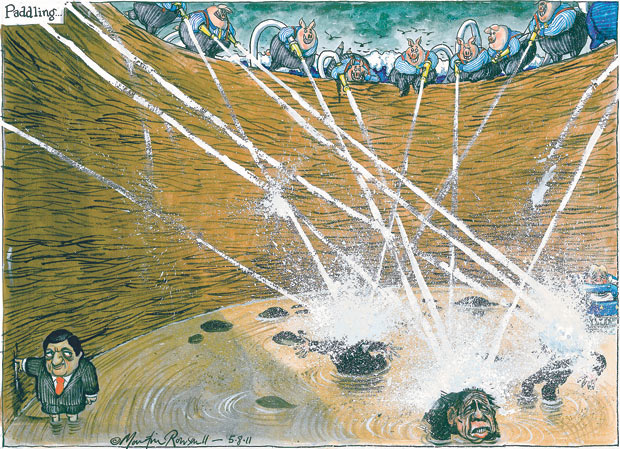
3. 'Italian bank run' - CNBC's Larry Kudlow says the Euro slumped vs the Swiss Franc this morning because there was a silent run going on in Italy's banking system...
Here's Tyler citing Kudlow at Zero:
"Sources tell me Italy has to restructure bonds.Deposit run on Italian banks.EU will have to mount Tarp rescue.Big stress on interbank loans." Basically, this is the worst possible combination for Europe which means that another bailout is not only imminent but has to happen tomorrow.
Incidentally Reuters is reporting of an emergency meeting between Sarkozy and Merkel and Zapatero on "the markets" which can only mean damage control following today's disastrous Trichet performance.
4. 'God I'm so wasted' - The Onion has some fun imagining US Federal Reserve Chairman Ben Bernanke getting a little sloshed at his local bar...

Bernanke, who sources confirmed was "totally sloshed," arrived at the drinking establishment at approximately 5:30 p.m., ensconced himself upon a bar stool, and consumed several bottles of Miller High Life and a half-dozen shots of whiskey while loudly proclaiming to any patron who would listen that the economic outlook was "pretty goddamned awful if you want the God's honest truth."
"Look, they don't want anyone except for the Washington, D.C. bigwigs to know how bad shit really is," said Bernanke, slurring his words as he spoke. "Mounting debt exacerbated—and not relieved—by unchecked consumption, spiraling interest rates, and the grim realities of an inevitable worldwide energy crisis are projected to leave our entire economy in the shitter for, like, a generation, man, I'm telling you."
After launching into an extended 45-minute diatribe about shortsighted moves by "those bastards in Congress" that could potentially exacerbate the nation's already deeply troublesome budget imbalance, the Federal Reserve chairman reportedly bought a round of tequila shots for two customers he had just met who were seated on either side of him, announcing, "I love these guys."

5. Why it didn't work - Peter Allen, Barry Eichengreen and Gary Evans do a great job at Bloomberg of explaining why the markets don't believe the second Greek rescue deal will work.
This is a precursor to why markets are so disillusioned with the official responses to the European debt crisis.
The debt-reduction deal failed because it didn’t reduce the debt. Instead, Greece gets a reduction in interest rates and a lengthening of maturities on its loan from the European Financial Stability Facility. But that loan also has been supersized, and the country has to pay back the additional official debt. The government in Athens also gets a 20 billion-euro ($28.7 billion) bond-buyback program funded by the EFSF. But again, the country will have to repay the money used to finance the buybacks, plus 3.5 percent interest.
Obviously, this is a raw deal for Greece. It also is a bad deal for the euro area, whose leaders again failed to contain the crisis. And it is a bad deal for the European taxpayer, who will shoulder all the sacrifices, while the banks make none.
How could things have gone so wrong?
One answer is that none of the participants involved -- the EU, the French and German leaders, the Institute of International Finance -- knew what they were doing. A 21 percent reduction in net present value sounds impressive, but it has no bearing on the amount by which the exchange will reduce Greece’s debt. No one appreciated that 30-year zero-coupon bonds are much more expensive in today’s low-interest-rate environment than they were 20 years ago, in the days of the Brady Plan. No one understood that the debt exchange effectively increased Greece’s annual interest payments once the cost on the debt to purchase the principal collateral was taken into account.

6. Ya don't say - Even the US Treasury acknowledges in this Bloomberg story that the US dollar is losing its reserve currency status.
The Treasury Borrowing Advisory Committee, which includesrepresentatives from firms ranging from Goldman Sachs Group Inc. to Pacific Investment Management Co., said the outperformance of haven currencies and those from emerging nations has aided in the debasement of the dollar’s reserve status, according to comments included in discussion charts presented ahead of the quarterly refunding. The Treasury published the documents today.
“The idea of a reserve currency is that it is built on strength, not typically that it is ‘best among poor choices’,” page 35 of the presentation made by one committee member said. “The fact that there are not currently viable alternatives to the U.S. dollar is a hollow victory and perhaps portends a deteriorating fate.”

7. 'American banks cutting loans to Europe' - Institutional Risk Analyst's Chris Whalen tells CNBC that US regulators are forcing US banks to cut lending to European banks.
"I have been speaking to risk managers at the big European banks telling me that US regulators are forcing American lenders to cut counterparty loans."

8. The Fed doesn't have room to move - Former Fed economist Vincent Reinhart says the Fed doesn't have room for QE III here at Bloomberg.

9. Totally a rap video about the debt ceiling - This debate really did seep throughout American culture.
10. Totally Clarke and Dawe - Talk about the debt ceiling debate and why they run a current affairs programme with no script...
43 Comments
FYI Bernard - Critics of the Dodd Frank agreement say regulation is strangling competition and making the problem with ratings agencies worse. Here's Jim Gellert from Rapid Ratings (a credit rating company) with his views:
http://video.foxbusiness.com/v/1084813298001/oversight-of-the-credit-ra…
1) 1.5% is the end of the rises?
So much for 8% floating then.
"The ECB increased liquidity for banks, offering unlimited funds for six months to prevent the money markets freezing up. The bank also left interest rates unchanged at 1.5pc and signalled an end to its rate-rise cycle."
Wow, I will be looking at the markets in the morning....
:/
http://www.youtube.com/watch?v=J4FtDkFgSa4
regards
I'm staying with no QE3......excercises in futility....as Bernake/Geithner proclaim Bollard a genius...The policy of "Do nothing, wait n see, do nothing some more" is now in force.
Unilateral ground zero becomes Multilateral.....either game on ...or end game.
End game....the suggestion is if the ECB doesnt step in and big time overnight Italy is going down.....I dont think they have days certianly not weeks to think about it. So overnight if we dont see many billions thrown at it....
regards
John Key is the "kiss of death". See what happens when he goes over and has a whisper in Bernanke's ear and tells him how it's done. Unfortunately Bernanke and Geithner didn't know what "no 8 fencing wire" was. They thought he said he does it 8 times higher.
.... is it possible to kill someone when you kiss their arse ? ..... if anyone could , Jolly Kid is the one to do it ........
Looking even through a clean window - the black raven just doesn’t go away.
Hey Walter....what did you say to Gummy....is he staying at your place...?
Yes - and since I have eaten him – I’m a capitalistic swine - but he was crunchy and Tai spicy. I miss him in a way. I'm wonder what's David B. and Big Daddy Olly's son are alike.
I've decided it's time to flush GBH out....
I know he's round here somewhere, I just don't know where...
Manilow's grunge rock sound is a tadge too much heavy-metal for the Gummster .... but thanks for the thought .......
..... now Mantovani , he was an excitement machine ......... yeah , baby !
[ ..... " Supplies " Mr Clistov , I roved the Fliday joke .... ]
Great to see you back Gummy. We missed you.
cheers
Bernard
Thanks for that , big guy .
....... I needed a break to chill out ...... that capital gains tax debate last month caused my gummy brain to melt-down . Had to get away for a spell in my swamp .
Still boggled by the choice of Labour to run with a seriously complicated tax , which raises very little revenues initially ...... rather than attempt a land-tax , which is simple to implement , readily transparent , and immediately brings in the dosh .
Great to see your up and about again GBH....I'll be in and out a bit as things are quite dire for me at the mo.....
But y'know it's the ol "smile though looking shakey"...."smile even when your faking"
stay well, talk soon..!
I gotta say you were sorely missed by Bernard and a number of us ......didn't find the welcome matt myself........sob.....felt as popular as my wifes last anniversay present ...I got her an Anal Intruder 3000....could be I'm just missing the mark a little.
Would you feel better , Count , if you knew that as I sat in my newly acquired swamp .... surrounded by cane-toads , ... I thought of you , Walter , and Bernard !
........ ahhhhh , and they say that Gummy has no heart .......... tch tch !!!
Hey , I also got a little Honda TMX 155 to tootle around on ..... the toughest bit is remembering to ride on the right-hand side of the road .
Got another load of coconut seedlings to plant ....... it's all go go go during the monsoon season . See yer soon , mon !
Yeah - Italian male are lazy – they don’t have balls – a working moral – but their donkey’s have.
http://www.youtube.com/watch?v=ZAFiXA_jTVI
..exchange them for a little bit of power and colour
http://www.youtube.com/watch?v=_dntfod-Cbo&feature=related
..and they are very, very airy with their wife’s
http://www.youtube.com/watch?v=s2ww9C_rNEo&feature=related
....just useless like Bernasconi - their chief
Clarke n Dawe good fun as usual....Ta
To all those (many apparently absent today) who thought I was wrong about growth
I apologise.
You can indeed have exponential growth, in at least one thing.
I'd forgotten panic.
LOL
Ah yes, actually we missed two things, greed which we have watched, no matter the size of the income and bonuses, its more, more more.....but now its the turn of the other, quite right PDK...
Missing, maybe they busy are screaming at their brokers? the PI trolls of course take months to unload, if its actually happening, which since its Italy and at 7% odd for bonds, seems very probable from what the predictions were. I wonder if Paul Krugman who keeps commenting on the "invisable bond vigilaties is noting how fast they strike when they do.....
Me, I looked at my ex-shares today while the NZX showed all red (for hours), and grinned, seems my timing was good/lucky....15%+ down since I sold last year....
regards
I wonder if the US will 'adjust' the jobs data in light of these recent developments...
YES
yeah see the revision a lot later...still can play the market on that one...wealth is all relative.
Double post
If you look at WTI, its been dropping for week+....jobs I think wont look hot.....but there is no real pani.....yet. If the ECB does nothing overnight though.....
regards
The thing that most don't realise is if this is the likely looking start of the crash many have seen coming, that its effects will be massive.
This isn't just another economic cycle of the industrialised world, this is the end of the industrialised era.
In the shares I look at not one is green....all red, all my pages.......British banks are being hammered, down 9 to 11%......US banks 5 to 6%, I wonder what I will wake up to...OZ banks down 4%
cripes.....
regards
Scarfie you are on the right track for sure. One just has to see what is happening internally in the USA to realise that there has been a transition prepared for.
I have to agree with you..but i think that September of this year will be remembered, as historical.I have to smile at the Spin.."Is this the start of another recession?" cripes we were still going downhill from the effects of the last crash. We are in uncharted territory.I think its called "Normalcy bias" Its when things have changed so radicaly that it will take a while for the new reality to sink in and adjustments to be made.
Royal bank of scotland has dropped 12% and its still going down
regards
Ye Ha - USA added 117K jobs in July, more than expected.
We can all relax now. Footsie has risen 30 points immediately and DJ Futures 77 points.
Unemployment fell to 9.1% from 9.2%. Makes our 6.5% look good.
How many of the 117ooo jobs are burger flipping and party work pre the pres elections?
and what will the number be revised down to...and where did the extra million going onto foodstamp existence come from...and how soon before the debt ceiling needs to be jacked up again...and and and...
...and waht about New Zeeland ? Our contry is full of inskilled youngsters, filing up warehouse selves, while our goverment imports infrastrkture needs in the billions manufaktured from highly skinned Koreans/ Chineses - it just doens't make sense. The general NZ workforce remains low paid and unskinned and we can not pay taxes tommorrow therefore, for all we need consuming - because the goverment is so stupid - even when Paulina Bennett creates 5 more jobs from beneficanaries and other unemplyoed - we are poorer then busy Chinese milking cheap fonterra cows and making trains for us - now. We shut do waht we do best, drink, rugby and selling more houses to each other and do it up - at least the gardens and main entrances doors and sell it expensive to the rich immigrants from overseas to finaly get richer - some at least - some of the rich ones in Wellington/ Auckland - olllllies olllas.
The banks are getting desperate. Just received a letter from mine (ANZ) explaining that they will be reducing my mortgage repayments to reflect the original term/end date of the agreement. I have been paying it down at a much higher rate thanks to the current low interest rates.
They are saying that this is 'cause they are moving to a "new technology system" - apparently so wonderful it can't cope with a customer making anything other than the minimum repayment.
What complete and utter bullshit! The real reason is their loan book is flat/shrinking and they're geared for it to be going up at double digit rates. The peasants are paying off their debt. Can't be having that now can we.
Scum!
Just checked on the latest data from the reserve bank, confirms credit growth is flat (households +1.1%y/y) to negative (consumer debt -1.0% & agriculture -0.4%y/y)
The banks are desperately trying to keep their ponzi scheme from imploding.
US credit rating downgraded by S&P
http://online.wsj.com/article/BT-CO-20110805-718118.html
By Min Zeng and Stephen L. Bernard Of DOW JONES NEWSWIRES
NEW YORK (Dow Jones)--Standard & Poor's took the unprecedented step of downgrading the U.S. government's "AAA" sovereign credit rating Friday in a move that could send shock waves through global financial markets and potentially undermine world economic growth.
In a press release, S&P, cut its top-notch long-term credit rating for the U.S. Treasury's debt to AA+ with a negative outlook. It is the first time in modern history that one of the three main ratings firms has stripped the U.S. of its coveted AAA rating.
S&P warned last month that if the U.S. government didn't approve a credible medium-term plan to shrink its fiscal shortfall, it would downgrade the rating even if Congress approved a debt deal that raised the Treasury's borrowing limit. On Tuesday, just in time for a deadline to avoid default, U.S. lawmakers passed a bill increasing the U.S. debt ceiling by $2.1 trillion. However, the amount of planned quid-pro-quo deficit cuts ran to $2.4 trillion, well short of the $4 trillion that S&P had suggested was needed to put the nation's fiscal house in order.
Some market participants have warned that the tepid pace of economic recovery means that even deeper fiscal cuts may be needed to reduce the share of public debt to U.S. gross domestic product, a closely watched gauge of a nation's fiscal health.
The two other main ratings companies, Fitch Ratings and Moody's Investors Service, both affirmed their top-notch ratings of the U.S. during the week, although Moody's assigned a negative outlook to its "Aaa" rating. Given that it made the most aggressive warning before the debt deal, S&P's announcement then became a closely anticipated event.
While many have expected it, the downgrade by S&P could generate anxiety in the global financial markets, which were roiled this week by heightened fears about the global economy and the euro zone's debt problems.
The news could spark selling in U.S. stocks and the dollar on Monday but, paradoxically, the Treasury market could see two-way flows. Some investors may be forced to sell Treasurys as they are required to hold only AAA-rated assets, but the selloff in risky assets might also push buyers back to U.S. government bonds, which function as a global safe haven in times of market turmoil. Few markets match the depth and liquidity of the Treasury market, which has $9.3 trillion in debt outstanding.
For investors, a key concern would be the ripple effect on global markets. Treasury yields have long been used as the benchmark for a variety of interest rates from consumer loans to corporate finances. So if the downgrade raises the U.S. government's borrowing costs, the same could happen to other markets as investors dump riskier assets.
In addition, Treasury securities are widely used as collateral for banks, dealers and hedge funds to borrow short-term loans in the repurchase-agreement markets, or repos.
One concern is that Treasury bonds might no longer be considered top-quality collateral in repos, thereby choking a primary channel of short-term funding for banks. That in turn could push investors such as U.S. money funds to cut lending to banks, stifling liquidity and pushing up the cost of funding.
Repos, which grew to become the so-called "shadow banking system," are often described as the oil that lubricates the economy. Higher borrowing costs would thus have a broad impact, hurting everything from consumer borrowing to corporate finance.
There are about $3.94 trillion in Treasurys used as collateral for repos, according to data from J.P. Morgan. Another report from Bank of America Merrill Lynch says that roughly 74% of primary dealer repo financing--about $2.1 trillion--involves Treasury collateral.
" The thing that is perversely both meaningless and full of meaning was announced on Friday evening New York time. The United States of America is now rated AA+ with negative outlook by Standard & Poor’s.....The US is still, of course, rated AAA by Fitch and Moody’s.... It’s the linkages and the contagion (the horror! the horror!) that matter." FT, London
We welcome your comments below. If you are not already registered, please register to comment
Remember we welcome robust, respectful and insightful debate. We don't welcome abusive or defamatory comments and will de-register those repeatedly making such comments. Our current comment policy is here.