

Here's my Top 10 links from around the Internet at 8 pm in association with NZ Mint.
I welcome your additions in the comments below or via email to bernard.hickey@interest.co.nz.
I'll pop the extras into the comment stream.See all previous Top 10s here.
Sorry I'm so late today. We had a couple of sovereign credit rating downgrades. Haven't had one for 13 years. Major spanner in the government's works. Go the All Blacks (but not so hard that anyone gets injured and after all it's the Canadians so actually you don't need to go that hard...please, please don't let Dan or Richie hurt themsleves...)

1. The problems in China - Mish at Global Economic Analysis points to an email from a reader in China (backed by links to local news sites in Chinese) saying that private business owners are now disappearing or jumping off buildings because they can't pay the very high interest rates being demanded by 'trusts' and other loan sharks.
This all follows the government ordered crackdown on lending from state banks to slow the economy and inflation.
So property developers and private business owners moved to the loan sharks and trusts (finance companies) to borrow more to pay the interest on the other loans...
Sound familiar?
These loans pay monthly interest rates of up to 10%.
It all appears to be unravelling in tragic fashion inside the more speculative and entrepreneurial parts of China.
Here's the reportage via Mish:
Since April this year 29 private business owners have disappeared, all of them had over 100 million RMB businesses. 11 of the 29 owned shoe manufacturing businesses.
An analyst from China Investment (China's Sovereign investment fund) pointed out that it's because they are squeezed by a rapid increase of component and labor costs. A rising RMB is also a reason why many export oriented companies are hit. In August, Zhou Dewen, President of Wenzhou Small-Medium Business Development Association said the profit margin of Small-Medium businesses in Wenzhou has dropped to under 5% and absent of policy changes, 40% of businesses in Wenzhou will go out of business by next Spring Festival (late Jan 2012)"Grey Finance" Brewing the Chinese Crisis) states that most of those owners have borrowed "private" loans (typically 70% of all loans), with MONTHLY interest rate ranging from 3% to 10%.
About 89% of families/individuals and 59% of companies in Wenzhou participated in such "private loan" schemes. In Erdos (the ghost city you blogged many times), such "private loans" are more than 200 billion RMB with annual interest rate over 60%. Now they are crashing, causing rampant unfinished real estate projects in Erdos.
2. Speaking of Ghost Cities - Here's the ghost cities documentary from Adrian Brown SBS Dateline. I may have pointed to this before, but it's well worth watching. It's from April.
3. More on the runaway bosses - Reuters also reports on the problems of Chinese entrepreneurs going into hiding or worse after using loan sharks.
Many cash-strapped firms are unable to borrow from banks amid a credit clampdown by Beijing, and some have turned to China's underground lending market - which pools money from individuals and firms - at annual interest rates as high as 100 per cent.
The staggering rates, at more than 15 times China's benchmark lending rates, have pushed some firms to the limit.
In just one day last week, Chinese media reported that nine bosses of small-sized firms in China's entrepreneurial capital of Wenzhou, in eastern Zhejiang province, had skipped town after realising they could not repay their corporate loans. 'The private lending craze has fuelled an economic bubble, and the 'runaway episode' in Wenzhou is a landmark event in the bursting of such a bubble,' the official Financial News, a paper run by China's central bank, said in a report on Wednesday.
This detail about how the informal lending sector works is fascinating. This is what happens when you suppress deposit rates in conventional banks.
An investment consultant in Beijing, who only gave his surname, Bai, told Reuters that he remits his salary back to the northern Chinese province of Hebei each month for his mother to lend to businesses.
'The money that I lent at the start of the year had annual interest rates of 10 per cent. Now rates have risen to 50 per cent,' he said. 'My 100,000 yuan of savings has grown to nearly 150,000 yuan.'
But firms cannot afford such sky-high rates, said Zhou Dewen, head of the association for small- and medium-seized enterprises in Wenzhou. Many earn profit margins of between 3-5 per cent, so loan defaults may spike if rates do not ease next year. Even Mr Bai is worried for his borrowers.
'My neighbours at home are lending at annual rates of 150 per cent,' he said. 'Which industry can enjoy such high profit margins? It's not like they are trafficking drugs.'

4. Lower growth for longer - Here's what PIMCO, the world's biggest bond fund, sees for the world over the next few years.
- Over the next 12 to 18 months, we expect the global economy to expand at a very modest real rate of 1% to 1.5%
- Global imbalances have continued to rise in the post financial crisis environment, global leaders continue to fail in their policy coordination efforts, and deleveraging and reregulation continue to be critical over the course of our cyclical horizon.
- We are transitioning into a world where we believe the incentives of policymakers and the divisiveness of politics will become the predominant drivers of investment returns and economics.
5. 'Those European idiots' - Renowned eurosceptic Peter Oborne repeatedly describes a EU spokesman as an idiot through this otherwise quite interesting BBC Newsnight panel discussion below.
I like it when Jeremy Paxman turns to the spokesman and says: "So Mr Idiot would you like to respond?"
Then the idiot walks out. After being called an idiot several more times.
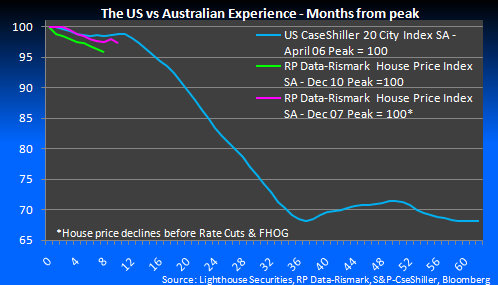
6. Australian house prices falling fast - Macrobusiness.com.au points out that Australian house prices are currently falling faster than they did in 2008 and faster than they did in America's housing market early in the housing recession there.
Australia's house price dip in 2008 was only temporary becuase the government intervened to guarantee its banks, slash interest rates and offered a first home buyer's subsidy to ensure the economy didn't tank. It's not doing the same thing this time around.
I'm not so sure Australia will see the same slump we've seen in America because Australia doesn't allow 'jingle mail' where the home owners can walk away from the debt and Australia's banks didn't outsource their credit decisions to dodgy middlemen. But still, Australia's house prices are vastly over-valued relative to incomes. Supply is also tight in some places, but not everywhere. The Melbourne apartment market and the Gold Coast apartment market is flooded.
Here's Macrobusiness:
As you can see from the chart below the current pace of house price declines in faster than that experienced in Australia during the 2008 slide, while US prices declines were even more tempered through the first 12 months, before the tsunami of selling began once people realized the Ponzi scheme of buying and flipping was done.
It seems that the fall in the appetite for, and price of, credit has been responsible for the slow melt in prices to date. Should prices fail to recover, it is likely that the selling pressure will intensify as investors can no longer justify holding on to properties that are falling in value and, with an unequivocal connection between falling house prices ad rising unemployment, we are unlikely to have seen any forced selling yet either
7. A good European summary - The Economist has an excellent summary of the bureaucratic machinery behind the eurozone and concludes thus:
European leaders such as Mr Barroso may well feel “wounded” by the patronising lectures of outsiders. But unless the euro zone’s countries listen to good advice, and quickly act on it, they will face not just humiliation but economic catastrophe.

8. Some great pictures on the Euro crisis - Thanks to Foreign Policy for the gallery. Click on the picture to go through to the gallery.

9. It wasn't just Japan - The shorthand used when talking about long periods of economic stagnation is Japan since the early 1990s.
But there are other countries and other periods of stagnation, including New Zealand from 1921 to 1927, according FTAlphaville's pickup of a Goldman note.

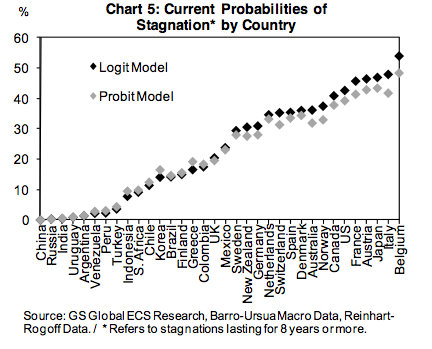
Also the Goldman note includes a chart showing the likely probabilities of stagnation for various nations.
Interestingly, New Zealand has a probability of about 30% of going into a stagnation, which is higher than Greece (!), South Africa and obviously China (on 0%), but also surprisingly below Australia, Canada and Denmark.
Belgium looks like it is toast, as does Italy, which is much more problematic for everybody because it has so much debt, much of it held by German banks...
10. Totally Clarke and Dawe on Wayne Swan's award for being the best Finance Minister in the world.
His groin muscles and hammies are fine.

We welcome your comments below. If you are not already registered, please register to comment
Remember we welcome robust, respectful and insightful debate. We don't welcome abusive or defamatory comments and will de-register those repeatedly making such comments. Our current comment policy is here.