

Here's my Top 10 links from around the Internet at 1 pm in association with NZ Mint.
I welcome your additions in the comments below or via email tobernard.hickey@interest.co.nz.
I'll pop the extras into the comment stream. See all previous Top 10s here.
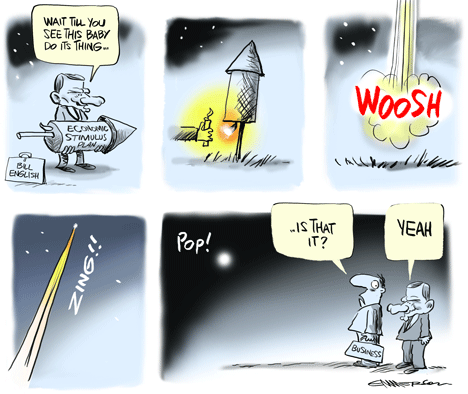
The cartoon above #8 is not very respectful of Silvo Berlusconi...no more bunga bunga for me...

1. 'Cut off my finger instead' - Bloomberg has some excellent on-the-ground reporting on the debt problems with loan sharks in the key Chinese city of Wenzhou.
Everyone is looking at Europe right now, but the problems in China are at least as important for us.
The government in China has been cracking down on government owned bank lending over the last 18 months to try to slow down inflation.
In the process many people who had directly or indirectly relied on that lending were forced into the arms of private networks of lenders and loan sharks.
Now as what increasingly looks like collections of Ponzi schemes blow up, all sorts of ugliness is ensuing.
We've already heard of indebted small busines owners jumping off buildings and 'disappearing'.
Now they're offering up their fingers.
Bloomberg reports on the travails of Zhong Maojin, who built up a chain of pharmacies in Wenzhou through borrowing from friends, family and a whole lotta loan sharks.
Hours after a creditor and his gang of tattooed thugs hustled Zhong Maojin into a coffee shop in Wenzhou, he says he wouldn’t yield to their demands.
They wanted to take over one of the pharmacies in a chain he’d built by borrowing from private lenders. Instead, he made an offer of traditional retribution in this eastern Chinese city, known for loan sharks who have sometimes meted out violence to bad debtors.
“If you like, you can cut off one of my fingers instead,” Zhong, 42, says he told them.
Giving up the store would have made it impossible to pay back another 130 creditors, Zhong said. He’d borrowed 30 million yuan ($4.7 million) at interest rates as high as 7 percent a month to expand the business. Many of the lenders were elderly neighbors who’d mortgaged their homes.
2. 'Prices are in free fall' - Gordon Chang writes at Forbes that Chinese residential property prices are in free fall.
The country’s largest builders began discounting homes in Shanghai, Beijing, and Shenzhen in recent weeks, and the trend has now spread to second- and third-tier cities such as Hangzhou, Hefei, and Chongqing. In Chongqing, for instance, Hong Kong-based Hutchison Whampoa cut asking prices 32% at its Cape Coral project. “The price war has begun,” said Alan Chiang Sheung-lai of property consultant DTZ to the South China Morning Post.
What started slowly in September turned into a rout by the middle of last month—normally a good period for sales—when Shanghai developers started to slash asking prices. Analysts then expected falling property values to move Premier Wen Jiabao to relax tightening measures, such as increases in mortgage rates and prohibitions on second-home purchases, intended to cool the market.
They were wrong. After a State Council meeting on October 29, Mr. Wen affirmed his policy, stating that local authorities should continue to “strictly implement the central government’s real estate policies in the coming months to let citizens see the results of the curbs.” Then, the selling began in earnest as “desperate” developers competed among themselves to unload inventory. One builder—Excellence Group—even said it would sell flats in Huizhou at its development cost.

3. The disaster in Hamilton - I am an infamous sceptic about the economic benefits of sports events promoted by politicians. That didn't make me very popular in the last couple of months, but I'll stick to my guns.
Particularly with the evidence now emerging out of Hamilton's Council about what went on to secure the V8 race that has cost ratepayers there around NZ$38.7 million, which is about the same as the loss borne by the National Government for the Rugby World Cup.
Here's Daniel Adams at The Waikato Times:
Former Hamilton City Council chief executive Michael Redman resigned as Auckland City tourism and events boss last month after being criticised in the Audit Office review of the V8 Supercar races in Hamilton.
Audit NZ said Mr Redman spent more than $3 million without authorisation, and failed to keep the council fully informed over the street race, which is expected to eventually cost ratepayers $38.7m.
City chief executive Barry Harris said his initial advice from council lawyers was that Mr Redman "may have acted in breach of his statutory obligations" by advancing host fees of $837,000 to the failing initial promoters, another $3m to their creditors after they went broke, and to a lesser extent, payments for V8 Supercars Australia's freight costs.
4. 'If Italy blows up a Depression is upon us' - Ed Harrison writes at Credit Writedowns about what the blowout in Italian bond yields to over 6.7% actually means.
He eventually sees the ECB (which means the Germans) capitulating and printing money to buy Italian bonds. The chart shows the yield on the Italian 10 year bond, which is the canary in the mine of the world's financial markets right now.
if you are an investor, this is the moment of truth. Everything – every asset class - depends on how the euro zone performs in the Italian Job. There are only two outcomes, here. If Italy blows up, a Depression is upon us; banks would be insolvent, CDS triggers would implode the system, bank runs would begin, stock markets would crash, and you will would see sovereign debt yields go to unbelievable lows for nations with a lender of last resort. If Italy survives, I would expect a monster rally in periphery debt, stock markets, and bank shares and a selloff in CDS at the minimum. However, the euro zone is already in recession so that rally will not be sustained.
Forget about Berlusconi and austerity in Italy. That's a sideshow too. Austerity is not going to bring Italian yields back down. These days are over, folks.
Here’s the real problem: Italy needs to run a primary budget surplus (excluding interest payments) of about 5 percent of GDP, merely to keep its debt ratio constant at present yields. That’s never going to happen. So the yields for Italian bonds must come down or Italy is insolvent.

5. How Citigroup kept breaking the law - And getting away with it. Jonathan Weill at Bloomberg has written an excellent piece detailing how America's hopelessly conflicted and useless SEC keeps letting Citigroup off securities law fraud.
Again, I shake my head and wonder why the people aren't rioting in the streets of America.
Although they have at least started camping in public places.
Here's Weill:
Five times since 2003 the Securities and Exchange Commission has accused Citigroup Inc. (C)’s main broker-dealer subsidiary of securities fraud. On each occasion the company’s SEC settlements have followed a familiar pattern.
Citigroup neither admitted nor denied the SEC’s claims. And the company consented to the entry of either a court injunction or an SEC order barring it from committing the same types of violations again. Those “obey-the-law” directives haven’t meant much. The SEC keeps accusing Citigroup of breaking the same laws over and over, without ever attempting to enforce the prior orders.

6. The problem with America - Tom Ferguson talks at Alternet.org about the cancer at the heart of American democracy: money. Occupy Wall St are onto it. This article is essentially connected to the one above.
Ferguson uses the great phrase that the bureaucracies and regulators in America are just the employment agencies for the 1%.
I’m a social scientist, so I actually counted: about a third of all the signs that day had money and politics as their themes. It was obvious that you here at Occupy Boston and your colleagues in New York, Oakland, Chicago, and other cities have already grasped the heart of the problem of money and politics in America: that we live in a money-driven political system that works pretty well for the 1%, but no one else.
Firstly, the rot is very deep. In short pieces for the Financial Times, theWashington Spectator, and some scholarly work, I’ve focused attention on the way both parties in Congress now “post prices” for committee slots, chair positions, and leadership posts. Congress today is all too reminiscent of Best Buy or Target: You want a committee slot or an important leadership post, you buy it. The result is a kind of arms race in contributions, which just gets worse over time. Most Americans don’t know this. When they learn it, they usually are disgusted.

7. Pre-emptive strike? - The Telegraph reports on the release of the IAEA report out today that some are saying could be used as the reason for an Israeli first strike on Iran's nuclear facilities.
As if there aren't enough problems in the global political scene at the moment.
Here's The Telegraph:
Its report will disclose that North Korea has provided mathematical formulas and codes involved in designing a nuclear device and that Abdul Qadeer Khan, the "father" of Pakistan's atom bomb, has handed over plans for a neutron initiator, a key element in a bomb.
It will also say that the Iranians were aided for at least five years by a former Soviet scientist, alleged by The Washington Post to be Vyacheslav Danilenko. He was allegedly contracted in the mid-1990s by Iran's Physics Research Centre, a facility linked to its nuclear programme. There is no evidence that Moscow knew.
According to intelligence sources and documents provided by the Iranians, he helped to design a so-called R265 generator, a high-explosive device used to trigger a nuclear chain reaction. The West also believes that Tehran has a blueprint for a nuclear device small enough to fit into a warhead, and has completed a steel container the size of a double decker bus in which the high-explosive element of such a device could be tested.

8. EFSF already stuffed - Elizabeth Pfeuti reports at efinancialnews that fund managers say the much touted 'Big Bazooka' EFSF fund is already dead in the water.
An issue of 3 billion euros by the fund to help bail out Ireland overnight failed to raise the necessary amount.
So far there has been little support for the EFSF strategy from long-only bond investors. A note from Swiss private bank Lombard Odier last week typified market sentiment: “An expanded EFSF looks like over-indebted eurozone sovereigns lending money to themselves to insure against losses on their own debt and improve their perceived solvency.”
David Lloyd, head of institutional portfolio management, who leads sovereign debt funds at M&G Investments, one of the UK’s largest bond investors, said: “What the politicians seem to be suggesting is creating a huge off-balance sheet SPV [special purpose vehicle], with the EFSF taking on the equity. We’ve seen that model go wrong before.”
Duncan Martin, partner at the Boston Consulting Group, said: “It looks like a synthetic mezzanine collateralised bond obligation.
Christian Schwarz, credit strategist at Credit Suisse said: “To resolve the crisis we do not need a new vehicle that uses leverage and complicated tranching – that would be just fighting debt with debt. We need a buyer of last resort – this can only be the ECB – it has unlimited money to throw at the problem – the EFSF is limited and would not have the same credibility.”

9. 'Dear ECB, please save us' - Here's the guts of it. The rest of Europe (except the Germans) want the European Central Bank to intervene to print money to buy toxic Italian, Spanish and Portugese bonds, The Guardian reports.
No wonder the price of gold is at a record high in euro terms.
Germany has come under heavy pressure from its EU partners to abandon its veto on a huge rescue operation by the European Central Bank to prevent the eurozone from falling apart and the world from sliding into renewed recession.
With the eurozone's main €440bn bailout fund in tatters, it has emerged that the ECB has been forced to intervene at an increased rate by buying up more and more distressed government bonds. Figures released on Monday showed it bought €9.5bn last week – or more than twice as much as a week earlier (€4bn).
The eurozone's 17 finance ministers began crisis talks in Brussels on Monday night "to stop the rot" with Italian bond yields – the country's cost of borrowing – hitting a new peak of 6.69%, threatening to crash the eurosystem, and political leaders from virtually all countries outside Germany lining up to demand full-scale ECB intervention. Bond yields of 7% would be seen by the markets as a trigger for the IMF to intervene as it did when Irish borrowing costs reached a similar level last year.
10. Totally Jon Stewart on the 7 billionth person
We welcome your comments below. If you are not already registered, please register to comment
Remember we welcome robust, respectful and insightful debate. We don't welcome abusive or defamatory comments and will de-register those repeatedly making such comments. Our current comment policy is here.