

Here's my Top 10 links from around the Internet at midday in association with NZ Mint.
I welcome your additions in the comments below or via email to bernard.hickey@interest.co.nz.
I'll pop the extras into the comment stream. See all previous Top 10s here.
Number 7 is today's must read. Clarke and Dawe is great.

1. Getting ready for Euro exit - German tourism firm TUI Ag has started asking Greek hoteliers to sign a contract detailing how they would deal with a Greek exit from the euro.
When this stuff starts happening on the ground you know the Euro has a problem.
It means the Greeks themselves will start running through the scenarios.
Most of which involve withdrawing as many euros from their Greek banks and putting them into banks elsewhere.
That requires some work and travel.
Deposit boxes are impossible to buy in Athens.
2. Here's Reuters on TUI's planning:
TUI clearly thinks differently and has told Greek hoteliers it would pay them in "the new currency" if the euro ceases to be used by Greece -- a move which would be beneficial to TUI since any such currency is expected to depreciate against the euro.
Uncertainty surrounding the single European currency has meant that corporates have become far more wary about where they put their cash and with whom they deposit it.
"We have around 2 billion euros in cash and are holding it in various currencies, spread between six different banks," the boss of the pan-European construction company said.
Uncertainty has forced bankers, lawyers and accountants to pick over the fine print of existing documentation for bond contracts, currency swaps and other financial transactions in case the unthinkable were to happen.

3. ECB buying covered bonds - Bloomberg reports the European Central Bank is now buying covered bonds in Europe to support the market. New Zealand's banks (and their Australian parents) are on big pushes to sell their covered bonds into Europe.
Got a feeling the ECB won't be buying ours. But it turns out they are very popular with the Europeans. Because they're not from Europe.

4. Oops - Bloomberg reports Standard and Poor's accidentally sent a message to subscribers overnight suggesting it might downgrade France's AAA credit rating. Markets fell until the message was corrected.
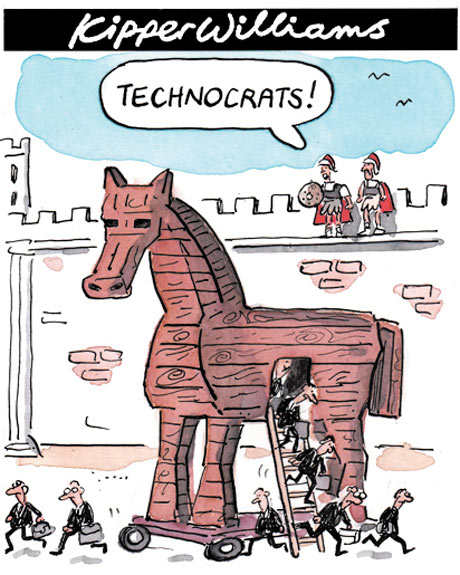
5. What were the auditors doing? - The amazing Olympus scandal may hit the reputations of KPMG and Ernst and Young in Japan. Olympus did some extremely dodgy acquisitions with non-companies registered in the Caymans that were designed to cover up past losses. It was only exposed after a foreigner got the top job at the Japanese camera and medical equipment maker.
“Why didn’t the auditors function as a check on the cover-up? It is like the robbers had hired the police,” says Tsutomu Okubo, an Upper House Diet member from the ruling Democratic Party.
There is a mystery over why KPMG Azsa, which was Olympus’s auditor until June 2009, signed off on Olympus’s accounts in March 2009, even though it disagreed with the way Olympus accounted for its acquisition of Gyrus, the UK medical equipment maker Olympus acquired in 2008.
Olympus paid its financial adviser about one-third of the $2.2bn it paid for Gyrus, an extremely high fee considering that most M&A advisory fees are about 1 per cent of the purchase price.
Tsuyoshi Kikukawa, then Olympus chairman, admitted in an email to Michael Woodford, the fired chief executive, that Olympus had switched auditors from KPMG Azsa to Ernst & Young ShinNihon after it clashed with the former over the accounting of the Gyrus acquisition.

6. 'Run for your lives' - This is actually the headline in this De Spiegel piece on the Eurozone crisis with this excellent chart below showing how much Euro-dreck the ECB is buying and how much the Italians will have to roll over next year.
Does not compute.

7. How America was bought - Bill Moyers writes an excellent history lesson at The Nation explaining how big business began lobbying much harder in the early 1970s to buy back American democracy.
It worked. This is today's must read.
Moyers explains here how it started:
The rise of the money power in our time goes back forty years. We can pinpoint the date. On August 23, 1971, a corporate lawyer named Lewis Powell—a board member of the death-dealing tobacco giant Philip Morris and a future justice of the Supreme Court—released a confidential memorandum for his friends at the US Chamber of Commerce. We look back on it now as a call to arms for class war waged from the top down.
Recall the context of Powell’s memo. Big business was being forced to clean up its act. Even Republicans had signed on. In 1970 President Nixon put his signature on the National Environmental Policy Act and named a White House Council to promote environmental quality. A few months later millions of Americans turned out for Earth Day. Nixon then agreed to create the Environmental Protection Agency. Congress acted swiftly to pass tough amendments to the Clean Air Act, and the EPA announced the first air pollution standards. There were new regulations directed at lead paint and pesticides. Corporations were no longer getting away with murder.
Powell was shocked by what he called an “attack on the American free enterprise system.” Not just from a few “extremists of the left” but also from “perfectly respectable elements of society,” including the media, politicians and leading intellectuals. Fight back and fight back hard, he urged his compatriots. Build a movement. Set speakers loose across the country. Take on prominent institutions of public opinion—especially the universities, the media and the courts. Keep television programs “monitored the same way textbooks should be kept under constant surveillance.” And above all, recognize that political power must be “assiduously [sic] cultivated; and that when necessary, it must be used aggressively and with determination” and “without embarrassment.”

8. Chart of the Day - The spread between French and German bond yields. This tells you contagion is spreading to the core of Europe. HT Moneyweek.

9. 'Economic armageddon' - Just so people think it's not me being excitable (I'm looking at you Gummy). Here's the Guardian reporting on British planning for Euro turmoil. The A word is used.
The Treasury and Bank of England are making contingency plans for an "economic Armageddon" if the euro falls apart, business secretary Vince Cable said on Thursday as the European commission slashed its growth forecasts and predicted that the continent could be plunged back into recession next year.
With David Cameron warning that the moment of truth was approaching for the eurozone, ministers are resigned to a severe downgrade of UK growth and public finances when the Office for Budget Responsibility reports this month. Brussels officials said the outlook for the UK economy had deteriorated significantly throughout 2011 and its recovery was lagging rivals'.
10. Totally Clarke and Dawe - Professor R Bitrage comments on the European crisis and Greece's problems.
"A taxation system of some kind somewhere in the Aegean wouldn't go amiss."
"The elephants can't get through the mountains."
101 Comments
http://blogs.telegraph.co.uk/finance/ambroseevans-pritchard/100013218/s…
The reality is that EU leaders are still unwilling to contemplate an orderly break-up of monetary union, or to deploy the system’s dwindling reserve of credibility to prepare for this traumatic moment.
To the extent that the Reuters story catches one vein of thought in EU capitals, it is about forcing weak states to leave EMU. This is the worst possible outcome. It can only set off a chain reaction, ultimately engulfing France. At that point the whole eurozone would spiral into a catastrophic depression – if it is not already. Germany itself would be ruined.
Here is the news....in a joint press release by the Merkozy couple, the ECB is to be empowered to enforce the purchase of piigs debt at predetermined rates of return by every registered bank operating anywhere in the EU euro market and by every insurance company and every hedge fund. Failure to comply will bring down the force of the law and the termination of operations...together with prison sentences for managers....and massive fines.
Governments within the piigs or any other eu hole that requests ECB determined bond purchases by anyone, shall lose control of their right to determine fiscal policy within their country until such time as debts are paid off. The ECB and the EU will decide on all new fiscal policy.
I am getting excitable about the destruction of the EURO and the Eurozone , Bernard . The world will be a better place without these artificial constructs , dreamt up by a bunch of self-serving socialist bureaucrats .
... a Europe , separated once again into sovereign nations , each fully responsible for it's own financial affairs , will be much stronger and more stable .
The EURO has destabilised the region . Bring back the Lira , the Drat-ma , and the beloved German Mark .
... how much must the world suffer , before the foolishness of socialism and central planning is expunged from our memory , once and for all .
...Bravo... Gummy Farage...!.
The world will be a better place without these artificial constructs , dreamt up by a bunch of self-serving socialist bureaucrats .
Agree, in terms of longer term. Short to mid term there will be a lot of pain
1. all money is an artificial construct so being artificial maybe isn't the point.
2. Actually the point is about banks leading stupid amounts of money to people and countries that they shouldn't have. The Greeks have been behaving like this for quite a long time, none of this behaviour is new, People did know about the whole tax is a joke and civil servants not working stuff. Most of the bankers who lent the money probably holidayed in Greece, they knew, they all knew. So they went ahead and created a whole bunch of new money and then lent it to people who could never pay it back, sounds familiar? Once again the borrowers have to pay the price for Bank executives getting a little bit richer.
But do nt worry it will all be solved by the new head of the European Central Bank, someone called Mario Draghi (one of your self-serving socialist bureaucrats- maybe?) - Private Eye points out that while he was 'punting financial products as a partner at Goldman Sachs between 2002 and 2005, he insists that he had no idea about the Credit Default Swaps his firm was writing in order to conceal Greece's chronic finances.
Meanwhile the actual elected Socialist Prime Minister (who really sort of could be called asocialist) who actually had the honor to point out, when he was elected, that Greeces finaces were a sham has been rolled. Now that is real democracy in action.
3.The beloved DM is a bit of an artificial construct or myth building exercise as well. Guess how many times the DM had to be bailed out?
SPIEGEL ONLINE: The Germany of today is considered the embodiment of stability. How many times has Germany become insolvent in the past?
Ritschl: That depends on how you do the math. During the past century alone, though, at least three times. After the first default during the 1930s, the US gave Germany a "haircut" in 1953, reducing its debt problem to practically nothing. Germany has been in a very good position ever since, even as other Europeans were forced to endure the burdens of World War II and the consequences of the German occupation. Germany even had a period of non-payment in 1990.
http://www.spiegel.de/international/germany/0,1518,769703,00.html
And anyway in the current situation what would they be able to sell if/when the new DM takes of like the CHF- next to nothing. Have you driven a Hyundai lately- they re not bad- do you need a Mercedes?
3. The socialism you refer to is of course socialism for the rich. Actual people were not allowed to vote for the Euro any place much at all. Plenty of places like the Euro- actually more stable than what they had before- a frightening though maybe.
My daughter send me this from the states, dont know if the link works. Good for a laugh.
https://mail.google.com/mail/?ui=2&ik=f7e47c8ee5&view=att&th=1338feb483…
Armageddon, Spike Milligan used the term in one of his books...........arm a gedon outa here, and I reckno that's what any sensible Euro investor would do,Ged outa there.
So far there is unofficial denials that there is even plans for a breakup of the Euro/EC
Just wait till Merkel/Sacorksy/Barroso et el officially deny there is such a plan to confirm that the EC is breaking up.
"Never believe anything until it is officially denied"
My chioce is over Christmas / New Years Holidays.....
Yep that article is shiveringly spot on. Anyone 50+ ought to recognise their part in it.
If it was such a dead cert, would you not short the Euro?
You wouldn't be the first if you did...
EUR/USD fell from 1.385 to 1.35 over-night.... bounced a bit but no rally.
Short anything not USD, it all trades the same, everything, same day highs, same day lows etc. Should be a good slide tonight.
Why Im selling all my sheep. Our Growth figures on the other hand are based on solid resoning by some of the best brains in the country.
Savage recession looms as EC warns of slower growth in Europe The threat of savage recession was piled on to deliberating European leaders amid warnings that the "clock is ticking" for them to resolve the debt crisis.
http://www.telegraph.co.uk/finance/financialcrisis/8882562/Savage-reces…
BazzaMcKenzie
So the growth projections have been downgraded to close to zero. Anyone believe that by Jan/Feb they won't be further downgraded to below zero.These government forecasters are always behind the curve, which is to say they are always wrong. Growth is already negative because the only possible mechanism for growth of the FPIIGS, ie default and exit the euro, has been ruled out. So the FPIIGS are guaranteed to contract further and rapidly.And since they are no longer able to buy much of that good German product, Germany is guaranteed to contract.It is really pretty dam simple, and yet the clods in government employ cannot understand it.http://hat4uk.wordpress.com/2011/11/10/eurocrisis-bankfurt-mole-confirm…
Were I a sovereign lender, I’d be alarmed. Maybe they are….but keeping quiet. Or perhaps they’re stupid. It’s often hard to tell these days.
It's certainly no Porsche, but scientists at the University of Groningen in the Netherlands are still excited about their latest achievement: creating a "car" that's only a billionth of a meter long.
http://www.spiegel.de/international/zeitgeist/0,1518,796970,00.html
You might want to hang house prices as well around the necks of the youth in the generation gap cartoon
PwC has just released this statement: "The Pike River Receivers confirm that a number of charges have been laid against the company by the Department of Labour. These were served yesterday.
The Receivers today asked the District Court to lift the existing suppression orders which had been previously sought by the Department of Labour.
The matter is now sub judice and the Receivers will not be making any further comment at this time."
Awesome the Irishman is back, this guy cracks me up (bad language advisory).
http://www.zerohedge.com/news/irishman-back-and-shares-his-views-wall-street-total-fucking-chaos
How long before we read about the bankers and pollies becoming the prey....not enough police and security lot to protect them all...only a matter of time IMO.
"Ah... Piss Off, Sir, I'm going for a pint!"
Perhaps Mr Hickey should have ended his interview on TV3 the other night like that.... ;)
Im with you on that one Wally, here is where the first problem is going to come from,
http://www.economist.com/blogs/dailychart/2011/07/youth-unemployment
Then its going to be pension fund failures, every one is going to want to hold the torch, while the rope gets fixed to the lamp.
I see rising demand for gated community property, armoured cars, bullet proof 'glass' and security staff...lots of work on offer for returned soldiers....also security systems and services...dogs of the eat you type...explosive sniffing clobber and oh maybe the fools who bought those British bomb detector gizzmo garbage units, will be able to offload their rubbish. Must also mention big demand for helicopter services to do the commuter runs from back lawn to bank roof.
FYI from a reader via email:
http://www.businessweek.com/magazine/why-americans-wont-do-dirty-jobs-11092011.html
I see this story is way too late for today, but I hope you have time to include it on the weekend or Monday.
What your publication lacks is a perspective that is an immigrant perspective. Now I just don’t many any immigrant, I mean a perspective that encompasses a person from relatively poor country, who is coming here to work hard and do better.
I am lucky, years ago, my granddad made the trip from India to avoid a life of poverty and destitution. I am very glad he did, even though a lot of his life was crappy.
I think it would be hard to argue that any system has lifted more people out of poverty than capitalism. Over the last few years you seem disillusioned, but just remember, that is liberal left that actually oppress by trying to implement their version of equality.
Enjoy your weekend
FYI from a reader via email:
Bernard
You may have been inundated with this one already by Terry McFadgen on Macrobusiness and top tens already up I see but it's worth repeating I reckon. This guy isn't some Muppet from outer space...(no offense to the Muppets).
http://www.macrobusiness.com.au/2011/11/expect-the-revolution-to-grow/
Cheers
FYI from a reader via email:
Hi Bernard
Asset sales are currently topical. Think about these numbers for a moment. 13 million M3 of logs exported (an average of say 120US a m3) or close to 2 billion NZ dollars a year. By processing into lumber the value at least doubles. So NZ’s lost opportunity each year is 2 billion NZ dollars climbing to at least 3 billion a year by 2024. There has been 2 further processing plants closed down in our region in the last week so this figure is going to keep on increasing. The crazy thing is it is going to Chinese sawmills which are not more efficient than us and worldwide demand is not decreasing.
Just for your info 98% of log exports are what they call A grade logs which are for industrial purposes pallets, packaging, furniture, temporary construction. There are only 2 mills in NZ that use this log the rest is for the building industry. To say that we cannot compete with the Chinese is bullsh$t. It is just a lame excuse from the forest owners to justify the easy options they take in exporting logs.
As an aside we cannot get enough A grade logs to meet demand. When the log price is high, export has priority when it is low (currently) harvesting will have an extended shut over Christmas.
Finally the biggest joke is South Korea that has a 5% tariff on lumber imports from NZ (not Chile) but accepts around 20% of our logs without a tariff.
Why are we so stupid as a Country?
Thanks for reading
Regards
NZ’s log exports to China one-third of 2011 harvest
Log exports from New Zealand in 2011 are set to reach a new record high. During the first eight months, total shipments were 25 percent higher than the same period last year (54 percent higher by value) and total exports for 2011 may reach as high as 13 million m3, which is more than a doubling from just three years ago.
It is worth noting that almost half of the timber harvest in the 2Q was shipped overseas in log form and that almost one-third of the timber harvest in New Zealand is shipped to Chinese sawmills. While log exports have increased substantially this year thanks to demand in China, lumber exports have actually declined from last year.
The steady increase in log exports the past five years may very well continue in the coming 15 years as the theoretical harvest level in New Zealand is set to double to 55 million m3 by 2024. Most observers in the industry agree that, for a number of reasons, this timber harvest scenario is less likely. Depending on market conditions, a more realistic level of annual timber harvests in 15 years would be between 35 and 45 million m3 annually. Even this lower harvest outlook alternative would increase available log supply from the current levels by over 50 percent. Source: Wood Resources International LLC,
First of all, why are we so stupid as a Country? Because the economic leadership have had their heads in economic idealism for years. If anybody had actually listened to all the protests at the time when neo-liberal reforms were introduced to NZ they would have seen that it was not exactly doing what it promised.
"To say that we cannot compete with the Chinese is bullsh$t.", actually I think the premise behind this statement, that NZ should persue it's "comparative advantages" is the bs. Not only are there many exceptions, but this is exactly the same kind of argument made in genetics like 'that animal was successful because it has wings'. The argument is retrospective, of course you can justify any reason for the animals success because the animal was a success already. Equally you can apply any reason to the success (or failure) of a business which has already been observed, that doesn't make it true.
Even if it were true, it only focuses on one part of the picture like economic growth is the only thing which is worth considering. 50% of all global traded goods, don't change ownership when they change country. Imagine what local production could do for fossil fuel consumption rates.
Canada is in exactly the same situation persuing it's 'comparative advantages' with the US. Says how much economic thinking is based on cronyism anyway.
If you thought Italy was bad... http://www.guardian.co.uk/business/nils-pratley-on-finance/2011/nov/07/…
AndrewJ, Therefore more money printing by Europe is a certainty.
or not, I thought that was the Eu's problem they couldn't default by QE like the UK and USA are doing. I think the big drop in consumer demand is about to hit.
Must be time for you to get the ski's out?
AndrewJ, Your chart shows you that the worse the mess becomes the more QE will be wanted by Germany. The exporters are screwed without the rest of the nations buying their products. It will be reasoned adjustments can come later or that people have learnt their lessons.
#5
It would be a brave audit partner who really called a client to account given how much all the other partners in the firm rely on audit engagements as their foot in the door to more lucrative work. Audit work generates comparatively low contributions despite using raw graduates as "slave" labour but the fees generated by other parts of the firm more than make up for it.
"Tens of thousands of netizens have been venting their anger online, demanding their leaders sort out China's own problems before bailing out Europe."
There will be no Chinese bailout for European banks in the 'piigs bond bloated debt and greater fraud euro fiasco'
Print print print print print print print ....................
http://www.marketoracle.co.uk/Article31494.html
This idea that printing trillions in euro will solve the piigs debt problems...is ...well madness. But go ahead and read the above article....and while you are reading...ask yourself what the unintended consequences will be.
If Germany does not agree to printing money in large quantities by the ECB, the following may happen:
1. The stresses in the sovereign debt markets such as the ones seen for Italy could break up the Eurozone; and
2. A fresh financial crisis would be triggered as Europe's financial institutions -- including banks -- haemorrhage hundreds of billions in losses as Greece, Italy and other nations leave the euro, devalue their currencies and force investors to write down bad debts."
Just hurry up and crash the system please, it's broken beyond belief.
Patience skudiv...give the swine time to move to safe ground. We can't have the bankers and pollies and scumbags getting hurt like the peasants can we.
I see that is plan, it's working then. All that talking about doing something, and never doing anything is just a stalling tactic, very formless.
Wolly, Gummy - you'll love this:
Just FYI, Raf comments here on Interest.co and comes from the same stable as Iain Parker - interest and debt free money supply and I think Kim Hill got it. Will Wolly and Gummy get it? Well said Raf. Was that Iain Parker passing some of the cue cards? For those interested in the topic, these might be of interest too: http://www.positivemoney.org.nz/ 'Why we must abandon the economic orthodoxy and embrace capital, trade and exchange rate controls' http://www.changenz.co.nz/posts/why-we-must-abandon-the.aspx Well said Bernard. Cheers, Les. www.nzmea.org.nzYou think "Kim Hill got it".....YOU THINK....!....jeez that's gotta mean something....but what?
That interview is only about 30mins long, go for it, enjoy. See if you get it. Think it through.
Jeez Les ...has it not dawned on you that I and others may well have 'thought it through' and judged the parky free credit concept as seriously flawed....! That I and others just might be a tad more capable and qualified than parky...?
But are you better qualified than Raf? If you think you are, listen to the interview and provide arguements against the points and ideas Raf provides. Forget your tangle with Iain, just concentrate on knocking Raf's arguements down, see if you can. Do you think you can? 30mins of easy listening, should be right up your street - easy listening, that is.
I heard it live , on Kim Hill's show , and am as confused as Ms Hill was by Raf's theories .
She correctly pointed that the new money system requires an even greater central government control of the system . Raf's explanation left me unconvinced ....
...... I still am haunted by images of re-creating the days of Muldoon ........
And , incase you missed it Les , Robert Muldoon is one of the few politicians whom Iain Parker lauds .
Roger - Yep, I recall that observation by Kim Hill, similar to our observations, concerns raised in the past on this topic. However, I thought Raf dealt with it well. Plus, I recall some of us, even Wolly(!), have called for better, more robust regulation in this area as we've considered the way the present system has been abused, even contributing to our present woes, so I ask why not let OUR government have more control of this particular function? At least we can vote the blighters out if they start stuffing around, we can't do that with the present suppliers of 98% of our money, can we? Looks where it's got us .....
Cheers, Les.
http://www.younoodle.com/people/raf_manji
Go read all about it Les....he's a gift to mankind...and wants us all to know it!
Wolly - playing the man, not the ball - that's quite unlike you Wolly. However, thanks for the link, looks like Raf is a good sort in addition to being well qualified to comment on this topic. For those interested in what seems to have stumped Wolly, see links here:
Again, well done Raf.
Les : In the 100 years til 1913 the US greenback was basically a stable currency , it fuctuated abit , but from inflationary periods , and deflationary spells , it ended that hundred year period bascially where it began .
...... in 1913 the Federal Reserve was founded . In the 98 years since then , the US dollar has been devalued by in excess of 95 % .
The solution is simple , as Jim Rogers says , ban the Fed ! ..... destroy the central banks around the world . Remove the crony-capitalism component of finance . Allow the free market enteprise system to flourish . Free up Iain Parker's time for focusing upon his truck-driving duties ........ Win / win !!
Waste of your time Gummy...some people are open to the idea that there is a secret way to solve the problems and all they have to do is believe in the money tree to see it emerge from the soil and grow to lord it over the economy saving us all from ourselves...and the cost of borrowing other peoples money.
Yup , same with the gold standard ..... it is the central government , the bureaucracies , who are stuffing up the system . All these dreams of new munny , or gold , currency pegs , or matabele gumbo beans ..... all they boil down to is attempting to stop the politicians & central banks from screwing up the economy ....
... the irony is that Bernard wants increased controls and powers for the very fools who are to blame ...
"Allow the free market enteprise system to flourish..."
Yeah, that'll put an end to predatory and monopolistic abuses by sociopathic corporations.
Good one, here is an excellent example of a free market, unregulated, deals in commodities, shows just how bad "free markets" are for regular workers.
http://www.reuters.com/article/2011/10/21/us-commodities-houses-idUSTRE79K49320111021?irpc=932
They form an exclusive group, whose loosely regulated members are often based in such tax havens as Switzerland. Together, they are worth over a trillion dollars in annual revenue and control more than half the world's freely traded commodities. The top five piled up $629 billion in revenues last year, just below the global top five financial companies and more than the combined sales of leading players in tech or telecoms. Many amass speculative positions worth billions in raw goods, or hoard commodities in warehouses and super-tankers during periods of tight supply.
U.S. and European regulators are cracking down on big banks and hedge funds that speculate in raw goods, but trading firms remain largely untouched. Many are unlisted or family run, and because they trade physical goods are largely impervious to financial regulators. Outside the commodities business, many of these quiet giants who broker the world's basic goods are little known.
Their reach is expanding. Big trading firms now own a growing number of the mines that produce many of our commodities, the ships and pipelines that carry them, and the warehouses, silos and ports where they are stored. With their connections and inside knowledge -- commodities markets are mostly free of insider-trading restrictions -- trading houses have become power brokers, especially in fast-developing Asia, Latin America and Africa. They are part of the food chain, yet help shape it, and the personal rewards can be huge. "The payout percentage of profits at the commodities houses can be double what Wall Street banks pay," says George Stein of New York headhunting firm Commodity Talent.
Responding to Rafs arguments
1. *Interest* not being created, Steve Keen has a simple mechanical model to show interest is not a problem.
Essentially the bank only sits between a buyer and a seller. Providing the buyers can earn money from the sellers the system is indefinately sustainable. And that means for it to be sustainable the sellers have to *spend* the created money they receive rather than *only* be savers. There is an argument today that there are excessive savings.
The interest 'problem' argument appears to hinge on a belief that banks suck money from the economy and dont pay it out in wages, costs and shareholder dividends and so forth. It also seems to rely on a belief that rich people hold money. But they generally dont. They have assets like land houses boats cars and planes.
2. Bank *margin* from loans creating deposits. He focused on the deposit held by the borrower. Once the loan is *used* the deposit is held by a creditor. If there is no creditor then the bank has simply lent cash when the money is used.
3. QE where the government buys the governments own debt securities is a method already available of providing debt free money. The limiting factor is the amount of inflation that newly created money will create. Dont we already have a substantial amount of inflation?
4. I have no objection to money reform, bank profits are excessive, but many of the reformers arguments seems a bit muddled up to me.
"1. *Interest* not being created, Steve Keen has a simple mechanical model to show interest is not a problem."
Yes, he did indeed develop such a model, but it is like those of his neoclassical and Marxist, intellectual opponents is premised on the assumption of the financial economy as a circuit, rather than based on how it actually operates, as an accounting cycle. He ignores completely the overhead costs due to rental extraction by wealthy and powerful groups within society, essentially the issues that classical political economy arose to address. Land rents (Adam Smith, David Ricardo, John Stuart Mill, the French Physiocrats), interest (Pierre Joseph Proudhon, Adam Smith)
"The vast majority of money is credit created by banks through loans to businesses and individuals. This money does not “circulate”, but instead operates in an “accounting cycle”. Ignoring consumer credit momentarily, which is just a mortgage on future incomes, money flows from the bank to businesses and finally to consumers as income. The income is then spent by consumers on goods and services and flows back to the bank via businesses and in the process cancels all the debt created in order to produce the good or service. http://social-credit.blogspot.com/
The interest 'problem' argument appears to hinge on a belief that banks suck money from the economy and dont pay it out in wages, costs and shareholder dividends and so forth. It also seems to rely on a belief that rich people hold money. But they generally dont. They have assets like land houses boats cars and planes."
He, like yourself ignores completely the overhead costs due to rental extraction by the wealthy and powerful institutions and individuals that have appropriated the vast majority of the the world's resources and pass them down to their descendants through inheritance. These are the issues that classical political economy largely arose to address. Land rents (Adam Smith, David Ricardo, John Stuart Mill, the French Physiocrats), interest on financial capital (Pierre Joseph Proudhon, Adam Smith)
"The limiting factor is the amount of inflation that newly created money will create. Dont we already have a substantial amount of inflation?"
Quantity of money theorists have got the causality of inflation the wrong way 'round. The quanity of money is the mere symptom, not the cause of inflation. Demand for money due to rising prices causes the quantity of money to expand, because when faced with rising demand for money, bankers merely extend further credit. In relatively free market, price changes are determined by market fundamentals, e.g. demand/supply changes. The inflation rate is actually low by historic standards, and what sectors of the economy are the key drivers of inflation? Healthcare, education, local government costs, housing, all sectors of the economy which are marked by significant government interference.
Great to see someone from "inside" the system picking up these ideas. Wolly, so what do you call it when a central bank lowers it's interest rate to zero? At around the 15min mark Kim asks this question, we are conditioned to believe that all money must carry interest, but the reality is that the economy needs to grow at a greater rate than this interest in order for it to be paid off. The money itself printed into circulation isn't free it's backed by the asset that was created when it was spent into circulation. It's entirely dependant on what the money is spent on.
Yes Fred, how correct you are...now ask yourself whether the 'free market' is not better able to identify the wasteful ways to use that credit...better that is than any form of bureaucrat or politician or do gooder.....?
There in lies the first level of foolishness...that govt knows best.
The second level is more one of mindless acceptance that politicians can be trusted not to scam rort and pork slice their way into whatever form the public social free credit boondoogle takes. This is the 'bridge to nowhere' and 'electorate to get new airport'...type scam decisions....one step deeper and you have the committee deciding on which contractor does what...which union runs what....take your pick Fred!
The free market does make dumb decisions. Losses take place. managers fired. Learning happens. Unfortunately of late the lying thieving corrupt govts have lept in to bailout the free market with taxpayer dosh...too big to fail Fred...!
And have you thought about the small matter of applying the public social free credit model inside the existing free market govt bailout scam model, the one with the existing mountains of debt and bank farming of the country....how would you merge those Fred?
The sort of rubbish that comes from those pushing this new age super secret money credit solution....all of it is aimed at the simple mind...the sucker.
Gonzalo Lira hits the spot here http://gonzalolira.blogspot.com/2011/01/why-democracies-will-always-go-…. All a pollie can ever do is promise to spend more than the incumbent and as you say they also vote more pork for themselves vis a vis their generous superannuation scheme as a reward for public service. Of course the ideal situation is that a Government should run a surplus, but because we run under fiat money system this would be deflationary and harmful to exporters. A surplus under a sound money system would result in the treasury being just that, a treasury, under fiat money it can only contain fiat, which is actually worth nothing to the issuer. It's all a matter of degrees and scale.
I think where the confusion occurs is that people forget that we actually run under a fiat currency, and when you factor that in, then logic by which the Government can (and should) spend changes. What you say is correct for a sound money system (and then you go on to conclude shhhh don't tell the pollies that because they would then be in to the free credit boondoggle).
IF a Govt was to run a deficit then why not print the money to cover it, this helps exporters as well. Make it conditional on what the money is spent on, it can only be spent on assets. The PPP model simply means that the people pay twice.
"Existing mountains of debt" - if it's private debt then fine, but no bailouts. Banks and lenders take the risk.
Les... Re listen to Raf.. AND keep in mind a couple of first principles about money
1/ Money is REAL. It is : 1/ A medium of exchange 2/ A store of Value 3/ A unit of account
2/ Every new Dollar that is created devalues every dollar already in existence. ( Money creation IS NOT a free lunch )
3/ The benefit of new money Creation accures to those who get the first use of that money ..and then the benefit slowly radiates outwards ... in a diminishing way... ( In this regard ..u can see that it acts as a TRANSFER of wealth )
In my view there are many flaws in Rafs' point of view.... BUT ..I do agree with the general point of view that Banks should not be able to create Money as Credit....
Cheers Roelof
1) The biggest thing of all, it is an IOU for energy/work....if there isnt the energy the paper or for that matter gold isnt under-written and therefore cant be cashed. Which is an interesting argument FOR inflation.
2/3 From my perspective fiat currencies can and do work...its pollies etc that debase them.....interesting thing is that studying things like the roman empire and others is the debasement that occurs to feed the work wanted to be done by the ppl.....eg for the roman empire support a large army...this was fine as long as they could expand and absorb more energy to support that cost....they declined when they could not.....I think we are at that point. We will decline because now the creation of more money isnt supported by the increase in fossil fuel extraction rate to compensate ie the major under-pinning of the fiat system.....I suspect that this has been so for at least a decade just its been hidden by debt.........se didnt pront more money we printed IOUs....same thing
Very fasinating.....for me anyway....of course Im in the same test tube.....
Also complex societies use more energy to become more complex....centralisation is energy hungry.......if we dont have the energy then we have to become less complex, there is no choice.
In the short term this means globalisation is toast....its too complex and energy intensive.....this in effect is the start of less control......eventually it will come down to very local communities, villasges and towns...central govn will cease its present level of "interference"....the Libertarian types should be dancing for joy at that prospect.....
regards
Is capitalism or democracy the problem ? Read a different view:
http://gonzalolira.blogspot.com/2011/01/why-democracies-will-always-go-bankrupt.html
Raf makes some really interesting statements in this radio interview – well worth to listen.
It's the unholy union of govt and banks, spawning poverty, madness, chaos and destruction.
And while you folks have been watching the Merkozy piigs euro debt fiasco play out...on the other side of the planet a nuclear debt is about to go off....
. http://www.foxbusiness.com/politics/2011/11/11/warned-fha-bailout-coming/
Wolly, for a long time I’m saying accumulating and accelerating of worldwide negative events on many fronts will lead into the fall of societies with severe consequences for all of us.
Your comment (link) is just another piece in a puzzle.
Could be a Swiss reactor Walter!...oops wrong location
Wolly - I wouldn’t be surprised, in recession times -> when lack of money is common -> services and maintenance neglected –> and as a consequence -> we will see catastrophic events -> unavoidable.
How can the 100’000 km NZroadways and NZbridges be maintained to satisfaction ?
How can risky NZeconomic plans mining/ drilling not fail risking life’s, catastrophic environmental events ?
How to maintain/ service - our multi billion $ infrastructures to a high quality/ medium standard ?
…and what on earth is the government doing, having all this megalomaniac economic plans and no money to pay for ?
Now now Walter...no good hyperventilating...take a pill....shite has always hit the fan and always will...The plans are fodder for the masses...you know that....now you go ahead and make your will out in favour of Wolly c/- this site. I promise to keep it out of the hands of the IRD.
To the SPCA Blenheim - to the loudest barking dog - Wolly. Is that address correct ?
Wolly this is fox news FFS....its the Govn's fault no matter what.....mantra.
This isnt a pinch of salt time, its a bucket load...
regards
So what steven...take off your red blinkers and for once accept as fact that which is fact.
Take off your blue blindfold.
It is extremely hypocritical of you to be accusing anyone else of bias. After all this time, and all your many posts about "goofy", "cunnie", "Aunty Helen", "Labour lefties", "reds", "pinkos", "commies", "socialists", "greens", and all the rest, while either avoiding criticism of National, or just outright hero worship and promotion of that party, you forfeit the right to accuse others of bias and partisanship.
"All year long financial commentators have been asking Meredith, “show us the defaults!”
The largest municipal bankruptcy in history was filed yesterday when the county commissioners of Alabama’s Jefferson County voted 4-1 to file Chapter 9. Melinda Dickinson reports for Rueters,
The bankruptcy filing by the southern U.S. county will add to concerns about the risks in the $3.7 trillion U.S. municipal bond market, which was hit recently by the high-profile debt crisis in Pennsylvania’s capital of Harrisburg."
"Saadi Gaddafi, a bisexual playboy, was granted asylum on "humanitarian" grounds, the Niger president said, adding it was unlikely he would ever be extradited back to his home country." telegraph
See what 138 tons of stolen gold can buy you.....!
the Niger river is a big river to swim across, especially with a lawnmower tied to your foot. Once someone figures out where the gold is, that will be his fate.
..on many fronts..
Speaking on condition of anonymity because he wasn't authorized to talk to the media, the official said tests are under way around the country to try and identify the source.
http://news.yahoo.com/nuke-agency-reports-unusual-radiation-europe-134506410.html
I found this on the Christ Martenson Forum Blog, something to chew on:
http://www.chrismartenson.com/forum/10-trillion-geometric-error-us-inte…
US/Canadian consumer interest calculation method a monstrous fraud
by Timothy Paul Madden
He writes: About the "nominal method" of interest calculation which is objectively fraudulent and has been prohibited as criminal fraud in the UK since 1974. Yet it has been required by law in the US since 1968 under the federal Consumer Protection Act.
Nominal_rate_August_22_2011.pdf
Cannot download the PDF.
May be Google Timothy Paul Madden
downloaded fine on my Mac, go to where it said click to down load, can put it up here if you want
Andrew
AndrewJ - thank you.
Here is the news
"Fears of eurozone debt contagion have hit France - as Italy and Greece move to change their governments in a bid to stabilise their battered economies.
Leading economists have warned the £261bn worth of Italian debt that French banks hold leaves them dangerously exposed to the spreading financial woes.
That figure represents more than half of all European bank lending to Italy.
British banks, on the other hand, could also be affected by a French crisis due to the amount of French debt the UK holds.
The French fears come after ratings agency Standard & Poor's accidentally sent out a message saying it was downgrading the country's prized "AAA" credit rating.
The error stood for an hour and a half before it was retracted by the agency - but fears spread across financial markets that it could be a sign of things to come"
old news Wally, its Spain next, France has to wait its turn. Im trying to double guess what this means to the CAP agreement, it could have a big impact on us.
The Common Agricultural Policy (CAP) is a system of European Union agricultural subsidies and programmes. It represents 48% of the EU's budget, €49.8 billion in 2006 (up from €48.5 billion in 2005).[1]
Markets rise but contagion fears spread to Spain
Political progress in Italy and Greece pushed stock markets higher but economists warned of stormy weeks ahead as attention turned to Spain amid fears it could be the next economy to come under the spotlight. http://www.telegraph.co.uk/finance/financialcrisis/8885146/Markets-rise…
S&P sure gave Sarkozy the screaming heebees.....he must have been hopping round like he had a hornet in his jockstrap. Sarkozy does the triple A dance.....hahahahaaaaha
John Key is a fan of Joseph Stiglitz
How do I know?
Because Joseph Stiglitz says
One of the things that makes the American common currency work across the country is we have a common fiscal authority and high migration - we're willing to allow North Dakota to become empty.
In Europe, there's no fiscal authority, migration is more difficult and most of the countries are not willing to let themselves become empty. So the framework for allowing for an effective common currency is not there.
And, as we all know
John Key is willing to allow New Zealand to become empty.
Yes – he wants us, 95% of simple souls out of New Zealand, to become the clever “Jewish Banking Hub of the South Pacific” the so called - “JB.Hot.SP”.
There I was thinking that North Dakota was booming and unemployment was negative there and that North America was moving rapidly to self sufficiency in oil and gas.
interesting development in Chile.
http://www.telegraph.co.uk/finance/newsbysector/industry/mining/8885348…
I doubt we have much to complain about. When European imperialism was dismantled in 1950s and 1960s it was sold to the American people as bestowing freedom and self-determination on the former colonies. Effectively, the former
colonies assumed the costs of administration and defence which we no longer paid for, and only provided us with agricultural and mineral
production. It was really an improved form of colonisation in which
the relationship became solely economic.
Chile was the first South American country to obtain independence from Spain. It helped its neighbours to become independent too. We applauded. The west wanted its mineral production and returned machinery and vehicles to facilitate
extraction and transport to the ports. When government became
populist under Allende, we commenced a policy of economic warfare by withholding spare parts and credit to bring transport to a standstill and by funding and stimulating armed rebellion in the armed forces until Allende was killed and the populist government replaced.
It is against that background that the policies of Chile need to be considered. I think, as a fundamental statement of any nation's beliefs, that domestic productions should be owned domestically. A great many former colonies accepted our loans and investments but resent our using them to get our own way on national policy. Governing a country should encompass all of it including agricultural and mineral production. If we don't like the government, we simply refrain from contact with it. Had we been open-minded about it, we would have accepted the costs of administration and defence and there could be no difficulty in taking the goodies but we wanted to economise to ensure the very best prices.
It seems to follow from this that trade in commodities should be under each nation's control and the role of multi-national companies brought to an end. I note a great meny of western multinationals trade in former colonies without any local capital at all. They provide the host government with a “letter of comfort” implying that head office will pick-up the tab if they become insolvent. At the very least these companies should incorporate themselves in every country they wish to trade in so local people can partake of the profitability of their actions. Failing that, AngloAmerican may concern itself with minerals it can obtain in its home country.
The sale of Chilean national assets by AAS to Japan is clearly a matter of interest to Chile, particularly when it occurs shortly before the nation's own chance to buy. It seems obvious that every country would like to recover ownership of its own assets. On the other hand, they know the strength of our determination to have their production which enforces a consensual attitude on them which we have historically interpreted as weakness. Now the money is becoming worthless, it is an opportune time to reconsider the shape of international trade.
The latest quarterly report from the Office Of the Currency Comptroller is out and as usual it presents in a crisp, clear and very much glaring format the fact that the top 4 banks in the US now account for a massively disproportionate amount of the derivative risk in the financial system. Specifically, of the $250 trillion in gross notional amount of derivative contracts outstanding"The top 4 banks: JPM with $78.1 trillion in exposure, Citi with $56 trillion, Bank of America with $53 trillion and Goldman with $48 trillion, account for 94.4% of total exposure. As historically has been the case, the bulk of consolidated exposure is in Interest Rate swaps ($204.6 trillion), followed by FX ($26.5TR), CDS ($15.2 trillion), and Equity and Commodity with $1.6 and $1.4 trillion, respectively. And that's your definition of Too Big To Fail right there: the biggest banks are not only getting bigger, but their risk exposure is now at a new all time high and up $5.3 trillion from Q1 as they have to risk ever more in the derivatives market to generate that incremental penny of return."
http://www.zerohedge.com/news/five-banks-account-96-250-trillion-outsta…
European Stability Mechanism (ESM) - A new dictatorship
http://www.youtube.com/watch?v=gls3pO-94b4 http://www.consilium.europa.eu/media/1216793/esm%20treaty%20en.pdf
I don’t think there is a unique solution. It involves a mix of defaults, restructuring , heavier taxes not only on revenues but on assets, austerity from the gov’t, whatever works; and bigger focus on real production and wealth - making stuff, developing technologies, solving real problems as opposed to financial problems. Financial problems should be among the easiest to solve, it’s just math and 0s on computers, after all !
In 2007 Ireland had a government debt to GDP of 25%.
Since the bank recapitalization (now completed) debt has soared to 96.2 % of GDP. Only one country in the 27 EU countries had its banks stress tests independently verified including the asset values of houses. Ireland. The model used I believe a 70% peak to trough fall in prices as a model.
Your comments about Belgium are interesting. In Ireland the banking sector has been completely restructured, purged of much of its bad and doubtful debt into a 'bad bank' NAMA and the two pilllar banks, Bank of Ireland and AIB at a discount. These pillar banks have been recapitalized so that Bank losses are now part of the Irish national debt. The bailout of Dexia and others for example has yet to be baked into Belgium's national debt pie.
You might wish reconsider 'Belgium is not to badly off'. I would suggest Ireland's medium and long term prospects are better.
A nation of 4.5 million (Ireland) produced enough food to feed 36.2 million people last year. Ireland will recover. Over the coming years the ECB and Britain are going to make a lot of money from the interest from their Irish loans IMHO. I note Emergency Central Bank funding from the Irish Central Bank to Irish banks has fallen from a peak in February by over 20 billion euros. As the overseas assets are sold (Anglo's $10 billion US loan book for example) Debt will peak and then fall.
Steglitz49
Thank you kind, OwainGlyndwr, my learned friend. That is most fascinating. Well done the Irish. I see they followed Sweden´s example of 20 years ago of creating a "bad bank". It worked wonders for Sweden and seems to do the same here -- Euro or no Euro.The main net food exporters in Europe are Ireland (as you mention), Denmark, Netherlands, France, Poland and Spain. Germany and Belgium are net importers, and somewhat surprisingly Italy is a small net importer. (Norway, Sweden and Finland are net importers.)
Let´s hope that Ireland can continue to do well. Onwards and upwards.
Finally, Belgium must have a huge net income from all the EU stuff. I know these overpaid freeloaders do not pay tax (at least not in Belgium) but they must spend to live. http://www.telegraph.co.uk/finance/financialcrisis/8885723/Geithner-tel…
Now that the crumbs have settled , from the luke-warm Key-Banks cup of tea , we can pray that the good citizens of Epsom have the commonsense not to vote for John Banks .
........ being a party piece in a cynical MMP game is one thing .....
Being represented by a tired old National hack from a by-gone era , is quite another .
Strategic voting means that the common sense thing to do being on the right of centre is vote ACT.....and since the ppl of epsom are not stupid I suspect they will......
The interesting thing is ACT's %...its still 2% despite DB promising 10%.....which is surprising...also that ACT has virtually no money........I guess the tight wads that expect ACT to hand them $ hand over fist are not prepared to poney up.....
regards
Think that the good people of Epsom have had a gutsful of Act, Hide & Brash. They do have a sort of amused affection for Banks... which might be just enough.
The interesting electorate might be Rodney, if Craig (Conservative) wins this - there may be more Conservative Party votes nationwide than Act. Now the Conservatives might do a better job than Act to keep National to (original) core values...
Germans bribe Greeks to buy submarines with borrowed money.
"ThyssenKrupp's planned withdrawal is believed to be linked to a corruption scandal involving Ferrostaal. The Munich public prosecutor's office has accused Ferrostaal of paying millions of euros in bribes to Greece related to the purchase of 214-class submarines. The joint venture has been widely cited as an example of how German and other European companies have massively profited from a Greek government that has, for years, spent beyond its means. Many German firms doing business in the country have also been complicit in corruption."
http://www.spiegel.de/international/business/0,1518,796474,00.html
I knew this was going on, its just how things are done there. At last it starts to come out, there will be lots more bribery and corruption than people seem to expect.
http://en.wikipedia.org/wiki/Currency_Act
The quote from franklin appears to be much earlier than 1764
According to Wiki colonial script enabled the devaluation of debts owed to British merchants.
"The acts sought to protect British merchants and creditors from being paid in depreciated colonial currency"
And again according to Wiki the currency act of 1764 did not prevent paper money from being produced. It just said it was not valid for the legal payment of debt. Later amendments enabled colonial script to legally clear a debt.
I realise Wiki is not a very reliable source of information and history is itself written by those with most money.
Iain,
"Every new dollar created devalues every dollar already in existence"
I state this as a first principle.... This a departure point from which one can explore the impact of changes in money supply.
Add to that , the principle... That the benefit of new money Creation accures to those who get the first use of that money ..and then the benefit slowly radiates outwards ... in a diminishing way... ( In this regard ..u can see that it acts as a TRANSFER of wealth )
I think where we part company is in deciding what is the most equitable and fairest way to increase the money supply.
What u say ..."every new unit of money entering circulation only reduces whats already in circulation if it exceeds the level of real trade and ability of sustainable natural resources to support it which causes quantity of money inflation. Kept in balance, no inflation. no reduction of purchasing power. ....
sounds good in theory, BUT..it is very..very difficult to determine how money supply growth manifests in an Economy... ( and therefore very difficult to measure )
Also... if money supply was constant , then as an economy grows, the purchasing power of each dollar would naturally increase. Rather than creating money we could do the opposite and bring in smaller denominations of money.. eg bring back the 1 cent piece.
This would be a benign deflation ..and would "break the back" of the "Financializtion" of our economies. ( borrowing money would be more burdensome)
SO... why do we really create more money..????? In the final analysis... it is to get something for nothing...
If I could create a Billion dollars out of thin air... I could set myself up for life... I could Buy Dozens of Farms.... Many houses.... some businesses.... maybe an airline.. BUT... this is not a majical Holy Grail win/win senario... It is a Transfer of wealth.. at NO COST to me...but there is a cost to someone... There is no free lunch...
The impact of my $1 billion dollars will manifest in different ways... but the bottom line is that I have "clipped everyones ticket"... and they probably will never realize it..!!!!
Cheers Roelof
"sounds good in theory, BUT..it is very..very difficult to determine how money supply growth manifests in an Economy... ( and therefore very difficult to measure )"
Is it really so difficult to see the consequences of extra money in the economy? Seems to me that governments go to great lengths to hide the consequences of additional money.
It was a great item by Raf Manji on National Radio.Well done.
We welcome your comments below. If you are not already registered, please register to comment
Remember we welcome robust, respectful and insightful debate. We don't welcome abusive or defamatory comments and will de-register those repeatedly making such comments. Our current comment policy is here.