
Here's my Top 10 links from around the Internet at 10 pm in association with NZ Mint.
I welcome your additions in the comments below or via email tobernard.hickey@interest.co.nz.
I'll pop the extras into the comment stream. See all previous Top 10s here.
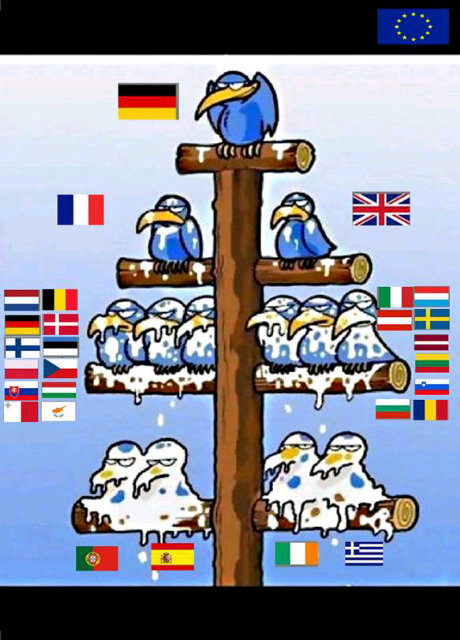
Number 8 is today's must read, particularly if you a supporter of an FTA with America. My favourite cartoon is Euro Angry Birds.

1. Is China about to ease? - Bloomberg reports Chinese lending jumped in October.
It suggests the Chinese may be about to use similar tactics to the ones they used in late 2008 to switch the activity in its economy from exporting to infrastructure and housing construction.
We'll see if China is really serious about money printing and building fast railways to nowhere to try to keep its economy going. It's not in the current 5 year plan..
There's still plenty of inflation in the Chinese economy, but it has come off the boil in the last month or so.
The other major macroeconomic factor to watch is whether the European Central Bank starts printing money as everyone except the Germans (and the Finns and Dutch) want.
It's all part of the extend and pretend strategy.
It didn't work in 2008.
We'll see whether it works three years later.
Local-currency lending was 586.8 billion yuan ($92.5 billion), the People’s Bank of China said in a statement on its website yesterday. That was the most since June, exceeding the previous month’s 470 billion yuan and all 18 estimates in a Bloomberg News survey. M2, the broad measure of money supply, rose 12.9 percent.
Chinese officials aim to sustain the nation’s expansion as the property market cools and Europe’s slowdown hits exports. Daiwa Capital Markets sees a rebound in lending through this quarter after Premier Wen Jiabao said economic policies may be “fine-tuned” and pledged support for smaller companies. In China, the government guides lending levels.
“This is a meaningful pickup in new loans which suggests selective easing has already started,” said Qu Hongbin, a Hong Kong-based economist with HSBC Holdings Plc. “This should help stabilize growth with small and medium-sized enterprises and increase credit support for ongoing infrastructure projects. China has no risk of a hard landing.”

2. Euromess - The Telegraph reports the big (1 trillion euro) bazooka fund set up the Europeans to stop contagion spreading from Greece failed to raise enough money for Ireland's next bailout tranche of 3 billion euros last week. Instead it had to resort to buying its own debt.
Just nuts.
Here's The Telegraph's Harry Wilson and Kamal Ahmed:
The European Financial Stability Facility (EFSF) last week announced it had successfully sold a €3bn 10-year bond in support of Ireland. However, The Sunday Telegraph can reveal that target was only met after the EFSF resorted to buying up several hundred million euros worth of the bonds.
Sources said the EFSF had spent more than € 100m buying up its own bonds to help it achieve its funding target after the banks leading the deal were only able to find about €2.7bn of outside demand for the debt.
The revelation will be seen as a major failure and a worrying sign of future buyers strike after EFSF officials and their bankers had spent recent weeks travelling the world attempting to persuade key investors, including China's national wealth fund and Japanese government funds, to buy its bonds.

3. 'You're fine until you're not fine' - Economic historian Niall Ferguson tells CTV in this interview that the Euro may live longer than the European Union and public debt over 100% of GDP is a dangerous thing. He makes a good point about interest rates being low until they are not. And then your frog is boiled.
"It's actually easy to leave the European Union, whereas it's hard to leave the single currency. So one possibility is that the euro may survive, but the European Union, the project of something that actually had a political as well as an economic character, that that might start to disintegrate."
Rising economic problems in the eurozone have created massive political turbulence, forcing the resignation of Italy's Prime Minister Silvio Berlusconi and, before that, the ouster of the Greek prime minister in favour of former European Central Bank vice president Lucas Papademos. Ferguson said those countries essentially ran into trouble because they choose to hold off on addressing their debt problems.
"What you're seeing in Europe, particularly Italy, is a warning for North America countries -- it's a warning that if you just let your deficit grow, if you allow your public debt to rise about 100 per cent of gross domestic product, at some point there will be a reckoning," Ferguson said.
"My argument is not that things happen gradually, but that they happen very, very fast. You're fine until you're not fine. You're paying 3 per cent on a 10-year bond, and then suddenly you're paying seven-and-a-half per cent."

4. Gold demand doubles - The Telegraph's Ian Cowie reports demand for physical gold has doubled in the last year.
Fears about the global credit crisis, the euro, inflation and the falling real value of paper money of all descriptions helped more than double demand for physical gold held by BullionVault last year; pushing up profits by 48pc it reports today.
The dealing facility, which was set up just five years ago, now holds gold and silver worth more than £1bn on behalf of 33,000 investors. It’s an ill wind that blows no good and rotten returns from bank and building society deposits have boosted demand for valuable metals. Paul Tustain, founder and chief executive, said: "The major driver of growth has been the steady realisation among private savers that low interest rates are here to stay.
5. The capitalist network that runs the world - The New Scientist reports on research about the linkages between 43,000 multinational corporations and the linkages between the companies that own. It finds a 'super entity' of 147 companies controls 40% of the wealth in the network (pictured below) HT John via twitter
The work, to be published in PLoS One, revealed a core of 1318 companies with interlocking ownerships (see image). Each of the 1318 had ties to two or more other companies, and on average they were connected to 20. What's more, although they represented 20 per cent of global operating revenues, the 1318 appeared to collectively own through their shares the majority of the world's large blue chip and manufacturing firms - the "real" economy - representing a further 60 per cent of global revenues.
When the team further untangled the web of ownership, it found much of it tracked back to a "super-entity" of 147 even more tightly knit companies - all of their ownership was held by other members of the super-entity - that controlled 40 per cent of the total wealth in the network. "In effect, less than 1 per cent of the companies were able to control 40 per cent of the entire network," says Glattfelder. Most were financial institutions. The top 20 included Barclays Bank, JPMorgan Chase & Co, and The Goldman Sachs Group.

6. So what happens now? - Reuters analyses the possibilities for Europe in the wake of the Italian bond market meltdown last week.
Efforts to construct a financial firewall to protect Italy, Spain and potentially France are running behind the curve, shackled by legal and political obstacles to using the European Central Bank or issuing joint euro zone bonds.
"This summer, I thought the "muddling through" scenario had a 50 percent chance of success. Now it's clearly less," said Jean Pisani-Ferry, director of the Brussels-based Bruegel economic think-tank and an adviser to the French government and the European Commission.
"Leaders everywhere are now aware of the very high risk if they let things run out of control, that it can lead to a financial catastrophe for Europe," he said in an interview.
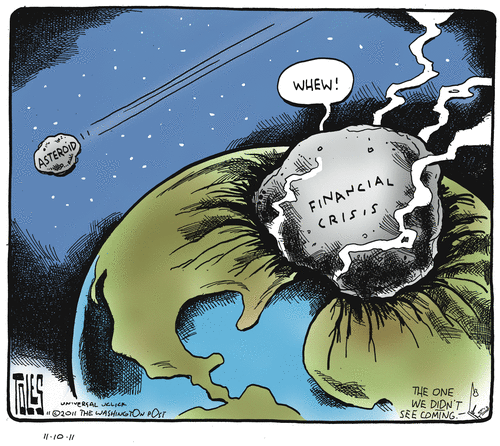
7. Only weeks away from collapse - The FT's Wolfgang Munchau reckons the euro is only weeks away from a catastrophic collapse. He writes persuasively that the European bond market is cactused and that the only thing that will save it is a Eurobond backed by Germans.
The Germans won't allow it. Ergo. Cactused euro.
Yikes.
Here's Wolfgang:
The cause of the panic attack was the European Council’s decision on October 26 to renegotiate the private sector participation of Greek sovereign debt holders. With that decision European leaders destroyed what was left of a functioning eurozone government bond market. Investors interpreted it – correctly in my view – as a precedent. They then dumped their Portuguese, Spanish, Italian and even French government bonds. As of now, there is only one significant risk-free asset in the eurozone – German government bonds.
The eurozone’s refusal to capitalise the EFSF properly contributed to the panic. A leveraged EFSF would have the worst kind of Eurobond: a tranche in a toxic debt security. I really hope EU leaders will come to their senses and stop pussyfooting with dubious financial instruments. The eurozone needs a risk-free asset class, and this means something boring and simple.
8. America's rotten politics - I won't attempt to paraphrase this history lesson from George Packer at Foreign Policy on how corporate money infected America's public. Just read it and reconsider any support you may have had for the US Free Trade Agreement.
The final rant is well worth it.
Inequality will continue to mock the American promise of opportunity for all. Inequality creates a lopsided economy, which leaves the rich with so much money that they can binge on speculation, and leaves the middle class without enough money to buy the things they think they deserve, which leads them to borrow and go into debt. These were among the long-term causes of the financial crisis and the Great Recession. Inequality hardens society into a class system, imprisoning people in the circumstances of their birth — a rebuke to the very idea of the American dream. Inequality divides us from one another in schools, in neighborhoods, at work, on airplanes, in hospitals, in what we eat, in the condition of our bodies, in what we think, in our children’s futures, in how we die.
Inequality makes it harder to imagine the lives of others — which is one reason why the fate of over 14 million more or less permanently unemployed Americans leaves so little impression in the country’s political and media capitals. Inequality corrodes trust among fellow citizens, making it seem as if the game is rigged. Inequality provokes a generalized anger that finds targets where it can — immigrants, foreign countries, American elites, government in all forms — and it rewards demagogues while discrediting reformers. Inequality saps the will to conceive of ambitious solutions to large collective problems, because those problems no longer seem very collective. Inequality undermines democracy.

9. This will happen one day in New Zealand - In my dreams at least. A national newspaper in Italy last week lead its front page with the size of the Italian 10 year government bond spread above German bund yields.
I kid you not.
Can you imagine the NZ Herald having on its front page the size of the NZ Credit Default Swap spread to US Treasuries. One day... One day...
“Spread a 500” (spread at 500 basis points) was a front- page headline of Corriere della Sera, Italy’s top-selling daily newspaper, on Nov. 9. That evening’s television talk shows featured charts of the 10-year spread as Italian economists and politicians discussed Italy’s crisis.
In downtown Milan, adjacent to the city’s landmark Il Duomo cathedral, a group of Italians gather frequently to gaze at market prices on a giant TV screen displaying Bloomberg data.
“What’s the spread? It’s the difference that a country pays on interest rates compared with another,” said a 76-year- old retiree who would only identify himself as Peppino. “How can we pay 6 percent interest rates in Italy and Germany 2 percent?” Peppino said. “It shows that Italy is sick. When a country is strong, the spread falls.”

10. Totally Jon Stewart on the Rick Perry meltdown. Fun times.
We welcome your comments below. If you are not already registered, please register to comment
Remember we welcome robust, respectful and insightful debate. We don't welcome abusive or defamatory comments and will de-register those repeatedly making such comments. Our current comment policy is here.