

Here's my Top 10 links from around the Internet at 7.30 pm in association with NZ Mint.
I welcome your additions in the comments below or via email tobernard.hickey@interest.co.nz.
I'll pop the extras into the comment stream. See all previous Top 10s here.
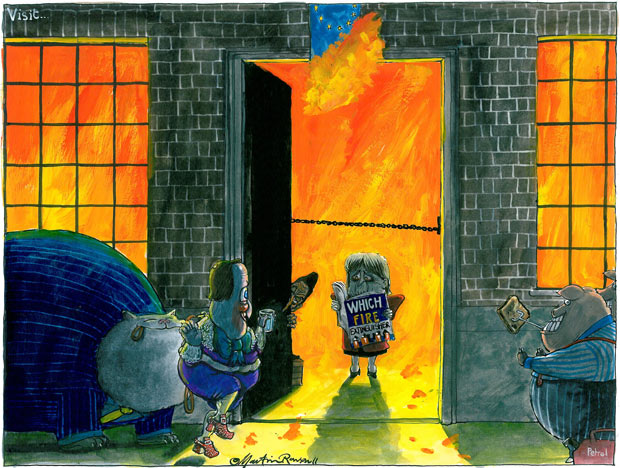
Keep an eye on Credit Agricole. See #9. The cartoon under #3 made me roll on the floor laughing. I need to get out more.

1. The problem with leverage - Ben Chu writes at The Independent that central banks and governments should be forcing banks to publish their leverage levels, not just capital levels.
He's right.
Here's the measures of leverage and capital that we've calculated for NZ banks.
It shows Kiwibank as the most leveraged at 23.4 and ANZ National as the least leveraged at 11.4.
But all the NZ banks are way less leveraged than the crazy British, American and European banks.
Chu writes below about some of them being more than 30 times leveraged.
Before they blew up...and had to be bailed out by their governments.
Andy Haldane, the Bank of England's executive director of financial stability, has produced research showing how leveraged three of the UK's largest banks were going into the 2008 crisis and how they fared in the crisis.
The table shows Barclays' capital base was leveraged around 39 times in 2007 and Royal Bank of Scotland 31 times. Both had to announce huge asset write-downs in the boom. Barclays wiped out 56 per cent of its pre-crisis equity and RBS lost 32.6 per cent and was rescued by the Government.
HSBC had a fairly conservative leverage of 21.3 and its losses in the bust were only 7.3 per cent of equity. It is also striking how quickly leverage ratios at Barclays and RBS were rising before the bust. Warning bells should have been ringing. These lessons are still to be learned by regulators. The Franco-Belgian bank, Dexia, was judged sound by the European Banking Authority in July, with capital levels of 12 per cent. But in October Dexia went bust and had to be rescued. Regulators should probably have paid closer attention to Dexia's leverage – an astonishing 60.

2. What a soft property market looks like - The Courier Mail in Brisbane reports on how deals are going bad in that property market as valuations come in less than expected.... HT Hugh.
SELLERS who manage to snare a buyer in Brisbane's soft property market are seeing their deals fall over as a new trend emerges of valuations coming in below contract prices, making it difficult to obtain finance.
Place research analyst Lachlan Walker said it was a problem that had been building since the start of the year and his agency had experienced several deals collapsing as a result.

3. Here's an interesting idea - Sam Sachdeva reports at The Press on a plan by the Canterbury Co-Operative Land Trust to develop sections for NZ$90,000 to NZ$100,000, which is about NZ$80,000 below market value. HT Hugh.
A model for elsewhere?
Residents have expressed concerns about the Government's offer to buy their homes for their 2007 rateable value, saying it will not cover the cost of buying a new section. Livingstone said the trust wanted to ensure that earthquake-hit residents could afford to buy a new home.
"A lot of people aren't in a position to take on an extra mortgage," he said. The trust would bring red-zone residents together to jointly buy land and develop it into sections.
Property developer and trustee Grant MacKinnon said selling all the sections before developing the land would cut out the developer's margin and sales and marketing costs, which could account for up to 40 per cent of a section's value.

4. What on earth is this all about? - Emma Goodwin at the Manawatu Standard reports Horizons, the Manawatu-based district council that's supposed to regulate farmers, is interested in buying some dairy farms through its investment arm.
Manawatu water ecologist Dr Mike Joy said Horizons getting involved in dairy farming had to be a conflict of interest.
"How can they be objective when making decisions about it?" Mr Joy said.
"It's like the police buying into a gang's drug business because it makes lots of money."

5. Keep an eye on this - The WSJ reports Iran says it shot down a US drone over the weekend. The Israelis are quietly blowing up sheds in Iran they think might be nuclear bomb factories. Iranian allies in Lebanon are firing off rockets into Israel.
Iranian 'students' are storming embassies. Sanctions are brewing. This one could sneak up on a few people.
Remember. Japan was throttled by sanctions during the 1930s in the wake of the Great Depression. That didn't end well when they went overseas looking for the stuff they couldn't buy. I know there's a lot more to that story, but still...
And here's one reason why - Reuters reports Iran is warning that any attempts to block Iranian oil supply would more than double crude oil prices.
Iran warned the West on Sunday any move to block its oil exports would more than double crude prices with devastating consequences on a fragile global economy.
"As soon as such an issue is raised seriously the oil price would soar to above $250 a barrel," Foreign Ministry spokesman Ramin Mehmanparast said in a newspaper interview.
The comments come as Iran strives to contain international reaction to the storming of the British embassy last week, a move which drew immediate condemnation from around the world and may galvanize support for tougher action against Tehran.

6. Free Trade deal with India? - This might be a little more difficult than the one New Zealand did with China.
India is much more wary of free trade. Here's an example. A deal to let foreign supermarket chains such as Walmart and Tesco into India has been rescinded just days after it was agreed, BBC reports.
Just days after approving long-awaited proposals to raise the limits on foreign investment, a government ally said he had been told the policy was suspended. The decision to allow chains such as Walmart and Tesco into India has sparked fierce opposition.
Critics fear the move would destroy millions of jobs and businesses. Mamata Banerjee, whose Trinamool Congress contributes 19 votes to the ruling Congress party-led coalition, said that Finance Minister Pranab Mukherjee had told her that the policy would be put on hold.

7. When credit bites back - The San Francisco Federal Reserve has written a paper documenting almost 140 years of recessions to show that bigger debt bubbles are followed by deeper recessions.
Ya don't say. HT Leith at Macrobusiness in a good piece titled 'We're all Keensians now' ;)
Here's the SF Fed.
Based on a study of nearly 200 recession episodes in 14 advanced countries between 1870 and 2008, we document a new stylized fact of the modern business cycle: more credit-intensive booms tend to be followed by deeper recessions and slower recoveries. We find a close relationship between the rate of credit growth relative to GDP in the expansion phase and the severity of the subsequent recession.
We use local projection methods to study how leverage impacts the behavior of key macroeconomic variables such as investment, lending, interest rates, and inflation. The effects of leverage are particularly pronounced in recessions that coincide with financial crises, but are also distinctly present in normal cycles. The stylized facts we uncover lend support to the idea that financial factors play an important role in the modern business cycle.
8. Cheap foreign imports - Rob Stock reports at the Sunday Star Times how the price of New Zealand carbon credits is crashing because of the importation of dodgy foreign ones.
Sigh...
Here's Rob with the details:
The price of New Zealand units (NZUs) has crashed from $22 in May to about $11 last week, stifling interest in developing carbon offsetting initiatives here, according to carbon market participants.
The price crash has been so steep that by one calculation, if the price trend continued for another 100 days, the value of NZU credits would be zero.
The reasons for the crash appear to be the unfettered ability of New Zealand emitters to import credits of dubious quality from overseas, coupled with the recent dumping of international credits by cash-strapped European industrial and utilities companies selling down their stockpiles of carbon to realise cash as the debt crisis worsens, participants in the fledgling carbon trading market say.
Big emitters here have been able to buy the UN-backed Certified Emmissions Reductions (CERs) cheaply to surrender under the ETS, gutting the price of NZUs.

9. Credit Agricole's axe sheet - Reuters reports the French bank is dumping assets in Asia.
Credit Agricole has listed 64 Asia loans worth US$1.1 billion, according to the French bank’s most recent axe sheet, obtained by Reuters. The loans currently support such companies as India’s Bharti Airtel and Hong Kong’s Sun Hung Kai Properties.
Two years ago, the bank was offering just 8 loans worth US$170 million in Asia, an axe sheet from that period shows.
“What you’re seeing is evidence of what one’s hearing: that the European banks are deleveraging and selling assets,” said Philip Cracknell, Global Head of Syndications for Standard Chartered Bank.
While axe sheets are common, it is unusual to have so many Asia loans on sale at one time and to see how widely these sheets are being distributed, with banks offering up deals to rivals they would normally want to keep out of the process.

10. Life's a happy place - The Conchords' Bret McKenzie and Kermit the Frog sing the theme tune for this blog. This one is especially for the Gummy Bear. He thinks I have little faith. I have a lot of faith in glove puppets and Kiwi comedians.
Because I love the Muppets and the Conchords.
We welcome your comments below. If you are not already registered, please register to comment
Remember we welcome robust, respectful and insightful debate. We don't welcome abusive or defamatory comments and will de-register those repeatedly making such comments. Our current comment policy is here.