
By Bernard Hickey
There was a time around 5 years ago when many of New Zealand's policy grown-ups believed an Australasian currency union was inevitable.
It seemed the logical end point to the deepening integration of the New Zealand and Australian economies through Closer Economic Relations (CER). Even the nation's chief currency trading Prime Minister, John Key, was musing aloud that it might be a good idea.
No more.
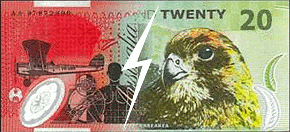
An opinion poll released this week by the Frank Lowy Institute think tank in Australia showed voters on both sides of the Tasman are now against a single currency.
The poll in mid-April of 1,000 New Zealanders over 18 found 46% now opposed some form of ANZAC dollar, up from 42% in a similar poll 5 years ago and above the 43% who now support such a currency. A poll of 1,005 Australians over 18 found 54% now opposed a joint currency, up from 42% in 2007.
Many economists and central bankers were always luke warm on the idea, which has always seemed more politically than economically driven. Back in 2007 many pointed to the apparent success of the Euro-zone as a reason for such a currency union.
Again, no more.
This weekend's election in Greece is all about the catastrophic failure of a currency union to deal with differences in the structures of economies within that union.
The euro-zone's inherent flaws have been exposed by the Global Financial Crisis, having been hidden for years by a series of property bubbles and rampant lending by European bankers determined to leverage their way to glory (and some really big bonuses).
Now the tide has gone out, Europe's bankers and the euro-zone are exposed in all their economic nakedness.
Essentially, Germany was the prime beneficiary of the Euro-zone. The new currency was weaker than the Deutsche Mark would have been, making German exports more competitive in the eyes of Southern European buyers, who were flush with their relatively powerful euros. Germany generated big trade surpluses with its Southern European neighbors and lent those surpluses to its neighbours to buy yet more German exports.
It's no accident that Greece and Spain are now awash with heavily devalued Porsche Cayennes and BMW X5s while Germany is struggling to get Greeks and Spaniards to repay the debts racked up buying said SUVs made in Leipzig and Spartanburg.
Now the only solution is for Germany to write an enormous series of cheques to keep Southern Europe in the euro or take one almighty hit by forgiving the debt. The first option is politically untenable. The second would wipe out Germany's banks.
Many economists now believe the cleanest and most effective option would be for Germany itself to leave the euro and return to a much stronger Deutsche Mark.
Suffice to say, this is one almighty mess caused by the formation of a single currency zone without either common economic fundamentals or common fiscal policies.
An ANZAC currency union would be similarly flawed. For it to work Canberra would have to take over New Zealand's taxation and spending policies. New Zealand's soft commodity exporters would also have to suffer the pain of any divergence between soft (dairy products, meat, fish) and hard (iron ore, coal, gold, oil) commodity prices through the cycles.
If we had adopted the Australian dollar five years ago we may well be facing our own Greek crisis within the decade.
We dodged a bullet with that one.
We welcome your comments below. If you are not already registered, please register to comment
Remember we welcome robust, respectful and insightful debate. We don't welcome abusive or defamatory comments and will de-register those repeatedly making such comments. Our current comment policy is here.