

Here's my Top 10 links from around the Internet at 10:00 am today in association with NZ Mint.
Bernard will be back with his version tomorrow.
As always, we welcome your additions in the comments below or via email to bernard.hickey@interest.co.nz.
See all previous Top 10s here.

1. 'A weird and wonderful point'
Izabella Kaminska at the FT points out that contrary to what most people believe, official Fed policy has been indirectly propping up real rates, which would otherwise have zoomed into negative territory. With markets still crowding each other out for safe assets, because savings demand is greater than investment demand, we have come to a weird and wonderful point where it’s not even that it doesn’t matter if China stops buying Treasuries very much, it actually does the US and the world a favour. At the NY Times, Paul Krugman has been making the point too:
The idea that we are at the mercy of the Chinese - that terrible things would happen if they stopped buying our bonds - is very influential. Yet it’s just wrong.
Think of it this way: the argument that interest rates would soar if the Chinese bought fewer bonds is the same as the argument that interest rates would soar when the U.S. government sold more bonds - which, as you may recall, was the subject of fierce debate more than three years ago - and you know how that turned out.
What China does by buying bonds is add to the excess savings - which makes our situation worse. (This is just another way of saying that the artificial trade surplus hurts our economy - just another way of stating the same thing). And we want them to do less of it; far from fearing that they will stop, we should welcome the prospect.

2. Is Apple the funding model for banks?
For years we have been making the point that banks, including ours, are too highly leveraged. I have previously suggested that seven times assets is enough. But attempts so far to wind things back, including the 'Volker Rule', have foundered in an unwinnable 'arms race' of regulation. The regulators can't win, and besides, there is just too much co-mingling of staffing between banks and under-funded regulators to think it a fair tussle. It's no different here. Kenneth Rogoff explains:
The clearest and most effective way to simplify regulation has been advanced in a series of important papers by Anat Admati of Stanford (with co-authors including Peter DeMarzo, Martin Hellwig, and Paul Pfleiderer). Their basic point is that financial firms should be forced to fund themselves in a more balanced fashion, and not to rely so heavily on debt finance.
Admati and her colleagues recommend requirements that force financial firms to generate equity funding either through retained earnings or, in the case of publicly traded firms, through stock issuance. The status quo allows banks instead to leverage taxpayer assistance by holding razor-thin equity margins, relying on debt to a far greater extent than typical large non-financial firms do. Some large firms, such as Apple, hold virtually no debt at all. Greater reliance on equity would give banks a much larger cushion to absorb losses.

3. Australia's Wile E. Coyote moment
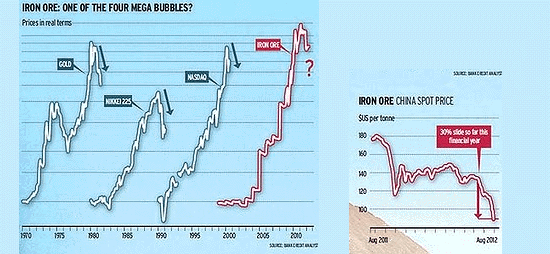
Aussie mining billionaires are losing A$150 million a day. BHP Billiton's earnings will fall by a third and Rio Tinto's will halve. Now the Aussies are worried. In fact, having the A$ as part of your reserve currency basket doesn't seen so smart anymore (that's a fast turnaround - remember it was the rage earlier in 2012). More from Peter Martin at the SMH.
Foreign buying of Australian government bonds fell to its lowest point in three years in the June quarter. The proportion held by foreigners slipped from 79 per cent to 77.5 per cent. Although the iron ore slide itself hasn't hurt the dollar, if foreigners start to believe it will, they could desert it en masse, leaving little holding it up.
Brian Redican of Macquarie Group says it could be the Aussie's ''Wile E. Coyote moment''.
''What we are referring to here is the well-known cartoon character who, when he's chasing the Road Runner, frequently runs off the edge of a cliff,'' he wrote to clients.
''Initially, at least, he doesn't fall. His legs are still running as if he is on land and he remains suspended in midair. But then he looks down and realises that there is nothing supporting him and it is only then that he succumbs to the forces of gravity and plunges towards the valley floor.''
On Thursday, the chief economist at AMP Capital, Shane Oliver, spoke of an US80¢ dollar. He said, if needed, it would fall to US60¢.
What would that mean for us?
4. The [financial] hurricane season
This one's for Bernard, as he stands to win a Five Loaves flat white if there is a major meltdown in September. Coffee bets are an integral part of the conversation here at interest.co.nz. Anatole Kaletsky is on your side Bernard:
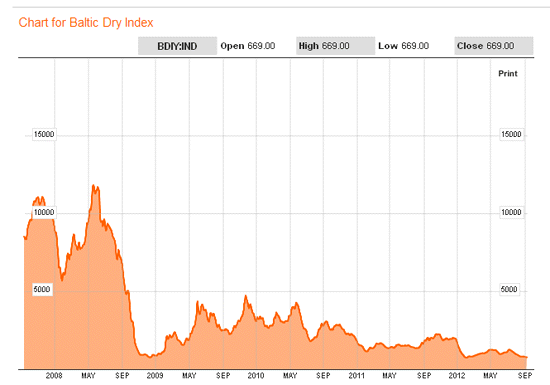
Most of the great financial crises of modern history have occurred in the two months from mid-August: the Wall Street crashes of Oct. 22, 1907, Oct. 24, 1929, and Oct. 19, 1987; Britain’s abandonment of the gold standard on Sept. 19, 1931; the postwar sterling devaluation on Sept. 19, 1949; the collapse of the Bretton Woods global monetary system on Aug. 15, 1971; the Mexican default that triggered the Third World debt crisis on Aug. 20, 1982; the breakup of the European exchange-rate mechanism on Sept. 16, 1992; the Russian default on Aug. 17, 1998, the bankruptcy of Lehman Brothers on Sept. 15. 2008 – and this list could go on.
5. Don't complain
It has been a wet weekend. Abundant reliable rain defines New Zealand; green and relatively clean. And last week, I highlighted the above average rainfall almost all of Australia has received in the past three years. We are the 'winners'. But it is not raining everywhere. It is looking increasingly likely the monsoons will fail in India this year. The NY Times is warning of the consequences:
Drought has devastated crops around the world this year, including corn and soybeans in the United States, wheat in Russia and Australia and soybeans in Brazil and Argentina. This has contributed to a 6 percent rise in global food prices from June to July, according to United Nations data.
India is experiencing its fourth drought in a dozen years, raising concerns about the reliability of the country’s primary source of fresh water, the monsoon rains that typically fall from June to October.
Some scientists warn that such calamities are part of a trend that is likely to intensify in the coming decades because of climate changes caused by the human release of greenhouse gases.

6. "Current prices do not justify talk of a world food crisis"
It is easy to pick one or two items and highlight their trends, but the overall impact is more sanguine. The UN FAO is monitoring the cost of food worldwide:
Although still high, the FAO Index currently stands 25 points below its peak of 238 points in February 2011 and 18 points below its August 2011 level. The FAO Food Price Index is a measure of the monthly change in international prices of a basket of food commodities.
The FAO Cereal Price Index averaged 260 points in August, the same as in July, with some increases in wheat and rice offsetting a slight weakening in maize. Deteriorating crop prospects for maize in the United States and wheat in the Russian Federation initially underpinned export quotations, but prices eased towards the end of the month following heavy rains in areas hardest hit by drought in the United States and the announcement that the Russian Federation would not impose export restrictions. Renewed import demand sustained international rice quotations.
7. Did NZIER get it wrong?
Matt Nolan at TVHE thinks they did.
As we have discussed a myriad of times, a PERSISTENT IMBALANCE is not the fault of monetary policy – it indicates that the real exchange rate is out of whack in NZ for real economy reasons. This could be fiscal policy, this could be an issue an issue of competition, this could be an issue of “impatience” by New Zealander’s.
Macroprudential regulation can be used to help against these issues in a “financial stability” sense – and the article makes the claim that they can help monetary policy BY reducing policial and social pressure regarding factors monetary policy is uninvolved with.
The article DOES NOT say that we should change the PTA to deal with the currency directly – and if that was actually NZIER’s intention I would be more than happy to have a open, and long, discussion with them regarding why this is the case.
8. That poor US jobs number for August is probably wrong
The monthly jobs number is one of the most closely watched indicators of the US economy and, in an election year, can make or break how a president is perceived. Although everyone makes a big deal on the day it comes out, the number is often revised up or down the following month - and very few pay attention to the revision. The Washington Post has the story:
The Bureau of Labor Statistics that compiles the employment data, comes up with the jobs estimate based on a survey of thousands of businesses and government employers. As responses to the survey come in, the bureau updates its estimates.
The bureau acknowledges that the initial jobs figure has a wide margin of error: 100,000 jobs. (That means that 90 percent of the time, the true figure lies somewhere between 100,000 more than the initial figure and 100,000 less than the initial figure. Ten percent of the time, the actual number is off by even more.)
In practice, government economists have tended to revise initial jobs data over the past three years by about 40,000 jobs.

9. Preparing for leaner times
Poverty is returning to Europe and companies there are adjusting to this new reality. Some are rolling out strategies they learned in the developing world. They know how to make this work for them. Spiegel Online reports:
"Poverty is returning to Europe," Jan Zijderveld, Unilever's top manager in Europe, told the Financial Times Deutschland on Monday. As a result, the company has begun offering smaller, less expensive packages so as not to put too great a strain on increasingly limited budgets. It is, Zijderveld noted to the paper, a strategy the company learned by doing business in the developing countries of Asia.
"In Indonesia, we sell tiny packages of shampoo for two to three cents and still earn decent money," he says. "We know how to do it, but in the European boom years prior to the crisis we forgot."

10. Because we can
Its been a while. Besides, 27 million views can't be wrong. Bohemian Rhapsody, almost as good as the original (or perhaps better?).
11. Politics season
This image has been doing the rounds as a 'Freudian slip', but it's just a deliberately doctored photo. The original is below it.



We welcome your comments below. If you are not already registered, please register to comment
Remember we welcome robust, respectful and insightful debate. We don't welcome abusive or defamatory comments and will de-register those repeatedly making such comments. Our current comment policy is here.