

Here's my Top 10 links from around the Internet at 10:00 am today in association with NZ Mint.
Bernard will be back with his version tomorrow.
As always, we welcome your additions in the comments below or via email to bernard.hickey@interest.co.nz.
See all previous Top 10s here.
1. QE-NZ
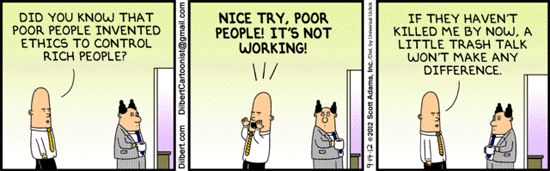
Many commentators have pointed out that quantitative easing would be much more effective if it was done in such a way as to avoid the banks, and went straight to the people who need it.
Apparently, the good folks at the software supplier that upgrades the TSB Bank ATMs got the memo. Kirsty Wynn at the NZ Herald has the details:
Cash machines are not often a bottomless pit of money - unless you bank with TSB. A software glitch has given Taranaki Savings Bank customers an unlimited overdraft facility. One New Plymouth customer was able to withdraw $31,500 he did not have.
Other customers took extra money too, but Martin, also known as Jormah Ewington, was the only one charged. Martin's lawyer, Julian Hannam, said this was because his client was the only one to go back time and again.
"There were other people who could get money but he took far more than anyone else," Hannam said. "The others were treated as a mistake, rather than an effort to appropriate funds which is the scheme that Jormah adopted. He just kept going back."
2. The bureaucrats have acted; can those elected?
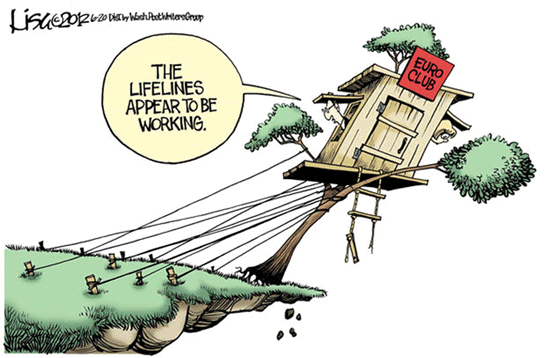
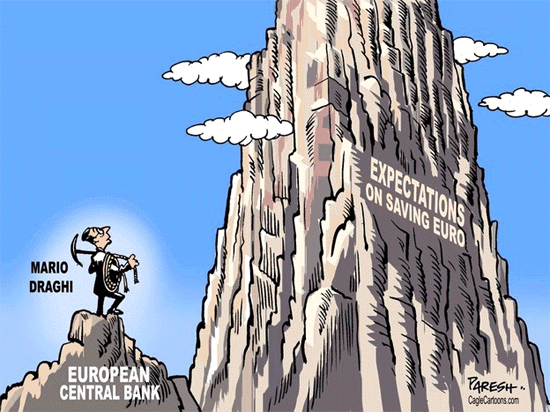
The US Fed has done its part; now it's the US Congress's turn. Draghi has done his thing, can the elected officials do what's needed too? All the monetary policy bullets have been fired; now we need some fiscal bullets, hopefully firing in the same direction. But how likely is that? Deborah Solomon takes a look:
You've got to give Ben Bernanke an A for effort.
After months of signaling, the Federal Reserve pulled two guns out of its arsenal: committing to a new, open-ended round of bond buying that will continue until the economy shows signs of improving, and promising to keep interest rates low through at least mid-2015.
In other words, the Fed will step on the gas for as long as it takes to jump-start the economic recovery.
3. The US's Wile E. Coyote moment
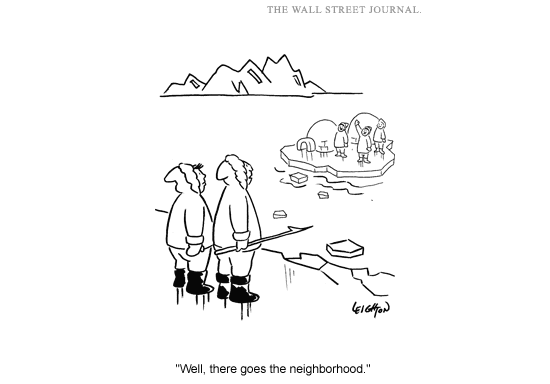
Comparing the US Fed to a rehab clinic offering addicted investors a synthetic high has been a favorite of Wall Street wags ever since the first round of Fed stimulus nearly four years ago. The punch line is that you always need more and more to get the same high and each bout of euphoria is followed by a crashing comedown.
After the frenetic reaction brought about by the announcement of the Fed's latest stimulus program - US$40 billion pumped into the U.S. economy each month - the coming week is likely to bring a more sober period for markets as investors digest what it means in the longer run and turn their attention to the remainder of the year. That will include rancorous US elections in November, wrangling over taxes and spending cuts and a slowdown in corporate earnings. More from Reuters.
4. Good company?
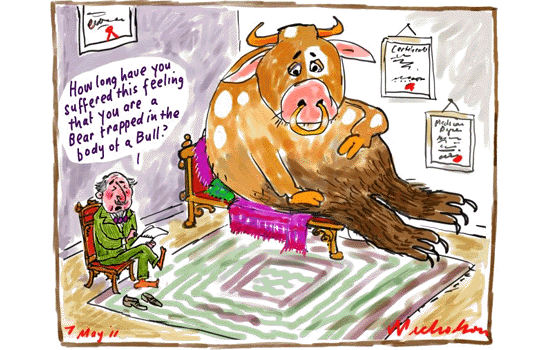
The Aussies are turning away from mining shares as a good place to build their wealth portfolio; they are turning to term deposits and commercial property trusts. Crikey, they are looking more kiwi by the day. Or so says Dave Potts.
5. of Statistics
Which two countries are the kidnapping capitals of the world? Australia and Canada. Official figures from the United Nations show that there were 17 kidnaps per 100,000 people in Australia in 2010 and 12.7 in Canada. That compares with only 0.6 in Colombia and 1.1 in Mexico.
So why haven't we heard any of these horror stories? Are people being grabbed off the street in Sydney and Toronto, while the world turns a blind eye? The BBC explains.
6. "Jobs from startups aren't saving us"
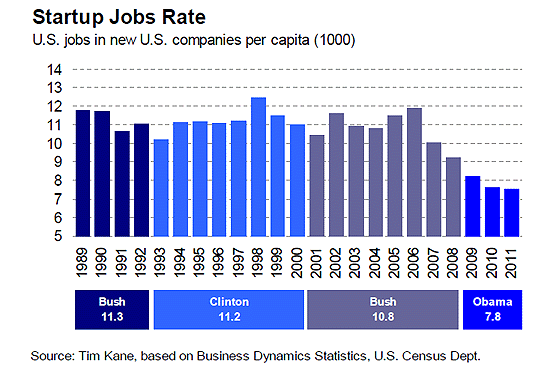
One of the benefits of a vibrant capitalism is 'creative destruction' - where disrupters introduce innovations and power employment along with their success. The cycles of capitalism should show that new companies and new ideas get established when the cycle is at its lowest and the incumbents are at their weakest. This renewal process has a great track record. But who is doing the innovation these days? Apple (the worlds largest company) and GE (the previous holder of the title)? Neither are startups, neither generating many jobs. And recent research in the US suggests something went wrong in the US in 2005/06 which is undermining the ability of startups to create new jobs. Any ideas? Here is the research from Tim Kane (.pdf)
7. Low dimensional thinking?
New techniques for everything from farming to computation interact and combine to drive the creation of more innovations in an ever-accelerating spiral. Paradoxically, technological innovation has also created our biggest problems, including climate change, environmental destruction and the threat of nuclear annihilation. Mark Buchanan, a theoretical physicist, and the author of "The Social Atom: Why the Rich Get Richer, Cheaters Get Caught and Your Neighbor Usually Looks Like You" has a persuasive view:
What comes next? Exponential growth on a finite planet simply cannot continue. If innovation is both the key to our success and the primary threat to our existence, what can we do? Can we innovate differently? More intelligently?
Some valuable thinking on the subject comes from Sander van der Leeuw, dean of the School of Sustainability at Arizona State University, who takes an optimistic view. We may indeed be able to use technology to find a path to a sustainable future, he suggests, if we use our technology in a fundamentally different way.
The gist of his argument: Humans suffer from a mismatch between our thinking about what we do and the truth of what we do. Our brains make sense of a multifaceted world by ignoring much of its complexity -- a trait Van der Leeuw calls “low dimensional” thinking. In engineering a dam, assessing how agricultural runoff influences an estuary or figuring out how automobile emissions might alter the atmosphere, our conceptual models (or those of our scientists and engineers) at best consider only a few of the true pathways of cause and effect. As Van der Leeuw puts it, “every human action upon the environment modifies the latter in many more ways that its human actors perceive, simply because the dimensionality of the environment is much higher than can be captured by the human mind.”
8. 'A fracking good story'
Who would have thunk? CO2 emissions in the United States have dropped to their lowest level in 20 years. Estimating on the basis of data from the US Energy Information Agency (EIA) from the first five months of 2012, this year’s expected CO2 emissions for the US have declined by more than 800 million tons, or 14%, from their peak in 2007. That reduction is more than Germany produces in one year, more than NZ produces in 24 years. Apparently, its the result of some smart, large public investment. Apologies for the spilt coffee, but I have always been a secret admirer of one explainer (who has always acknowledged the global warming trends) and who is pointing out this huge shift.
The amazing truth is that fracking has succeeded where Kyoto and carbon taxes have failed. As shown in a study by the Breakthrough Institute, fracking was built on substantial government investment in technological innovation for three decades.
Climate economists repeatedly have pointed out that such energy innovation is the most effective climate solution, because it is the surest way to drive the price of future green energy sources below that of fossil fuels. By contrast, subsidizing current, ineffective solar power or ethanol mostly wastes money while benefiting special interests.
Fracking is not a panacea, but it really is by far this decade’s best green-energy option.
9. Apocolypse not: Monitoring a dodgy track record
Matt Ridley can't see much difference between the religious or environmental doomsters. But he has been keeping the score on the environmental ones:
Over the past half century, none of our threatened eco-pocalypses have played out as predicted. Some came partly true; some were averted by action; some were wholly chimerical. This raises a question that many find discomforting: With a track record like this, why should people accept the cataclysmic claims now being made about climate change? After all, 2012 marks the apocalyptic deadline of not just the Mayans but also a prominent figure in our own time: Rajendra Pachauri, head of the Intergovernmental Panel on Climate Change, who said in 2007 that “if there’s no action before 2012, that’s too late … This is the defining moment.”
10. Nigel Farage, again
Not sure I could vote for him (I see too much of WP in him), but it is fun watching an articulate sceptic plying his trade of doom - even when his masters have the upper hand on the day.
and ...

We welcome your comments below. If you are not already registered, please register to comment
Remember we welcome robust, respectful and insightful debate. We don't welcome abusive or defamatory comments and will de-register those repeatedly making such comments. Our current comment policy is here.