

Here's my Top 10 links from around the Internet at 10:00 am today in association with NZ Mint.
Bernard will be back with his version tomorrow.
As always, we welcome your additions in the comments below or via email to bernard.hickey@interest.co.nz.
See all previous Top 10s here.

1. A Faustian bargain
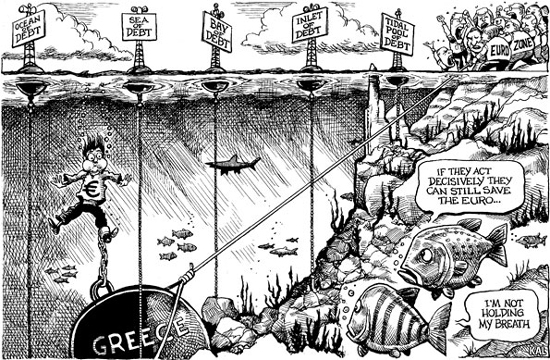
States and banks have made a deal with the devil, says Spiegel Online. Banks buy the sovereign bonds needed to prop states up in the tacit understanding that the states will bail them out in a pinch. But experts warn that this symbiotic arrangement might be putting the entire financial system at risk.
What's happening in Greece right now provides a dramatic example of how a state can make itself dependent on banks. The country is de facto insolvent and can no longer secure any loans on the financial markets. Nevertheless, it continues to be able to secure fresh funds by issuing short-term bonds, primarily to Greek banks, as it has recently to make up for a lack of liquidity as euro-zone member states continue to delay the release of the next tranche of emergency aid. Greek banks, for their part, finance their ailing country not only because the bonds have high yields, but also because they can deposit the bonds as collateral at Greece's central bank in return for fresh cash infusions of their own.
The books of many Spanish and Italian banks are also brimming with sovereign bonds issued by their home countries. They have taken out huge amounts of cheap loans at the ECB and reinvested most of the money in sovereign bonds. The business logic behind this strategy is clear: While the ECB only charges 1 percent interest on its loans, the sovereign bonds have yields of up to 6 percent.
2. Is negative news always true, positive news always false?
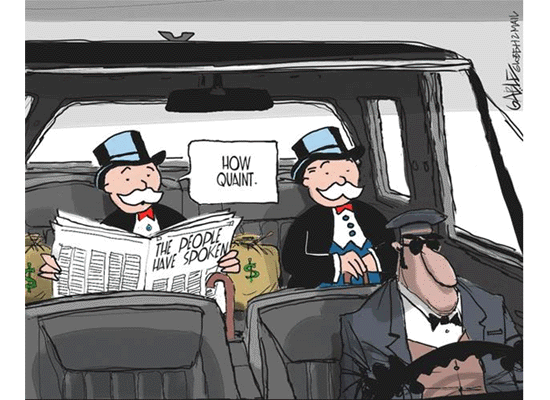
Or, Is it time to cheer up? Just a little? Reject the depressingly negative among us? Look at the data without a doom-filter? Anatole Kaletsky of Reuters thinks it is.
In terms of objective economic and financial conditions, the end of this year looks like a turning point in the slow recovery from the global financial crisis. Outside the euro zone, which now accounts for just 17 percent of global output and will shrink to just 9 percent by 2060 according to the OECD, economic statistics are clearly improving.
Unemployment, though still high, is steadily falling. Banks are now adequately capitalized. Property prices have stabilized, stock markets are rising and credit conditions have returned more or less to normal. For much of this year, the main obstacle to hiring and investment decisions, according to many business surveys, has been uncertainty about politics and monetary policy. That uncertainty is almost over. This may sound preposterous. After all, businesses and financiers have been obsessed all year with the euro crisis or speculation about Fed monetary policy or the U.S. presidential election or China’s surprisingly chaotic leadership transition — and now the prospect that the United States will fall off a fiscal cliff, dragging down the whole world economy.
But that is the point. Political uncertainties have been resolved or dramatically improved in all the most important economies.
Yet business sentiment is so negative that almost nobody believes this. Consider what is happening around the world - with the glaring exception of the Middle East, where war and political chaos is unfortunately quite normal. China has belatedly anointed its new leadership, which should end the paralysis in economic policy and ensure that the country’s gradual adjustment to a slower growth does not deteriorate into an economic collapse. In Europe, the crisis has certainly not ended, but German Chancellor Angela Merkel’s decision to back unlimited ECB bailouts and to keep Greece within the euro, essentially guarantees that the euro will not disintegrate, nor the banking system suffer a Lehman-style meltdown. At least until next October’s German elections.
Best of all, the uncertainty about U.S. politics and monetary policy, which have preoccupied businesses and investors this year to the exclusion of almost all other issues, is about to disappear.
3. Shrinking fast
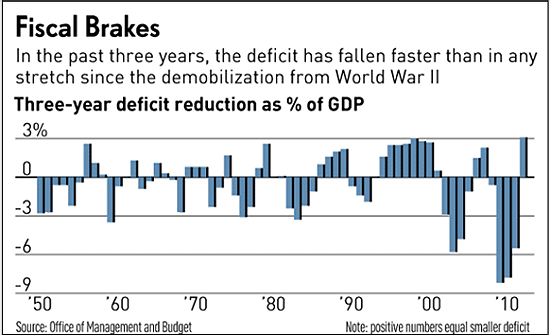
Jed Graham at Investors Business Daily gives us a fact you don't hear much about from Washington's chorus of deficit scolds, the US deficit is already going down at a very fast pace - the fastest rate since World War II demobilization.
Believe it or not, the federal deficit has fallen faster over the past three years than it has in any such stretch since demobilization from World War II. In fact, outside of that post-WWII era, the only time the deficit has fallen faster was when the economy relapsed in 1937, turning the Great Depression into a decade-long affair.
If US history offers any guide, we are already testing the speed limits of a fiscal consolidation that doesn't risk backfiring. That's why the best way to address the fiscal cliff likely is to postpone it. While long-term deficit reduction is important and deficits remain very large by historical standards, the reality is that the government already has its foot on the brakes.
4. 'Stop obsessing about the deficit'
When I was doing my MBA in the US, Robert Reich's writings were assigned reading. Later, his The Work of Nations got him the job of heading Jummy Carter's Labor Department. He is unusually physically small (he has Fairbanks disease), is very smart indeed, and wields big influence. He worries more about growth than deficits. Here is an extract from a CSMonitor piece he wrote last week:
I wish President Obama and the Democrats would explain to the nation that the federal budget deficit isn’t the nation’s major economic problem and deficit reduction shouldn’t be our major goal. Our problem is lack of good jobs and sufficient growth, and our goal must be to revive both.
With more jobs and faster growth, the deficit will shrink as a proportion of the overall economy. Recall the 1990s when the Clinton administration balanced the budget ahead of the schedule it had set with Congress because of faster job growth than anyone expected - bringing in more tax revenues than anyone had forecast. Europe offers the same lesson in reverse: Their deficits are ballooning because their austerity policies have caused their economies to sink.
The best way to generate jobs and growth is for the government to spend more, not less. And for taxes to stay low – or become even lower – on the middle class.
5. Using gold nanoparticles and light to produce hydrogen - future fuel?
In a rather remarkable achievement, researchers at Stony Brook University and the Brookhaven National Lab in New York are producing hydrogen from water using light and novel nanomaterials based on gold. The researcher says his project is first ever demonstration of the potential of using metal nanoparticles to make fuel from water.
Using nanotechnology, Professor Orlov’s group found that when the size of metal particles are reduced to dimensions below one nanometer, there is a tremendous increase in the ability of these particles to facilitate hydrogen production from water using solar light. “This is the first ever demonstration of the remarkable potential of very small metal nanoparticles [containing fewer than a dozen atoms] for making fuel from water,” said Professor Orlov.
6. Bureaucrats with a plan
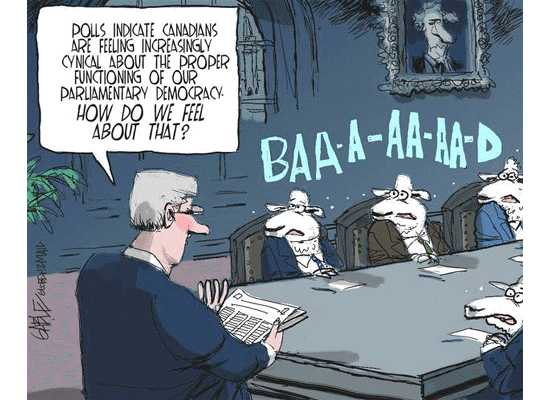
"Financial repression" is turning out to be the main way governments plan to escape the clutches of the debt-induced trauma they are suffering. Pity the savers. At least in New Zealand basic returns on savings are higher than the inflation rate. (Cue whiners who think otherwise, but you are wrong, at least at this time.) The problem is that a growing body of expertise is building on how to extend the 'repression'. I think that is one reason equity markets are taking off even in New Zealand. For the first time in a while, good dividend yields plus rising share prices make public company shares look attractive to first-time investors.
But New Zealand faces sophisticated 'repression' risk if what we see in other countries is any guide. What do you think the risk is of NZFirst or the Greens pressing for KiwiSaver or the Cullen Fund to invest more in NZ infrastructure? That is how 'financial repression' is more likely to come here. Here's how it is working out in Europe.
Many countries, including France, Ireland, and Portugal, governments have raided pension funds in order to finance their budget deficits. The UK is poised to take similar action, “allowing” local government pension funds to invest in infrastructure projects.
Direct or indirect monetary financing of budget deficits used to rank among the gravest sins that a central bank could commit. QE and OMT are simply new incarnations of this old transgression. Such central-bank policies, together with Basel III, mean that financial repression will likely define the economic landscape for at least another decade.
7. QE a 'time bomb'
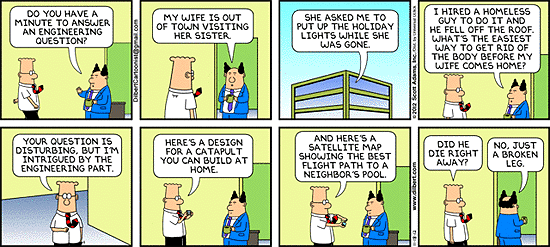
Economist Stephen Roach worries that the US Fed's approach to stimulating their economy will lead to another bubble. Roach also discussed with former FDIC Chair Sheila Bair and other panelists at Rand Corporation's Politics Aside conference in Santa Monica, Calif., whether the government will resolve the fiscal cliff. Roach is a former non-executive chairman of Morgan Stanley Asia; senior fellow at the Jackson Institute for Global Affairs at Yale University.
8. Laboring with the truth
I have been following Julia Gillard's "union slush fund" troubles as reported by the AFR mainly because I had a run-in with both Slater & Gordon, and the AWU (minor ones) in a previous life. Neither seemed to me to be high in ethics. But what seemed at first to be a relatively minor issue has now assumed bigger proportions given the Victorian Police have launched an investigation. After surviving Tony Abbott, Julia G may be about to trip over her past.
Victorian police have confirmed the fraud and extortion squad is assessing a file that relates to the alleged misappropriation of funds from a union. In a statement, Victoria Police said they were not in a position to confirm who may or may not be involved in particular investigations, or who provided statements to police.
The confirmation comes as a former union official is expected to tell police on Friday about his involvement in a slush fund scandal being linked to Prime Minister Julia Gillard. Former Australian Workers Union (AWU) official Ralph Blewitt said he would meet Victorian fraud squad detectives at 10am (AEDT) and give a detailed account of misappropriated funds.
9. Calculated risk
Follow the data is the big message from Bill McBride. He is a blogger who has been hugely influential for those of us who follow the wierd world of economic trends. BusinessInsider has done a profile. HT Dan Bell.
The economics blogosphere was invented in early 2005 by a retired technology executive in Southern California named Bill McBride. Thank God for that, because his blog, Calculated Risk, has been an invaluable and influential read for numerous reasons. For one thing, it's always been right.
In its early days, when we all started reading it, it was way ahead of the curve in terms of warning about the housing bubble, horrible bank lending practices, and generally the economic collapse. From his perch in Newport Beach, CA he could see first hand the people taking out loans worth 10x their income, filling their Inland Empire garages with Harleys and Boats that they obviously couldn't afford.
But unlike many other bloggers who made a name during the crisis, he didn't stick with the doom and gloom message. He started making arguments for a GDP rebound in 2009. Then in February of this year, he made his most important call: He announced: The Housing Bottom Is Here. McBride had officially come full circle from his days warning of housing collapse. Today, 8 months later, the housing bottom is becoming general consensus.

10. Another reason why NZ is way better
I'm very lucky indeed, compared to this English guy.

We welcome your comments below. If you are not already registered, please register to comment
Remember we welcome robust, respectful and insightful debate. We don't welcome abusive or defamatory comments and will de-register those repeatedly making such comments. Our current comment policy is here.