 At some point, we were going to see an ideological stand-off over electricity, but to put the current Labour/Green vs National stoush into perspective requires a dispassionate examination of everything involved: money, energy, and growth.
As good a place to start as any, would be a lecture given at Otago University a couple of years back by old Labourite David Caygill, wearing his Chair of the Electricity Commission hat.
In answer to the inevitable “why do our power-prices always go up?”, he replied 'Well, every time new generation is required, the cheapest of the available options is usually chosen. This means that each new one is more expensive than the last, and it has to be paid for”.
I challenged him, that his 'more expensive', actually meant 'takes more energy', but he didn't get what I was driving at.
We always pick the lowest-hanging fruit first, a sequence which applies to all activities, and all energy sources; the best dam sites, the best transmission options, the sweetest oil, blackest coal, windiest hill, sunniest site.
It follows that each subsequent choice will be of lesser quality – which has traditionally meant it will 'cost more'.
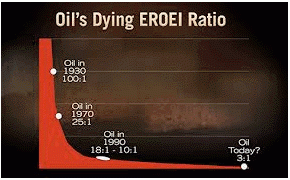
With energy, the way we measure this regressive process is by monitoring EROEI; Energy Return on Energy Invested.
It takes a certain level of EROEI to maintain our current level of activity, and as we descend towards (and through) that point, things go from 'easy', to 'harder', to 'too hard'.
Given that no work happens without energy being used, this tells us that physical growth – as opposed to piling up digital dollars – is limited.
At some point, the next-best option will be rated 'not worth doing'. More accurately; not worth doing at any price.
If you are down to needing a kilowatt of power to generate and transmit a kilowatt of power, or a barrel of oil to produce a barrel of oil – an EROEI of 1:1 = it won't happen. No amount of investment will alter that fact, although the funding of research may delay it's arrival. Clearly, at that no-energy-return point, 'price signals' cease to have any meaning at all.
The current 'debate', being played-out under ideological rules on a historical fiscal field, misses EROEI completely.
Competition, of course, happens physically as well as fiscally. In a zero-sum game, the choice to become a shareholder is the choice to advance yourself at the expense of someone else. The altruistic approach – the Labour-Green one – is to share it around more equitably. Both ideologies blame something other than the cherry-picking, ultimately based on EROEI, for the 'increasing price' of energy.
Both are wrong, and until we have leaders who understand this, we will continue to miss the main event.
The real story is that we are competing – Left, Right and globally, by bidding or warfare – for a dwindling supply of good-quality energy.
Money seems to be mentioned in every sentence of this debate, yet remains totally unquestioned. If you could become unlimitedly wealthy without raiding the physical world, we would have no need to water-down the RMA, fish unsustainably, avoid sequestering carbon, intensify dairying, mine Conservation land, frack, deep-sea drill, sprawl urbanly – all of which we are doing.
Accepting, then, that a physical-growth-based (energy-growth-requiring, in other words) system is doomed to stop growing at some point, and that our current growth-based fiscal system requires that physical growth to back it, then we can assume that the fiscal system will be in trouble. For instance; if the 'money' you expect to earn in the future requires the future availability of energy, and good-quality energy at that, how will it be earned if the energy is unavailable?
At what point will the absence of 'investment capital' actually represent a lack of energy – a lack of grunt – to do anything?
We need to frame this debate, then, in more than monetary terms.
Electricity is a competitor in the energy field, but in our case, it is largely renewable; the existing EROEI of – say- the Clyde dam, doesn't alter much over time. Fossil energy sources, being non-renewable, will be cherry-picked down to a point where even though it is less convenient to cart around a back-seat full of batteries, we will attempt to do so. Then trucks? Tractors? The returns from going down that road – surprise, surprise – will diminish with time too; we'll be cherry-picking the best first, as always.
Where to from here?
Firstly, efficiencies. Sure, we'll initially pick the low-hanging fruit there too, and it will require more and more effort for less and less return over time.
But we haven't scratched the surface, efficiency-wise, and one of the reasons is that we have been undervaluing the resource. Show me the politician telling you that!
We simply leave the lights on, the heating on, the TV on standby; without equating our actions with the fact that we are lowering the level in a dam somewhere, to no good purpose.
When more-than-averagely enlightened politicians suggest legislating for efficiency, we bleat 'Nanny State'.
We vote for whoever promises us our electricity cheaper, even as we waste it.
In the ultimate of ironies, if it was more 'expensive', we might use it less casually.
Primarily, though, this is neither a fiscal nor an ideological issue, it is an energy one.
How about we have the energy debate first, before we haggle over who gets what?
It matters little where you place the cart, if the horse is missing.
--------------------------------------------------------------------
Murray Grimwood says he is "a Columnist, and a Generalist specialising in energy efficiencies". He comments on this website as Powerdownkiwi. You can find out more about him here ».
92 Comments
Congratulations Interest.co.nz for having the kahunas to publish this. Thankyou Murray for taking the time to compose the piece. Now if the Herald has the balls to publish this then we might actually be getting somewhere, but I am glad for the progress that has been made.
The most telling comment is about finding leaders that understand. Perhaps some readers with critical thinking ability might step up to the plate to become leaders.
There is a striking contrast to this article from a regular correspondent in total denial about energy floating about and I expect it to turn up on interest.co somewhere. But at least some people with brains get it.
More EROEI nonsense ...
Just when will so called commentators learn this ratio is totally meaningless as it excludes price.
It is perfectly rational - and is happening as we sleep in ever increasing volumes to recover oil from tarsands by using a significant portion of the energy of the oil in the low cost tarsands to produce a much lesser quantity of much higher priced crude.
The EROEI is totally irrelevant !
If a process were to consume 2 bbls of oil costing $20 to produce 1 bbl of refined oil valued at $ 100 then this is perfectly rational.
EROEI has nothing whatsover to do with this perfectly valid proposition.
JB - please read the piece again, sans prejudice.
Price is money, and money is underwritten by? Bootstraps come to mind!
Once, we only needed a barrel of oil, to produce 100 (in energy-delivered work-doable terms, not your apples with pears version) , and at 1:1, there is no energy gain. The question is: where is the point on the decline, when BAU - with never more balls in the air - cannot be maintained. And when we might cross that point.
Money is underwritten by human greed and human ingenuity in looking for ways to assuage that greed. No reason to think there is a limit to either of those.
Consider a quantity of fossil fuel in the ground, with no human intervention; and a community of humans, with no access to fossil fuels. Which will result in the creation of economic value?
Consider a wild horse and a horse which has been trained to respond to guidance and command. They are the same age, weigh the same, eat the same, contain the same amount of raw energy. So are they both of equal value in meeting human needs?
What is your take on why a barrel of unrefined oil costs $20 and a barrel of refined oil costs $100?
To extract new sources of un-refined crude oil right now costs about $80~$90USD a barrel, thats the margnal cost of new capacity. Old oil might be $3 or $10 but the rice we pay is that marginal cost.
So I dont understand the context of what you are asking with "What is your take on why a barrel of unrefined oil costs $20 and a barrel of refined oil costs $100?"
regards
MdM - you miss the point.
Numerical dollars are irrelevant, as is the obfuscation of 'value-added.
This is the energy-content of the barrel we are on about. Regardless of what you 'value' the energy content of a barrel as, if it takes the same amount of energy to produce one, as it returns, it isn't going to happen. AT ANY PRICE.
The $20/$100 obfuscation is merely an attempt to pin a proxy-number on the usefulness of the energy in the form it's in. Means nothing,
The horse analogy suggests you are thinking, but it's flawed, with respect. The trained hores will represent more embedded energy, perhaps (energy required to produce hay, build/supply barn, fences, saddlery, food in the belly of the trainer), but in energy terms, 'what they can do on the farm', so far outweighs the energy needing to be embedded to train up the wild horse, that's a non-comparison.
My analogy is more along the lines - horse-wise - of a horse in a degrading paddock (overstocked, no fertiliser, say). It takes more and more of the day for the horse to eat enough to keep itself alive, leaving less and less of the day for it to do useful work - regardless of training. Eventually, it takes all day eating just to survive - no extra work available (EquIne EROEI at that point? 1:1). My question at that point, is whether either horse is worth anything?
Nat Radio Wortld-Watch (a sage and deep-thinking programme usually) Sunday before last, had a BBC/dochebelle piece on declining populations being a worry in Europe. Worry came down to 1 or 2 people too few, per house. Oil is used as if we had 300 people working for each of us, 24/7, no rest/no eat. 1 or 2 vs 300? It's a nonsense comparison - may I say.........horseshit.....
I question the validity of your dismissal of MdM's horse analogy PDK.
Beasts of burden are basically solar. Sure, they cherry picked fossil fertiliser first, but empires were built and sustained for thousands of years using beasts. The empires usually met their demise from a competitors breakthrough in military technology rather than diiminishing EROEI.
You also give the impression that a complete understanding of the fundamentals of EROEI is unique to one M. Grimwood and a handful of cronies. Far from it Muzza; the percentage who do may be small, probably about 1.5% in New Zealand, but that is 60k individuals, and many of those early understanders are also early action-takers. That percentage on the graph is not too far away from point where reality kicks it into an upward trajectory. Human behaviour nearly always does the hockey stick on a graph.
Diminishing EROEI at the end of the fossil fuel era is not the portent of catastrophe. It will be the catalyst for a mass awakening. Not just an awareness of energy fundamentals, but more important an awareness of awareness itself.
The fossil fuel era, from an historical perspective, will be too short to be called an era. More like an embarassing blip in human evolution.
VF - ah, but was it more efficient military technology? I challenge you, though - Empires have none-bigger supply-lines to defend, which takes ultimately unsustainable effort. Shows up in the likes of the energy balance-sheet of the invasion of Iraq. Nagasaki is the ultimate in military EROEI - not much expended but a helluva return. :)
I hope more folk know, but there's only one columnist/reporter stating the case (that I'm aware of) and no public debate. Proof is that most reporters don't factor it, don't get it when fed, and peddle horsepoo as a result.
You're right about the blip, and awareness. Although it may just drive a stampede in the direction of religion/bigotry/ignorance.
go well
I have read resonably convincing arguements that the amount of damage able to be inflicted by one person hasn't change much over history, it is just increasing larger cooperation (and so peoples energy) going into the supply chain, building and deployment of the weapons. Measured this way, the per person lethalness is pretty much the same of a sharp rock and a nuclear weapon (it is just a lot more people's effort went into producing the latter).
In that sense Nagasaki was a very large expendature of energy to cause a large amount of damage.
I think the main article on this was then arguing that this is the main reason we have never seen terrorists use WMDs to do large scale damage (rather than, say John Key feeling that it is prevented by the GCSB spying on New Zealand citizens)- that getting enough people together to carry out such an attack gets you over the threshold where someone is likely not to keep it secret.
No, I think you are missing mine through your continued and consistent refusal to recognise that it is human greed, and ingenuity in the service of that, which is the fundamental driver of economic activity and creator of value. Physical energy is an enabler, but not the motivator, of that. Fossil fuels are merely one form of energy.
Do you really not see that the main difference in usefulness between the two horses is that the one of them has been enhanced through the application of human skill? Compared to that difference, the different energy input is trivial.
The relative price of different forms of energy does not mean nothing. It is a measure of the relative value that humans attach to energy in a particular form, which in turn reflects the use they expect to be able to make of it. It provides essential information to guide the effort that it is worth making - which includes, but is not limited to, energy input - in order to convert it from a form that humans value less, into a form in which they value more.
WTF? What on earth gave you the impression that I consider financial profit bad and government taxation good? On the contrary, I'm strongly in favour of freedom and personal responsibility.
Please point out what I said that suggested otherwise and I will try to explain myself better, for you have completely and utterly and 180 degrees misread me.
MdM - I'm gonna quote this one in a lecture later this year, to some physics students, if you don't mind:
"the effort that it is worth making - which includes, but is not limited to, energy input
Cracker. Thanks.
Please state this clearly: You do not think that any value is, or can be, added to anything, by the application of human skill. Your position is that a person who expends the same amount of energy creates exactly the same amount of value, no matter how skilfully he uses his hands to create something of use, or uses his brain to influence others to do so. A fallen tree trunk which has been carved by a craftsman into a serviceable canoe and a set of paddles is of no more value than the same tree trunk along the top of which the same man has spent the same amount of energy doing the cha-cha. You believe that you have achieved nothing more by writing this article than I would have done if I had spent the same amount of time on the same computer typing out the words "Richie McCaw" until I had used up the same number of words. Yes?
MdM - you'd be pleased with the wee bit on Nat Radio Business at midday. Looks like to maintain the chimera, they are indeed going to include all kinds of stuff in GDP. Smoke and mirrors. It's an acknowledgement that the physical planet cannot underwrite the 'growth' that 'pollies need to hawk to stay in the game - haven't heard it put better.
Read my piece again. The Nats wouldn't have to have tried any of their physical expansions, if unlimited wealth could be had from 'value-adding', or 'creating out of thin air'. Adding, of course, has the prerequisite addenda: 'to something'.
The 'dollar' gotten from 'value-adding' (or from pinging-on an existing item like a house for 'more', from charging profit, interest) still expected to be able to purchase part of the planet. (That which circulated artificially cancels itself out, in physical terms, and the numerical representation of course, is as irrelevant as it is artificial).
It sort of worked while the supply of parts, and the energy to supply them, ramped exponentially; the ever-increasing collective total of cranially-held underwrite expectation - with the odd stumble - more or less underwritten. Not the forward expectation though.
Had to fall over, and it was very easy to see when.
PDK - Do you and your family live entirely off your block of land? According to the aritcle in the ODT that was published in 2009 you hadn't at that time of publishing achieved that.
http://www.odt.co.nz/your-town/dunedin/41143/life-grid-one-pioneering-f…
If your lifestyle block cannot support yourself and your family then there would be a lot of wasted energy/resources. You have to freight in fuel for your generator, you have to travel to work, you have the cost of batteries and the disposal, as you have limited power sources it would appear that an electric car would be out of the question and the article in the ODT 2009 said you have a landcruiser and tractor.
The energy used in the manufacturing and running of both would be considered high by some people's standards. I hope you have factored these costs into your energy usage equations.
Have you completed total energy consumption comparisons if you lived in the city vs Waitati? Have you compared city vs rural energy use? And who is the most efficient user?
Notaneconomist - you miss the point.
Who cares if we live entirely off the land or not? We happen to capable of doing so if we wish - at least for a long period of time (like Cuba, really). What's that got to do with the article? Attempting to shoot the messenger, perchance? Not part of the National Party?
Why would 'there be a lot of wasted resources'? That suggests you don't mentally separate unsustainable-in-the-short-term economic potential (which describes most NZ farming) with resource husbandry. Same failure the the current Govt is guilty of, and DoC too.
Compared to what, is the question. Only one of us works, part-time at that, and car-pools or uses the bus.
Neither the landcruiser, not the crawler, have turned a wheel or a track in 4 years. They are existing bundles of build-energy (1985, 1936) which I might use - sparingly - if ever needed. Seems we are past that, so far. I don'y think you 'hope' anything, I think you're attempting to belittle.
Electric cars might be valid in this country - particularly post-Tiwai - but not globally, they'd be fossil-fuel cars. I prefer my bike and the trailer, which can cart a 2 meter-long load of up to 100kg. Takes energy, but it's mine, eaten off the land. Leaves me healthier, too.
Yes, we are ahead by a country mile - so to speak. Ex grains and milk, we can be self-sufficient in food, we make all our own power, the generator use (it was a deliberate programme of reduction) is nearly zero now. Electrically, we get by - comfortably - on 1.5 kw/day. House heating is nil. Water heating is some wood, increasingly solar, heading for 100%.
Generally comparing rural and city is fraught with too many variables, but it's a foolish track to bother with. Both, generally, are based on fossil fuels, both are in physical overshoot, care of a species in biological overshoot, and the energy which fuelled the short hiatus is on the way out.
I'm leading by example, comfortable teaching and demonstrating how to do so. You?
PDK - Well I would have to point out that you consume more than you provide. You don't have a surplus for exchange. Efficiency is therefore lacking from your model. Someone else is having to provide your shortfall and that was why I asked the questions above.
If you put the existing bundles of energy to use you might be able to deliver a surplus whish is then tradable. If everyone can produce a suplus in their particular area then a more sustainable life is achieved as we each have something different to trade.
Sustainable is always being able to produce a surplus with the resources you have at your disposal. It would appear some people confuse inputs = outputs as being sustainable.
Resources may have a shelf-life but I think it is important to remember that humans have an uncanny manner in solving solutions and the mind of man is indeed extraordinarily inventive. Like all things in life we can invent positively or negatively.
Kindly read the article, and study physics.
And sustainability. Your version requires infinite growth on a finite planet - who fed you that crap? It's another I'll lift for lecturing with. Classic.
The shortfall is not 'made-up by someone else', it's made up by fossil fuels.
In energy terms the human brain can only address primary sources and efficiency of use. It's too late for an idea - or an efficiency - to save us from triage, post peak oil.
Could I respectfully suggest that instead of sniping from an ideological/ignorant point of view, that you take time out to do some homework? Drop by; I'm happy to explain - do it all the time.
http://www.resilience.org/stories/2013-04-22/social-justice-and-solar-equity
PDK - Obviously I have hit a nerve.
By my figures PDK is currently using about 5% of the average energy every New Zealander consumes. Seems like a pretty good every to me, not a percentage but a multiple. What is your energy balance NAE.
So you do understand EROEI.
You really need to get past the huge libertarian/austrian political blinkers you wear because it will blind side you.
The rest is wishful thinking or a belief that something or someone else you dont understand or know will save you. Which is an interesting clash of your outlook...on the one hand, the person or individual is most important, on the other rely you on others or a society to dig you out.
regards
This is either a troll, or from your post I dont think I can make it simple enough for you to understand, but I'll try.
Consider the phrase "robbing peter to pay paul"
I take it you understand that and have no issues with it?
Then that money is an IOU for work / energy.
So you go to work to earn money to buy either energy, food or things made with energy, very few exceptions to that rule.
So money is a proxy or IOU for energy, ditto gold is exchanged for energy or work.
So Energy return on energy invested means to get 20 barrels of oil out of the ground to your tank in the car costs 1 barrel of energy.
Tar sands gets about 5 barrels per 1 barrel...(at most 6). So to get 20 barrels of oil uses 4, leaving you with 16 barrels
With conventional oil I'd get 80 barrels for 4 barrels put in.
Can you see the scaling effect?
Convert that back into money at $100 a barrel
I would spend $400 to get $1600 or I could spend $400 and get $8000
Which profit margin would you prefer?
Now lok at our global economy, to function as it does today takes between 8 and 10 barrels of oil out for every one invested.
Tar sands only does 5
So toget that 10 you have to be "robbing peter to pay paul"
So our global economy cannot survive on that 5 to 1...
A claasic documented example is the US making ethanol from corn driving up the price so mexicans go hungry.....
So, no you are not "perfectly rational" as you have failed maths, physics, engineering and oil-geology, let alone economics...
regards
At times I wish I had written some of the pieces you have written, this is well said IMHO. Other times..........LOL
"change" hence why i call some ppl carrot pullers...
Perl is an interesting example, I hate coding but there are times, a few a year I wish I could code. However to code to a level that would be adequate for a "professional" output / finish would take a lot of my time for little gain. P*sses my management off no end on occasion they dont like paying contractors for work they consider their staff should be able to do in house.
Solar panels v peltic wheel. I think the peltic is victorian so 150 years on the examples out there are still going strong and are easy to fix, ie the society and engineering complexity is low. Solar panels however require a very high level of society and ppl specialisation, both of these seem to be a function of population size. Since we cant feed 7billion without fossil fuels and tahts past peak and gone by 2050 at the best we will never again have a society this complex and hence solar panels will at some stage be gone also.
So solar is probably a transitional technology, peltic wheels could be indefinate.....
regards
Net energy is what gives money its value, if there is no net energy left as the extraction process takes it all, money has no value. Further due to how our economy works that ratio isnt very good, ie 6 or 8 to 1 is probably it. So once we get to the point that we only get 6 or 8 barrels of oil out for every 1 invested the game is over for our global economy. That ratio looks really close, inside 20 years max and probably inside 10.
regards
Do these comments apply?
Our electricity comes from rain. So what if a damn level lowers as power generated. It rains later on (sure we could drought proof further). Why should we not use, and why should power consumption be used as a tax gathering mech to direct $ somewhere else.
Presently NZ does not waste energy compared to Australia or USA.
We could see the "use less" comments if we were a state that imported our fuel stocks, such as Korea, Japan etc. Or used atomic.
We do agree that power use by RIO is probably not first best use if thinking on behalf of nation state...
The paradox is, if we used as much power as RIO the price would be almost nothing.
Remember Al is known as frozen electricity...
If anything our systems need be further aligned to the ebb and flow of rain.
http://en.wikipedia.org/wiki/Energy_in_New_Zealand#Energy_consumption
Looks to me like we still import a fair percentage of our energy even if it isn't used in electricity generation. So what we possess that is renewable is still relatively important.
So 35% of NZ's total energy consumption comes from renewable sources.
Does anyone have a source that shows when NZ last used 35% of its current capacity? I suspect it was in the 1950s but at this time there were 2m New Zealanders. To find the equivalent of 35% of current energy per capita would probably take us back to around the 1920s. That's some lifestyle drop. And we are in a better position than most of the world.
I think the number is 70% of our energy use is typically transport fuel. How much of that do we make in NZ?
not a lot.
What does our food need? want to try an overhead powered tractor?
regards
Effectively up until the industrial revolution (coal and then oil) we lived on the annual solar limit.
I think only something like 65% of our power is renewable, and thats not transport fuel which can be typically 70% of our energy use.
The rio case is interesting and hence why I cant see a large buyer like pharmac cant get similar prices, either that or in effect we as consumers patung 23cents are heavily subsidising business and rio in particular.
If thats true and I suspect it is then its probably better for our National economy if rio is kicked out.
regards
Actually our fossil fuel use is comparible to OZ and the US and its hefty.
Hydro electricity doesnt power cars at the affordable price point that fossil fuels do...and never will.
regards
Henry - given that rain is solar, as is wind....... How about we align with solar gain? Just one step back, but it eliminates seasonal noise.
Water we store, not able with solar yet (we use solar electic fencing - but less than before), gave wind mill power pumping for stock water away ages ago...
PDK,
Well done on coming out of the anonymous closet.
Am sympathetic to the idea of using less fossil fuel based energy if plausible, for both peak energy (or at least as you point out, now very difficult to get at oil in particular) and climate change and other pollution reasons.
Given NZ is relatively well placed with renewable energy, then from a planet point of view it would seem to me that Tiwai Pt remaining an aluminium smelter may actually be better than it being replaced with a coal based plant somewhere else; so hopefully Rio will either enter into a new contract, or sell to someone who will. That might well keep NZ's supply and demand in relative balance, and still allow plenty of scope for something like the Labor Greens proposal to improve the functioning market for the benefit of consumers. I understand the Greens may push for some ETS lifting to achieve your price preferences to some extent as well. Assuming they also buy into an efficient government model then that would be okay with me as a form of tax, but all that is really an aside.
I understand low hanging fruit, and that no doubt has been true with oil exploration. Conversely many technologies of course have a form of Moore's Law; where the effectiveness of a technology improves and it's cost reduces. LED lighting will get cheaper. The first solar power companies cannot survive because their technologies have been usurped exponentially by new technologies. It won't be long before every house can and will likely have it installed. Windmills have become cheaper. Geothermal technology is considerably improved, and can work in smaller plants.
So, I'm not personally convinced we should all put up the growth shutters just yet, and certainly not from a market share perspective. But we should be trying to do it cleaner, and as cheaply and efficiently as practical. As noted previously I actually think demand from an ageing, and soon shrinking, rich world population (including China) will slow growth before energy shortage will; but time will tell.
Everything you comment on is good, but the thing that will hurt us is the lack of transport energy, as our agricultural / food system just cant get by without a lot of fossil fuel input at least to feed the world's population as it stands.
Second, yes NZ is the place to be...we are I hope going to be the best placed 4~6million ppl on the planet over the next 30 years, Im glad my kids are here...
But consider that as the Titanic sunk the lifeboats kept clear for a good reason so the ppl in the water wouldnt swamp the lifeboats. NZ cant move.
regards
Hi Stephen L........um , been well known round here for a long time who he is, you have not clicked on a number of past links put up there have you..... naughty man.
Well done PDK, it is not that easy writing whole articles. I think I agree with Stephen L, that it is not time for New Zealand to close down growth shutters just yet, but this issue cannot be ignored either.
I remember attending a forestry lecture once where this guy postulated that the collaspe of the Roman empire was that Rome exhausted the easily obtained supplies of wood. At the start of the emprire wood was obtained by a few km's of cartage but by the time of the empires collaspe wood to fuel heating and industry (pottery and metal work) was being shipped from North Africa. Destroying cedar forests, causing desertification etc. I think that pattern fits with the low hanging fruit and declining returns of energy invested to energy output argument.
So the stone age may not have ended with a shortage of stones, but the Roman empire may have ended with the shortage of wood.
But there is also the idea that Rome collapse was caused by its extractive dictatorial model. That because it lacked inclusive political and economic institutions, creative destruction new innovations that would have solved the energy problems were not developed. Especially towards the end of the empire, where power went to those who could form and protect a leadership coup.
I once listened to the then Mayor of Central Otago - a PhD in something agrarian, from memory - opine at a public gathering, that " The stone age didn't end for want of stones, and the oil age won't end for want of oil".
It takes your breath away - that someone in a leadership role, and clearly capable academically - can confuse 85 million barrels-per-day, and an equivalent amount of coal, roughly speaking - with a pile of inert stones. I suspect the phrase is mostly trotted out as spin, nowadays.
Did it occur to you that the 'extractive model' needed energy to do the extracting? Takes tillage, carts, horses, road-making, defence, storage - and that's just imported grain.
There was no shortage of wood, just the energy needed to bring the wood as the distance was too far away for it to be economic to do so for what ppl would "pay".
Now translate that into oil.
"dictatorial model" You really shoudnt allow your political blinkers/bias into your calculation/logic...its defeat the probability of getting a right answer IMHO.
regards
There are those here (MdM) who propose that wealth is created by greed. While PDK and others say that wealth is created by energy (or more exactly from high EROEI). There is elements of truth in both of these ideas. But I believe the greater truth is wealth is created by freedom. Free places have the rule of law, equality, education etc. They protect the weak with clever disruptive ideas from the powerful status quo. They have inclusive political and economic systems.
Using my Rome example most of the society was stuck in their prescribed roles of serving the elite. It was an exploitative society. Greed was no use to the slaves propelling the galleys that carried the wood. They could not innovate any better solutions. And the elite was more interested in protecting their position at the top of economic pile than in fostering greater innovation to make the pile bigger.
There was hundreds of things that Rome could have done better. They could have invented better sailing ships, wind mills, water mills, steam engines, electricity etc. Declining EROEI from a historical perspective appears predictive but it is not.
I have never - EVER - stated that wealth is created. By anything.
Wealth is the ability to buy a bit of the planet, processed or not.
It is underwritten, therefore, by the availability of said pieces.
Which require energy to be produced.
Don't mix yin/yang competition (shareholders vs consumers, slaves vs elite) with that ultimate underwrite. The two are entirely separate.
But you are correct re powermongers/leaders not wanting to change. Why would they? Why change a regime you think you're 'winning' in? The problem comes when you keep wanting to short-term win, but the process creates a long-term loss. The long-term loss in this instance, is 5-6 billion people, 2-3 deg. warmer planet, unaddressed impacts (degradation) and reduction in energy - both quantity and quality - available.
Even the Green leadership promise growth - in light of the above? Go figure.
PDK I would like to add that I prefer the greenies to the greedies : ). But I most prefer for New Zealand social democratic politicians who promote an old fashion mixed economy. This Neoliberal experiment of the last 30 years is the greedies vision writ large. It is not sustainable from a social and an environment perspective.
Not sure it was a 'neoliberal experiment. Think it was collective insecurity (those who have to be their status, rather than themselves) running into an ever-reducing list of available opportunities.
Will Catton wrote 'Overshoot ' in 1980. Worth a read.
Just remember that Labour have no answers - theirs is just the same growth philosophy that will kill off our species, if carried to it's illogical conclusion. Is that any more sensible because the roll of short-term beneficiaries has more/different names on it?
Not sure whether this echelon of Greens know, but are baing clever, or really believe the economics horespoo.
Completely agree with you about freedom. It's an absolutely essential precondition.
Not saying that greed is good. I'm saying that like gravity, it's a fact of life and a very powerful, reliable, predictable, consistent and inexhaustible force of nature. And like gravity, it can be used - you can exploit it to deliver the results you want. Or you can try and work against it; but that requires constraining individual freedom.
Greed can be used to deliver the results you want, as long as that is underwritten by the resources that support it. Or put it another way, exploitation only goes as far as the exploited can pay. That is for people or planet.
No, the principle is broader than that. "The results you want" might include less use of this or that resource. You can work with the force of greed to reduce the use of the resource, by pushing the price of it up, for example through taxation, regulation or constraining supply. Greedy people won't want to pay a higher price, so they will stop buying it. That's far more likely to be effective than lecturing them on their moral responsibility.
greedy people will just change to alternatives.
Yes! Yes! That's exactly the intention!
and the difference with National is what? a denial it is their fault and its someone elses wallet to fix it.
In terms of green, well we will have to adjust, no ifs no buts...teh Q is do we choose to act to ge there with minimum fuss and pain or do we deny and wait for a far worse path to be the only one left. History shows that we will do the latter.
regards
Mist - that's horsepoo. More accurately, cowpoo.
Mike Joy wouldn't have to say a thing, if those making money weren't doing the polluting.
It's entirely reasonable to expect those making the profit, to ensure they don't load the costs - and pollution/degradation are costs - onto someone else.
Yes, it's absolutely essential, not only from an economic but also from an environmental/conservation/sustainability point of view, that all costs be passed on to the consumer.
That is the only real and reliable way in which consumer behaviour, which is the ultimate dictator of what gets produced and how it gets produced, can be influenced.
Now if a dirtily or unsustainably produced good is cheaper than a cleanly or sustainably produced good, then that is an externality - the environmental cost is not being included in to the cost of production. That can be corrected through regulation, or mechanisms such as emissions trading, which make it more expensive to produce dirty than it is to produce clean.
But then that cost must be passed on to consumers. They must be forced to decide whether they want the good badly enough to justify the environmental cost of producing it. Including the environmental cost in the price is a direct, simple and reliable way of doing that. Exhortation and education are alternatives, but tend to be problematic and less effective.
And when no dollar cost, whatever, will represent the mitigation?
As in 'not enough physical ability to sequester, not enough energy left over to mitigate, not enough finite resource left (and finite substitutes are only a stop-gap to ultimate scarcity).
Then it doesn't happen?
Welcome to a world beyong growth. Or a world where people delude themselves into doing nothing until the ship sinks under them.
PDK, I do wish you would open your mind to the possibility that economics is not your enemy.
If a good costs more to produce than people are willing to pay for it - and that is a point that will be reached long before "cannot be produced at any price" - then it will not be produced. Nothing in economics claims otherwise.
Oh dear another red herring.
I dont think he see's economics is his enemy and I dont for sure. Certainly I agree that "If a good costs more to produce than people are willing to pay for it - and that is a point that will be reached long before "cannot be produced at any price" - then it will not be produced"
and this is what will make the Hubberd curve assymetrical, and what has been shown to be true over the last 4 years.
"Nothing in economics claims otherwise." which is the red herring bit...though this is in effect what some economists are saying or believing and have said if so in-directly...
ie that oil will be $500 a barrel, In today's terms. Realistically at $150 in today's terms a lot of the world will be exiting purchasing, like say Pakistan who have nukes.
nice thought eh?
regards
If the oil price goes to $500 a barrel, that will be because somebody is willing to pay $500 for a barrel of oil. If nobody is willing to pay that price, then oil will not be produced at that price. Show us where an economist has said otherwise.
PDK - It looks like CO2 protected the planet from the latest solar flares.
http://science.nasa.gov/science-news/science-at-nasa/2012/22mar_saber/
Try quitting on the red herrings, and "its black or white" outlook and try truth and understand "shades of grey" as a concept.
regards
You so called "Greater truth" is frankly a greater delusion on your part, I could go on but there is no point trying to counter a libertarian view point as in any fundimentalist, it will work itself out.
regards
Early days but potential net energy gain?
http://phys.org/news/2013-04-breakthrough-hydrogen-fuel-production-revo…
Man has been liberating hydrogen from plants since he became man, it is called fire. Only reason for that research is this "Zhang said when it does become commercially available"
Oh and it isn't an alternative to fossil fuels.
Sorry I didn't realise that realeasing high purity hydrogen from any type of biomas at 50degC at 1 bar had been happening for so long.
Someone should really tell this guy to stop wasting his time.
Unless he can get it to an energy out for energy in of 8 to 1 or better, he is indeed wasting his time.
regards
Not a silver bullet Steven. Part of a solution maybe.
Key word you missed - "commercially". ie: it will only make it to market is you have to pay them for it.
I can generate 100% pure hydrogen from water at room temperature at 1 bar using 1.5V of electricity. However, with an EROEI of at best 0.8 to 1, it is not viable.
Did you read the article? It's not that long. Production is with net energy gain.
Congrats on your experiment tho =)
The gain is at most 20%, lets be generious and say 50%, we need an EROEI of 8 to 1 or a 800% gain.
They have so far to go it isnt funny.
regards
For some reason the URL does not complete. I suspect its the piece that came up last month...
Hydrogen is at best a 1 to 1 EROEI (at best 1.5 : 1) , for our modern society we need 8 or 10 to 1.
So hydrogen will be at best a conversion process to take static energy to transport energy. If you come across a working URL, I'd like to read it though.
regards
Yes, congratulations are in order PDK and props to Interest.co on publishing the piece......at the very least, an acceptance that what you have to offer in terms of the acedemic content and knowledge base is worthy of publication beyond ..blog status.
Hope you are given the opportunity on more occassions to present your case in the interests of balance and hopefully the odd bit of enlightenment as Cassandra finds, if the dress can't change the mode of delivery can....maybe by sequining the message into the lining.
Something I would probably like to point out to the knockers here (int.co Blog), is that , this man is only trying to inform with benevolence as motive, not to harm anyone.....I think,IMO, many don't get even that before the shutters go up.
To balance that I would hope to see you continue this more accessible style of delivery , for while many of us do not grasp the physics of the subject matter, becoming the fastest way to lose an audience....and appear self indulgent at the same time.
Cheers to you PDK...big ups on it.
PDK
Its good to see pieces like this published though I don't hold out much hope when the dream sold by everyone to the masses is not the quality of the status quo but the "growth" we must have, so though the physics is immutable the psycology is maleable. Efficiency will be driven by ecomonics (in a sick sort of way the price rorts of the currently electricy supply has helped this) but it has finite limits. So what I see happening in the next decade is substitution (lng for oil, tight gas for coal), spin (hydrogen, methane hydrates, biofuels) until the options don't completely run out but hit a critical juncture, what Bernard referred to as the 'red line'
Neven911
I think by the time this decade has gone even the knumbskulls will have realised that what assets and $ they have need to be hoarded as thats all they will get. So I expect that even if this financial mess doesnt give us the worst economic depression ever in the next couple or 3 years, peak oil will.
regards
Having previously lived off-grid and having a power company come and put lines up the road to my place, I can attest first-hand that power companies are run by retards and cowboys. Actually, retarded cowboys.
Before I return to NZ I'll be committing myself to re-solaring my property (much cheaper now) and going grid tie-in. I hope that NZ will have leapt into this century by then and actually mandated the power companies to offer an excess power buy-back scheme at something close to what they sell it for.
The best thing you can do for yourself in this incredibly inefficiently-run society we have to is to remove your dependence and exposure to the people who make choices that profit them and not you - become mortgage-free, become power-independent, become oil-independent, become supermarket-independent.
I realise this is not easy for everyone, but the less you let idiots making poor decisions affect your day-to-day life, the happier you'll be.
And as for the NIMBY/renewables thing: you can stick a wind farm or thorium nuclear power plant next to my place any time.
I can remember in 1979 we got power on at our run. Coal ranges and tilly lanterns were the norm along with tippy tin toilets, no water scheme for stock or house, you kept the meat in a meat safe and had to kill regularly, hand pumped the fuel by hand from the tanks and my list could go on.
When we got the power supply through our place we had to pay for the poles and installation and then pay a power guarantee for something like 15 or 20 years regardless of the amount you used.
However the power supply gave us all the luxuries everyone takes for granted. Fridges, freezers, washing machine, clothes dryer, vacuum cleaner, water pumps, and we put in our own stock water scheme, best of all was the country set phone, a hair dryer and electric fencing. The shearing shed no longer had to be run by a generator at crutching time. We did however keep the Blade shearers for quite a few years after.
Some of the newer technologies were either not available, very costly and not as efficient. I agree with Mist that the State owned electricity held things back considerably. Despite that electric lighting in our house in the middle of nowhere was something that was finally celebrated.
I must admit that sounds farcical....but not far fetched...
Pity it didnt go to court they would I hope have been laughed out of court.
regards
LOL, i dont doubt its not true...similar stupidity ive seen before...that was over yorkshire water board.
They sued a guy over having not paid water rates. His defence was he had no water, and no loo as he had an agreement to go next door. They then sued him for dealing with the catchment off the roof but he had no connection to the storm water or a downpipe..the not having a downpipe meant it wasnt "piped" in anyway so he wasnt "using it" and hence disposing of it so the water board lost the case.
regards
Given that bankers do stuff-all useful work and still get paid a fortune I am not sure I would couple economic growth and energy consumption as closely as you do Murray.
However it 's a quibble of degree not substance. Put me in the camp of those who think we are experiencing something bigger than your average financial crisis and that there are aspects of secular change about where we are going. I do not believe that the King's horses and King's men will ever put this Humpty together again- at least not how it was.
Put me also in the camp of those who believe that, once all the tantrums have subsided (mainly politicians and their camp-followers), there cannot be any sensible debate about economic or social futures without considering the Big Three of energy, demographics and planetary carrying capacity.
Good on you, Murray, for getting stuck in on the things that really matter.
Strange but your first para is a classic from someone who really doesnt get it. So yes strip away the dross, consider that money is an IOU for future work/energy, hence the make believe.
There has been the drive for "advanced" economies for 30 years, ie the natural resources have been exhausted so they invent financial services that "produce" money for not much energy input. Though if you look at the energy impact of the banking sector I think you be astounded on how much they add to a person's co2 footprint (I was). So it consumes greatly, the Q is to what beneffit.
So for all the billions of $s created to cash these IOUs for work/energy there just sint enough reals goods and energy left to do so, and certainly for get the profit ofdoing so..
Hence the so called GDP is make believe, globalisation is make believe and yes those big 3 will come to the fore.
Sadly of course the Green's have bailed out of the hard yards....to busy buying votes. I had hoped they'd be / stay honest and to the principles, but it looks like no.
regards
If you valued my dazzling smile and would pay me just to beam at you then that would get counted in GDP. Of course the marginal consumption of the world's natural resources is nil.
In fact it is a net saving because if I was was smiling I would not be scowling and frowning and wondering why the f%#@ anyone would comment on a five day old comment of mine.
Solar energy is going to be a lot cheaper than what it is today, although one of the conductors used in solar power is silver. If every house has own supply of solar then this can generate jobs. The downside with wind power is that it quite damaging to wildlife as thousands of birds get killed flying into the propellers each year. Geothermal looks good for expansion in certain areas of NZ. We just need a combination of power, with innovation to keep NZ clean and green with renewables and turn most of the lights out in office blocks in the city when nobody is in the office after certain hours. Obviously you need the top of the building lights on so that planes flying over can make sure they dont crash into the buildings. New Zealand could be the leaders of the world with renewables while we increase our carbon footprint with cow dung.
Can anybody explain to me what the point of all the street lights are? Nobody is out walking at night now. Why not motion detectors that turned them on if someone was out there? The constant lights do not make us safer, and pollute our night skies. How much do we waste on street lights?
I would say that something like 90% of electricity/petrol/diesel is wasted. It is like a huge 50 course banquet with the obese participants shoving their fingers down their throats periodically, upchucking, and heading back to the buffet to eat some more.
Just sit and watch the cars with one person driving routinely into town (I don't object to cars for adventures to out of the way places). Make public transport free and available. (I would take the bus, but it is way cheaper to drive my car (crazy)) Much of the fat on our asses got there because we do not walk a couple of blocks to get the bus. - The diabetes epidemic stopped in its tracks by free buses.
Make solar water heating mandatory for every house. Using electricity to heat bath water is like feeding the cat crayfish. Electricity is refined energy for running motors/circuits- not heating.
What would happen if we put little wind turbines on any power poles that were in exposed positions? The poles are already there, the power lines are already there. We just need a little factory to churn out little wind generators.
The value of carbon fuels. Put 5 litres of petrol in your car and start driving from your house, in any direction, until the fuel runs out. Now push your car back home using just your strength- you can use a hand winch to get you up hills and coast down the other side.
Thanks PDK
LtS - I may have good news for you. Pretty certain there are a few lights out in the 'ole marquee, upthread.
It's a start. :)
That's a cracker idea about the turbines on power poles LTSD. Perhaps the vertical blade type wouldn't be too visually intrusive. Combine them with motion detectors. Hell yeah!
Warning: if you start You Tubing vertical wind turbines you can easily lose two hours before you realise it.
LTS
Firstly let me state I'm very pro a low energy future, But your post contains two common errors firstly "Public Transport is about energy efficency".No it is not, it is a social service which attempts to maintain the status quo by reducing congestion during rush hours, This is why a bus ticket even subsidised costs more than running a car (and far more than a motorbike). If you don't find this creditable ask yourself why it costs less per k to fly to Sydney than travel on a bus in Auckland? Its because the longer the distance travelled the more efficent public transport becomes, but distance consumes energy so a bus starting and stopping with a few people on it (the averade occupancy of a bus is 5-6 people including driver) is not and never will be enegy efficent.
Secondly, "that all renewable generation is a good idea", its not, the energy produced from small wind turbines is farcical there is a good article on the oil drum here http://www.theoildrum.com/node/6954
Neven911
You can lead a horse to water .....
Cheers PDK
Maybe a long shot here
www.iter.org
Nice to see an article like this in mainstream media.
I think it's a shame that so many people simply don't get the implications of EROEI Murray is making. So many want to cloud and complicate the issue with talk about money, greed, politics, capitalism, communism, and other 'isms'.
EROEI is very basic and doesn't need to be clouded with these other minor details. You have some resources (the planet), and some, well, parasites really (that's us). THE ENVIRONMENT IS ALL WE HAVE TO WORK WITH. We consume resources including the best parts of the planet and produce garbage. As time passes the best parts that are left are of lower and lower quality. Eventually people notice that there isn't enough food for three meals a day. Things get worse from there. No need for money, greed or politics in the equation as the outcome is inevitable.
That, or leave the planet and colonise others at an exponentially growing rate (probably wishful thinking).
Residential energy use - what is needed - a good start
The Department of Sustainability and Environment (DSE) for the first time has compiled data from Victorian Electricity Distributors to provide an overview of residential energy consumption for each Local Post Code Area.
Analysis of current energy monitoring practices in Victoria has identified a lack of place-based evidence that is flexible enough to meet the needs of different stakeholders and to support decision making at a range of spatial levels. To address this issue, DSE have collated and developed place-based energy use data.
The methodology transforms postcode-level source data provided by the Victorian energy distributors into consumption benchmarks for Local Government Areas, enabling changes in both the volume and share of energy consumption on a regional basis to be analysed.
http://www.climatechange.vic.gov.au/greenhouse-gas-emissions/residential-energy-use
It is NOT in the interests of Electricity Retailers (or Govt) to provide such data voluntarily
Imagine comparative data for total power use for each postcode for, and average per installation, and who's paying what, and how much (following up on Learn to Socialise comment above)
- Residential
- Commercial
- Industrial
- Government
- Local Body
KimY: Why wait? Install solar systems on your rental properties and increase the rents
Its not likely prices will rise in the near term, ie 5 years. Solar costs have dropped a lot and are already a goer in Germany and Iitaly, so its just a matter of time here.
regards
I think there are some errors in your assumptions...
1. I thought there was an agreement that anything you sell into the grid is at the retail rate? could be wrong mind.
3. If you did the upgrade and wanted to sell solar to the grid you would have a new smart meter as they would want the data per minute if not per second, no one visits.
You might find a tenant would pay more if their bills were far less, a hard call. Otherwise you would need 2 meters, messy.
5. Yes, you would need a consent. Not to run the cables the council wouldnt care, what they want to see is the house structure stays sound.
6. Nope you should be able to sell at a premium.
If you were going to do that much work I'd also consider solar water heating at the same time myself, more to sell into the grid, one consent, should be cheaper in one go.
regards
Interesting, starts to get just to complex. My understanding on the feedin tarrif was it was the same as the retail price, the advantage for the retailer is they make 4% as thats the transmission losses they dont incur. I'll do some more research on that.
Price will drop I think, looking at Germany and italy solar is cost effective now, hence its only a Q of time before thats the case here....New builds would make the first tier.
Solar water heating is about $7500k retrofit. that needs to get to <$5k to make sense...for new houses Id be surprised if it isnt economic already.
What I have noticed is some ppl expect high margins especially if effort/hassle is involved. So if you want something out of the ordainary then there is a high premium, I found that myself when altering my house...
regards
Mighty River Power - Johnsons Folly?
A slightly diffferent perspective .. was gonna write this up a while ago .. then I wasnt .. then I was .. then decided against it .. now it's a live issue again .. thanks rear-admiral PDK, good work .. so here goes
In 2007 when oil hit $147 a barrel and power prices which had been rising, began to rise faster. The pundits were predicting oil at $200 per barrel. That sort of thinking was front of mind when power price rises continued in 2008 and 2009. The power companies from generation through to retail were all government controlled and it really began to get up my nose to have the government with a suction pump in my back pocket that was just going to suck harder and faster in the future .. it was never gonna get any better .. so when solar panels came along it really got my attention .. because it was one way I could fix or lock in my power costs and get that prick government out of my life .. so began a quest that took about 8 months of prevaricating .. and I gotta say I havent regretted the decision .. here's my story of the criteria .. and how government just can't keep its sticky fingers up to the elbows out of peoples lives .. and the future implications of MRP
Because it is germane to the current MRP gymnastics I have put it up - have a read
Johnson's Folly - electricity - MRP - solar power
Good article in Stuff - further dimensions to the discussion
Every way one looks at it, the electricity market is a failed experiment and the government is now pursuing a path that will exponentially exacerbate those failures.
We welcome your comments below. If you are not already registered, please register to comment
Remember we welcome robust, respectful and insightful debate. We don't welcome abusive or defamatory comments and will de-register those repeatedly making such comments. Our current comment policy is here.