
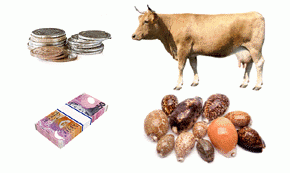
 If we used cows as media of exchange (if we bought and sold everything else in exchange for cows), would you say that dairy farming is a special industry that is macroeconomically important?
I would.
Because if we used cows as media of exchange, then what happened on dairy farms would affect the supply of media of exchange, and I think the supply of media of exchange is macroeconomically important in explaining short-run recessions.
And if you wouldn't say that, why would you say that banks are special and macroeconomically important in the real world?
Banks can create the medium of exchange "at the stroke of a pen", and lend it out for a monthly fee.
But a talented artist can create valuable drawings at the stroke of a pen, and lend those drawings out for a monthly fee to those who want to hang them on their walls.
If the medium of exchange is not special, or macroeconomically important, then banks are no more special or macroeconomically important than that talented artist.
1. Is the medium of exchange a special good, that is unlike all other goods, in a way that is macroeconomically important?
2. Are commercial banks special firms, that are unlike other firms, and unlike other financial intermediaries, in a way that is macroeconomically important?
I think those two questions are very closely related.
It would be hard to answer "no" to the first and "yes" to the second. That's because:
Banks are financial intermediaries whose liabilities are used as media of exchange. If the medium of exchange is not a special good, and not a macroeconomically important good, then banks cannot be special or macroeconomically important either. Banks would be no more special or macroeconomically important than mutual funds.
In long run equilibrium, banks are no different from other financial intermediaries. They borrow and lend.
They make life easier for ultimate borrowers and ultimate lenders to get together, just like shopkeepers.
And the main task of monetary policy is to keep the economy in that long run equilibrium by preventing monetary instability by preventing banks lending either more or less money for some people to invest or consume than other people want to save.
But in the short run disequilibrium, the quantity of medium of exchange matters a lot:
1. Every market in a monetary exchange economy is a market for the medium of exchange. This means that the medium of exchange is special because there are two ways an individual can get more medium of exchange: he can buy more medium of exchange (by selling more of other goods); or he can sell less medium of exchange (by buying less of other goods).
2. An excess demand for the medium of exchange prevents people making the mutually advantageous exchanges that would be possible if barter were easy so we did not need monetary exchange. That's what we call a "recession". If I could sell my goods, I would want to buy your goods; and if you could sell your goods, you would want to buy my goods; but neither of us will part with our money because we don't know whether that money will return to us, and it's too difficult to organise a swap.
3. Unlike other goods, people will accept more medium of exchange even if they do not plan to hold more medium of exchange and even if they think nobody else plans to hold more medium of exchange. We accept money in exchange for other goods only because we know that others in turn will accept it from us. The quantity of medium of exchange is supply-determined in a way that is not true of other goods. The talented artist can create drawings at the stroke of a pen, but cannot rent them out unless he can find someone who wants to hang that drawing on his wall. An excess supply of drawings immediately refluxes to the artist. The talented artist cannot create an excess supply of his product; banks (in aggregate) can. I borrow the drawings because I want to hold the drawings; I borrow the money because I want to buy something else.
So I think that commercial banks are macroeconomically important because, and only because, they influence the supply of media of exchange.
Otherwise, if that were not important, they would be just like any other financial intermediary.
But tell me: is the medium of exchange a special good, and a macroeconomically important good, and a good whose supply matters, in yourmacroeconomic view of the world?
If not, what's the big deal about banks?
And if we did use cows as money, would you forget about financial intermediaries, and start writing about dairy farms instead? Or if we used the drawings of talented artists as money, would you forget about financial intermediaries and start writing about artists instead?
-----------------------------------------------------------------------------------
Nick Rowe is an Associate Professor in the Department of Economics at Carleton University, in Ottawa, Canada. This article was first published in his blog Worthwhile Canadian Iniative here ». It is republished here with permission.
We welcome your comments below. If you are not already registered, please register to comment
Remember we welcome robust, respectful and insightful debate. We don't welcome abusive or defamatory comments and will de-register those repeatedly making such comments. Our current comment policy is here.