

Here's my Top 10 links from around the Internet at midday today.
As always, we welcome your additions in the comments below or via email to bernard.hickey@interest.co.nz.
See all previous Top 10s here.
My must read is #1 on some of the problems with the TPP.

1. Beware the 'free' trade agreement - America's Big Tobacco lobby is licking its lips at the prospects of using the Trans Pacific Partnership (TPP) 'free' trade deal with New Zealand and others to roll back some of the restrictions on tobacco use and marketing put in place around the world.
The use of the 'investor state' rules in agreements like the TPP is the favourite tactic of the tobacco firms.
The benefits of the TPP to New Zealand are debateable at best. America's dairy lobby has no intention of letting Fonterra in.
America's drug lobby wants to use the TPP to gut Pharmac and its movie/music studio lobbyists would love to use it to impose draconian controls on use of the Internet and intellectual property.
Here's a useful Quartz guide to how the tobacco lobby wants to use 'investor state' to water down the various moves to reduce tobacco use.
Malaysia is fighting the good fight, though:
Malaysia, where there is a strong anti-smoking movement, has proposed that tobacco be removed from the deal, so the TPP countries can apply restrictions without violating the terms of the partnership, a move also supported by anti-smoking advocates. Bollyky argues that a broad public health exemption for tobacco products should be included in the bill, following the Framework Convention for Tobacco Control, an international treaty signed by 176 countries. This would allow countries to pass anti-smoking measures without fear of challenge as long as they don’t blatantly favor domestic producers.
The US initially released a proposal to create a specific safe harbor for anti-smoking laws in the TPP, but then walked it back to a more general public health standard that still leaves room for tobacco companies to bring disputes. While this partially reflects the still-considerable political clout of the shrinking US tobacco industry, the bigger fear in the business community is that it will open the door to safe harbors for other controversial products like alcohol, genetically-modified crops and sugary soft-drinks.
2. 'Just make it up' - Many people have distrusted the detail in China's economic statistics for a while. Here's a BBC piece on how the Yunnan county government made up its economic statistics.
According to the Xinhua report, 28 companies in Luliang in south-west China reported a total of 6.34bn yuan ($1bn; £660m) in industrial output value in 2012. However, initial calculations showed the actual value was less than half of that - 2.8bn yuan. For their part, the companies alleged if they did not provide inflated data, then their reports were sent back by local government departments.
"They also said that fake reports would ensure they would enjoy favourable policies such as securing bank loans," the Xinhua report said.
3. Keep an eye on Italy - We haven't had a European crisis over our winter (their summer) for the first time in five years.
But this piece from Ronan Keenan at Macromonitor shows all is not well in Italy. Silvio is making a nuisance of himself again and could bring down the government. The economy, meanwhile, is still in deep, deep trouble.
There is little evidence of a recovery in Italy. The economy has contracted for eight consecutive quarters with the manufacturing sector experiencing a striking decline as output has fallen more than 25% from its peak in 2007. The nation’s unemployment rate is 12%, but this would be higher if not for a government policy introduced in the 1970s which aids struggling factories by paying “unused” workers 80% of the salaries while their employer attempts to solve its problems.
Earlier this week there were headlines trumpeting a rise in eurozone manufacturing aided by a surge from Italy. Export sales drove output in August but the same manufacturing survey also showed that employment in the factory sector fell for the 25th month running, and at a slightly faster rate than in July. On Wednesday it was announced that Italy’s services sector contracted by more than economists’ consensus, highlighting weak domestic demand. Overall, the manufacturing and servicing reports illustrated that while the wider global economic recovery is gathering steam, Italy remains stagnant.
4. New Irish bubble? - Who would have thunk that five years on from Ireland's crisis there would be fresh talk of a bubble in some parts of Dublin's property market.
Foreign buyers are at least partly to blame, albeit often from expat Irish returning home. Here's Reuters with the latest:
While prices began to rise again annually in June, some urban pockets are driving the recovery, with properties in Dublin being sold for 8 percent more than a year ago and higher still in affluent areas where 30-somethings outbid one another.
Having built the wrong stock in the wrong places during the boom - huge apartment complexes and out of town housing estates - there is now a big lack of supply in the capital and need for a battered construction sector to take the heat out of prices that some estate agents say are rising by 1 percent a month.
"There's an element of craziness creeping back into it where people are getting frantic," said Scott, a 37-year-old father of two young children, after wading through the crowds to view a four-bedroom, semi-detached house in leafy south county Dublin.
Property consultants Savills say 20 percent of its buyers are from abroad - mainly Irish residents keen to move home - piling even more pressure on frustrated domestic buyers.
5. Problems for Europe's Financial Transactions Tax - The FT reports there is trouble brewing for (continental) Europe's tax aimed at bank trading of wholesale financial instruments.
Europe’s plan for an expansive financial transaction tax hit a wall after the top legal adviser to finance ministers concluded it exceeds national jurisdiction, “infringes” on EU treaties and “is discriminatory” to non-participating states.
The unusually blunt paper from the EU Council legal service, obtained by the Financial Times, deals a heavy blow to a European Commission proposal to introduce a €35bn eurozone levy with global reach.
6. A 50 year bond - There's no better way to extend and pretend away an economic problem than to issue a 50 year government bond. Here's Spain's plan to do just that, courtesy of Reuters.
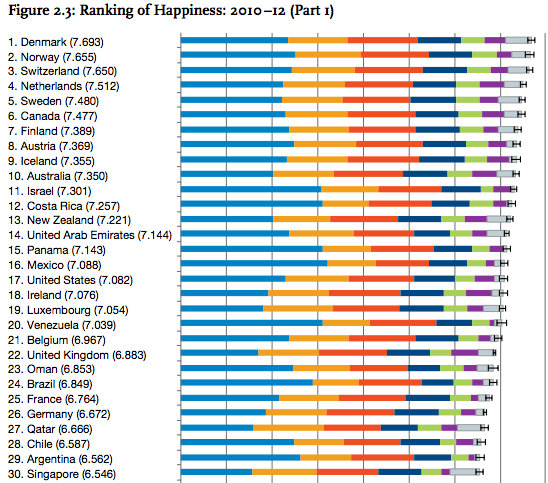
7. Not quite so happy - The UN has released its latest report on World Happiness from its Sustainability Development Solutions Network. Reading that title made me slightly less happy, but certainly people like the Treasury are now starting to use these sorts of Happiness indices to measure a nation's 'health' rather than pure GDP growth.
This UNSDSN report shows that New Zealand was officially the world's 13th happiest country from 2010-2012 with a score of 7.221. Denmark was the happiest and Togo was the least happy. Singapore and France were surprisingly unhappy. But it also shows our happiness fell between 2005-07 and 2010-12.
Here's some explanation via LA Times and report author Jeffrey Sachs:
After analyzing tens of thousands of responses, the researchers identified six main dimensions to happiness, including income, mental and physical health, social support, freedom to make your own choices, being inclined to help others, and living under a government that doesn't seem corrupt.
"There is no one key to a society's well-being, but if you take these variables, they explain about three-quarters of the observed variation across countries," said Jeffrey Sachs, director of the Earth Institute at Columbia University and an author of the report.
8. Same old, same old - China's factories are starting to hum again, which has reassured some, but it seems much of the Chinese growth is of the same 'bad' old types involving investment in concrete and steel, rather than spending by consumers.
It does appear that the “mini stimulus” outlined in July might be having some effect. BAML’s Xiaojia Zhi and Ting Lu say that Premier Li Keqiang “will likely “taper” his pro-growth rhetoric started in late June” now that the 7.5 per cent growth target looks well within reach.
SocGen’s Yao is wary of how this number is being reached:
The significant acceleration in infrastructure investment was clearly the major push. Although this set of data puts clear upward pressure on our short-term forecast, the dominating role of infrastructure played in the sudden turn-around confirms our concern over the sustainability.
9. China and diabetes - Here's the NY Times on one of the results of a the modernisation of China.
10. Totally The Daily Show on Syria. The duck from Wonder Pets makes an appearance.

We welcome your comments below. If you are not already registered, please register to comment
Remember we welcome robust, respectful and insightful debate. We don't welcome abusive or defamatory comments and will de-register those repeatedly making such comments. Our current comment policy is here.