

Here's my edition of Top 10 links from around the Internet at 10:00 am today. We now have a Monday-Wednesday-Friday schedule for Top 10.
Bernard will be back with his version this Wednesday. We will have another guest posting on Friday.
As always, we welcome your additions in the comments below or via email to david.chaston@interest.co.nz.
See all previous Top 10s here.

1. China's risky reforms
'Risk', 'reform' and 'finance' are three terms that go together everywhere.
But it does not get any bigger than in China.
Ian Bremmer and David Gordon have recently highlighted the huge risks - to everyone - about what is being embarked on in China.
We are in the middle of it, or perhaps at the beginning, and on a day-to-day basis it looks like BAU. But it's not. Change scares many people, but the process of change enables both the 'creative' and the 'destruction' parts to assert themselves. However there is no rule that says the process will result in benefits this time. Maybe they do in time over a long series of reforms.
But these types of grand, monumental reform processes can have uncertain results - and not necessarily positive or pleasant ones. We all have a huge stake in what happens next
When it comes to economic reform, China’s leaders no longer believe that time is on their side. With a new sense of urgency, President Xi Jinping and his inner circle are attempting one of the most ambitious economic and social-policy reform plans in history.
But in any authoritarian country, change creates risk. Consider the scale of the proposed plans. For China to reach the next stage of its development, a much larger share of Chinese-made products now destined for Europe, America, and Japan must be sold to consumers inside China. This shift will require a big increase in local purchasing power – and, therefore, an enormous transfer of wealth from large domestic companies to Chinese households.
In addition, China’s leaders appear to be on the verge of approving 12 new regional free-trade zones, which will drive competition and efficiency on a new scale in many economic sectors. They also recognize the need for further liberalization of the country’s financial system, a move that will require tolerance for outright defaults on bad loans – and the anxiety and anger that comes with them.
Here, as in other areas of the reform plan, change is dangerous; but Xi has come to believe that pressing ahead is vitally important if China is to take the next crucial steps toward building a middle-class, digital-age economy. Moreover, the reforms are crucial for the Chinese Communist Party’s long-term hold on power.
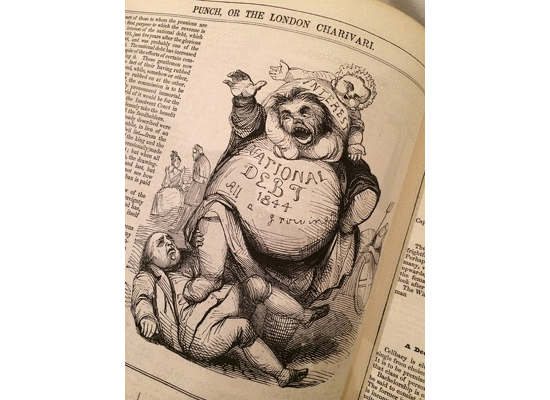
Same ol', same ol'. In 1844 folks apparently obsessed over the level of the national debt. I wonder what they would think of today's level.
2. Breath in
The Chinese banking system is getting more risky, and that's from official data out on Friday. The official China Banking Regulatory Commission said non-performing loans made by Chinese lenders reached ¥592 billion in the fourth quarter of 2013. They were last at this level in September 2008, the month Lehman Brothers folded.
The non-performing loan ratio of their Rural Commercial Bank is of special concern, I suspect.
It is being widely noted that this data shows that just the growth in Chinese bank lending in the past 5 years has been ¥89 trillion, about NZ$18 trillion - and this is about the same amount as the whole US banking industry, and more than the US GDP. Pray there is no Lehman Brothers event in China - even their huge foreign currency reserves may be no where near enough to get them out of a credit 'event'.
There is more here in this Bloomberg report:
Chinese banks are struggling to keep soured loans in check and extend earnings growth as the slowing economy and government efforts to curb shadow financing make it harder for borrowers to repay debt. Standard & Poor’s Ratings Services said this week that loan quality will decline in 2014 as banks remain at risk from debt-laden local government financing vehicles and manufacturers with too much capacity.
Investors are increasingly concerned that China’s investment through borrowing since 2008 may trigger a financial crisis, Haitong Securities Co. said in December. Liabilities at nonfinancial companies may increase to more than 150 percent of gross domestic product in 2014, raising default risks, the brokerage said. The ratio of 139 percent at the end of 2012 was already the highest among the world’s 10 biggest economies.
3. 'It's Europe or democracy'
The ECB should not be pleased with that German Constitutional Court decision on Mario Draghi's bond purchasing plans (The Big Bazooka).
Spiegel Online says the Constitutional Court is threatening to cause trouble, spelling it out in the detail of its decision.
The German justices insist that the German constitution sets limits on the ECB's strategy in the crisis. And that could have consequences that go far beyond the jurisdiction of the court in Karlsruhe. In a worst-case scenario, the Constitutional Court could forbid Berlin from contributing to efforts to save the euro or even force Germany to leave the currency zone entirely.
At first, however, the ECB reacted with relief on Friday when the German ruling was announced. It is what they had hoped for, said many within the Frankfurt-based bank. The European court is seen as being much more conciliatory than the German court and most believe that a complete cancellation of the bond-buy program (known officially as "Outright Monetary Transactions" or OMT) is unlikely. "The constitutional court is apparently unable to deal with the complexities of the issue and is now seeking to push responsibility onto the European Court of Justice," says Michael Hüther from the Cologne Institute for Economic Research.
But the relief might be premature. Even if the ECB wins the battle in the Luxembourg courtroom, it remains to be seen if the German court would be satisfied. A thorough reading of the decision reveals that, after spending months looking into the OMT program, a majority of the German justices have come to the conclusion for the first time that Draghi's bond purchases are unconstitutional. Only massive changes could make it acceptable.
4. Death by finance
Dani Rodrik, a Princeton professor, has a searing review of why emerging markets are suffering. He says emerging-market hype is just that. Economic miracles rarely occur, and for good reason. He also says financial globalisation has been greatly oversold, floating exchange rates are flawed shock adsorbers, and that faith in global economic-policy coordination is misplaced.
The deeper problem lies with the excessive financialization of the global economy that has occurred since the 1990’s. The policy dilemmas that have resulted – rising inequality, greater volatility, reduced room to manage the real economy – will continue to preoccupy policymakers in the decades ahead.
5. Go longer
Five years ago was 2009 - and to me that seems like yesterday. But in the language of investment decisions, that is the 'long term'. But if you think about it, 'long term' investing is trying to get the advantage of 'normal' returns, unobstructed by short term volatility and noise. It's clear however the returns and perspectives of 2009 and since are rubbish as a benchmark.
The long term you need to look at is probably much longer than five years. It is also important for KiwiSaver perspectives.
That's the view also of this NY Times piece.
These five-year numbers often color the thinking of not just ordinary investors but sophisticated strategists as well. Open a year-end report ... and you may now see the 2013 numbers for your own investments and for comparable benchmarks. Along with more recent returns, those 2013 five-year returns are appearing on financial websites, and in mutual fund reports and brokerage letters. And they are used by consultants for pension funds and other institutional investors in formulating asset-allocation and risk-management strategies.
Yet these five-year perspectives are very changeable. At the end of 2012, stocks’ five-year record was dismal. Now, it looks fabulous. What’s remarkable is that three of the years in each of those five-year records are exactly the same.
“This is an anomaly in market returns that’s occurred because of the calendar, and the extreme moves in the market that have taken place since the financial crisis, and it can be very misleading if you don’t look at it carefully,” said David Kelley, chief global strategist at J.P. Morgan Funds.
6. A mega sovereign writeoff
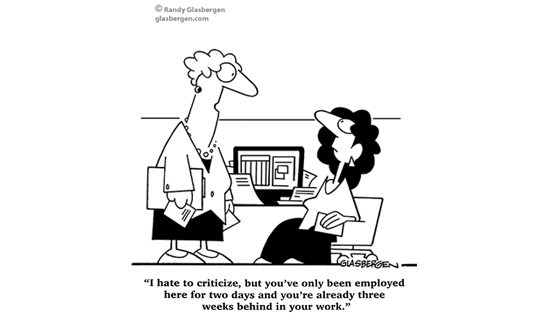
Edward Hadas has a big idea - born of the need to clear away the concrete shoes many countries have with their Government debt levels. He wants an international agreement for action whereby 'everyone' acts to rid themselves of the burden. And he says it could be done, even given the difficulties. An idea worth a read.
Massive debt forgiveness would solve the problem quickly and safely – if they are done right. There are three plausible ways to get rid of large quantities of unwanted bonds.
The first is through a large writedown. Basically, governments would re-issue all their debt with half the face value. For this “Reissue Day” approach to work, careful preparations and international agreement are required. Disaster can be avoided, although it would be tricky. A powerful propaganda campaign is a prerequisite, as is a clear plan to recapitalise banks, in part with new government funds. And all countries must agree to recognise losses on their holdings of foreign government sooner rather than later.
Alternatively, instead of writing down debts, governments could inflate up wages and prices. For example, a mandatory one-time doubling of all wages would quickly almost double nominal GDP, mechanically almost halving the economic weight of the government debt burden. The “Rescale Payday” would be technically and legally complex, a bit like dividing one currency into two. Forethought and flexibility would be mandatory.
Finally, governments could print debts away. As borrowings mature, they would be redeemed with newly created money. The monetisation would be followed quickly by new taxes which would reduce the expanded money supply to non-inflationary levels. The reclaimed funds would then be destroyed. The round trip sounds complicated, but the separation of bond redemption from tax recuperation would help governments arrange the details of the “Less for More Exchange” to allocate losses as fairly as possible.
I doubt that any of these techniques will be tried out, for both good and bad reasons. On the good side, there is the ethical concern about breaking financial contracts, the risk of social tension after a sudden redesign of a key part of the monetary system and the innumerable diabolical details. On the bad side are mainstream economists’ lack of intellectual courage and the inability of politicians to organise something as daring as the monetary equivalent of post-war reconstruction.
7. A culture of subsidy
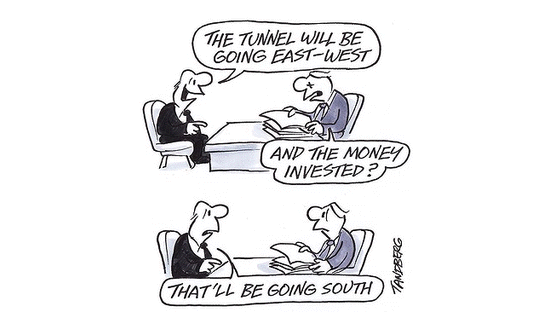
Corporate welfare doesn’t boost employment. But politicians love giving money to companies to create jobs. The benefits are fleeting, at best, according to Tamsin McMahon in Canada's MacLeans magazine. They point to many Canadian examples, and the best ones are from the movie business. But there are others as well. Here is one:
Pixar Animation Studios made no secret of why it chose Vancouver for its first international production office. Sure, the location was beautiful and the city boasted a bounty of educated and experienced workers. But it was the B.C. government’s aggressive new tax break for the digital film and animation industry that general manager Amir Nasrabadi said had made the city “a very cost-effective place to do business.”
At the 2010 press conference announcing the move, then-premier Gordon Campbell promised that the government’s plan to forgive nearly half the taxes on Pixar’s labour costs would be money well spent. He said it was the start of a partnership between government and industry that would last, “as Bud Lightyear would say, to infinity and beyond.”
Unfortunately for B.C., infinity lasted just three years. Last fall, Pixar’s parent company, Walt Disney Co., announced that, despite posting a US$1.6-billion profit that quarter, it was shutting down its Vancouver office, laying off 100 workers and shifting production back to its California headquarters in order to “refocus our efforts and resources under one roof.”

8. A dictator's disruption
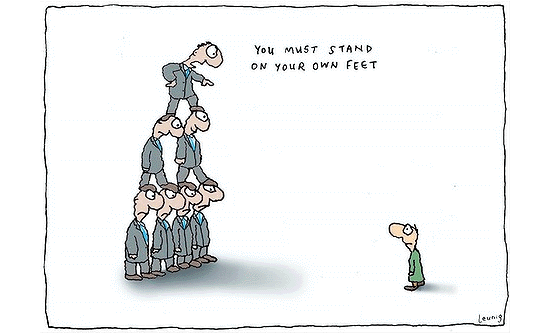
Amazon surprised the retail delivery world by suggesting drones could be used for its deliveries. People guffawed at first. But not for long. Others have taken up the challenge. And it looks like Dubai will be launching a service well before the Amazon one gets off the ground (so to speak). Here's more at Wired:
Officials in Dubai say the city is experimenting with drones to deliver government documents to citizens. Unveiled this week, the program is the first phase of what officials hope will lead to widespread government use of unmanned aircraft across the United Arab Emirates by next year.
“What these things are best suited for is delivery of small, light value things that are time sensitive, like medicines, identification documents, vital papers and things of that nature,” said Noah Raford, an adviser to UAE Prime Minister Sheikh Mohammed bin Rashid, according to The National. The drones would supposedly use retina scans and fingerprints to identify intended recipients.
Either way, the UAE’s effort doesn’t look great for Amazon. If it works, Amazon will have lost the race. If it doesn’t work, Amazon will be under more pressure to say why its drones will work out better. If they ever get off the ground.
9. The best and worst
Here a fun set of lists - if you have some spare time ... Bloomberg has done a wide ranging series on the Best & Worst economic stats comparing countries.
Actually, we are near the top of some 'good' stats, and near the bottom of some problematic ones. But we also have some of the heaviest men and women it seems. Not sure if that is good or not. Watching the Auckland 9's the mens weight may have been an advantage yesterday.
10. Today's quotes
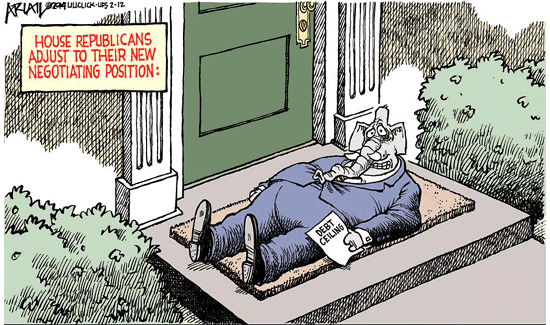
Bentley’s second Law of Economics: "The only thing more dangerous than an economist is an amateur economist."
Berta’s Fundamental Law of Economic Rents: “The only thing more dangerous than an amateur economist is a professional economist."

We welcome your comments below. If you are not already registered, please register to comment
Remember we welcome robust, respectful and insightful debate. We don't welcome abusive or defamatory comments and will de-register those repeatedly making such comments. Our current comment policy is here.