

Here's my edition of Top 10 links from around the Internet at 10:00 am today. We now have a Monday-Wednesday-Friday schedule for Top 10.
Bernard will be back with his version this Wednesday. We will have another guest posting on Friday.
As always, we welcome your additions in the comments below or via email to david.chaston@interest.co.nz.
See all previous Top 10s here.

1. Narendra Modi
The really big economic news this past week hasn't been about China, the US, nor Russia and Europe - not even about Thomas Piketty. Or our budget.
It's actually about India.
In case you hadn't noticed, India had an election and tossed out the Congress-led government accused of corruption and fraud during their 10 year tenure. Really tossed them out.
In coming is a tough, successful and focused strongman, determined to completely change India's fortunes.
Getting to this starting position Narendra Modi has cracked a few eggs and he is determined that India will become a modern economic and strategic power, ready to challenge China.
After years of poor public policy, he has an enormous task. And he has to do it within the constraint of a democracy, something its rival China doesn't have to worry about.
Don't bet against Modi: he transformed the state of Gujarat into an economic powerhouse. Impressive. Gujarat also has a fast expanding agricultural sector.
India is turning to professional managers. And a partnership with Japan is likely.
More from Michael Mandelbaum:
The election once again demonstrated how different in political terms India is from its giant neighbor, autocratic China. Now, however, the new government must try to match the superior economic progress that China has achieved over the last three decades. To do so, it will have to foster, in a different political context, two key ingredients of China’s economic success.
The first ingredient is a robust industrial sector composed of manufacturing industries that use unskilled labor, which would offer a route out of poverty for India’s hundreds of millions of rural laborers and their families. It is the route that China, and other countries before it, has taken. In India, by contrast, the underdevelopment of the industrial sector has kept the country from realizing its full economic potential.
The second ingredient is the infrastructure that all economic growth requires: roads, bridges, ports, and schools, as well as reliable supplies of electricity and clean water. Poor infrastructure constrains the industry that India does have. Factories need reliable supplies of power to operate effectively, good roads and railways to source inputs and distribute products, and, if they are to export those products, ports for cargo ships and airports for high-value items and business travel. China has these things in abundance. India does not.
2. Potential vulnerability
The latest OECD 'General Assessment' out over the weekend for the global economy has been picked up locally for its data on New Zealand's very poor housing affordability benchmarks (see page 33). There is nothing new in here for interest.co.nz readers however. But it does push the issue up in the election campaign.
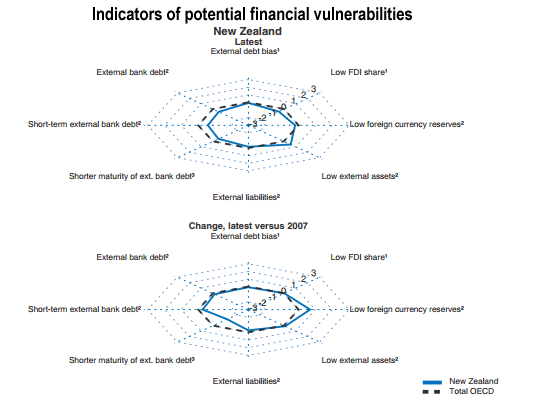
Also in the document, but most media will ignore, is their 'Indicators of Potential Vulnerabilities' and New Zealand gets [another rare] mention:
There are indications that some OECD countries (Australia, Canada, New Zealand, Norway and Sweden) which have suffered relatively little from the global financial and euro area crises are exposed to vulnerabilities stemming from the non-financial sector (most or all from household debt, house prices and relative unit labour costs). On the other hand, their financial sector does not appear to exhibit significant external vulnerabilities, as evidenced by the diamonds [below].

3. Upside down policy positions
Budget commentary from Matt Nolan at TVHE:
While the Labour and Greens alternative budgets were focused on industrial subsides (the “Green energy bank” is a form of industrial subsidy) – subsides that will benefit those who have the money to invest in the first place – National has come out with a budget focused on families/parenting, and a sixth budget that boosts real expenditure on education and health (at a time when the government was generally hesitant to spend).
Don’t get me wrong, Labour talk about poverty, but their policy solutions are … running a surplus, giving money to “winning” firms, and “magically” having lower unemployment for no given reason. I had assumed that after they canned the tax-free threshold policy they were going to announce something – seems not. Labour, the Greens, and National have all focused on the fact they are “responsible”, they are going to “run surpluses”, and they are going to “pay down debt” – and those statements are popular with the voters. But I’ve only seen one party target education and vulnerable families with policy suggestions – the two biggest concerns regarding inequality of opportunity – and that has actually been National.
It seems he overlooked Labour's Best Start policy - but he claims that was only because the party itself failed to mention it in their Budget responses.
4. Different directions
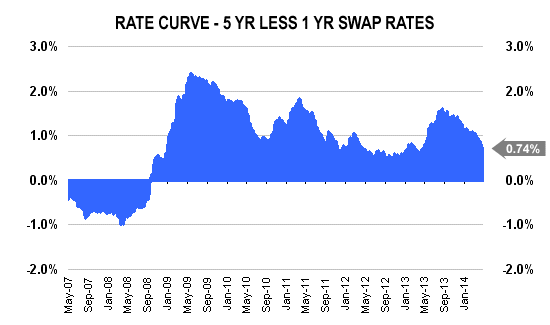
Falling wholesale rates in the US and Europe are having an impact here. While markets seem convinced the RBNZ will raise the OCR next month again for the third time, 2-5 year wholesale swap rates are falling. That has the effect of halving the difference between the one year and five year swap rates since September 2013.
In fact, the difference - a measure of the 'rate curve' - is the lowest since 29 May 2013.
5. Bonded bankers
Keeping up with financial innovation is a real challenge for regulators. But Mark Roe has an idea, a self-regulating idea: pay bankers with the same instruments that underpin its capital stability.
Banks overseen by managers who had larger unfunded pensions weathered the financial crisis better than their counterparts, presumably because they had a stronger incentive to keep them safe.
A more aggressive approach would compensate bankers with the same bonds that guarantee their institutions’ short-term, volatile, and risky debts. As a result, bank managers would have a personal financial stake in ensuring that the risky obligations do not blow up, as they did during the 2007-2008 financial crisis. If the obligations deteriorated and the bank failed, the managers would be left unpaid. Because the obligations would be guaranteeing the rest of the bank’s operations, the managers would, it is hoped, be especially vigilant in ensuring that basic operations were safe.
By tying senior managers’ pay to the bank’s stability, the financial sector, advocates argue, would be forced to police itself. This incentive-based regulation could bolster economic stability more effectively than expecting regulators to keep pace with banks’ risky activities.
6. 'Right about the past, wrong about the future'
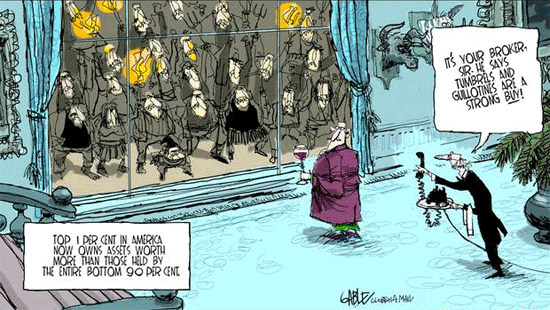
Inequality is an important issue. This week we will start to hear about it more because the authors of The Spirit Level are in town, hired here to promote their politics in support of left-leaning partys election campaigning. It is a pity in some ways that that a second rate and superficial book with some big obvious flaws is being used locally to pitch the issue, but I suppose we get second best because Thomas Piketty is otherwise busy.
Larry Summers has recently reviewed the Piketty book. He likes what he read. He says while Piketty doesn't get everything right, he is certainly asking the right questions. He even likes the Piketty 'solution', mainly as a very useful thought-exercise contribution. Summers review is a thoughtful one: settle in for a comprehensive assessment.
Piketty’s argument is straightforward, relying, as he says in his conclusion, on a simple inequality: r>g, in which the rate of return on capital exceeds the growth rate.
A brief look at the Forbes 400 list also provides only limited support for Piketty’s ideas that fortunes are patiently accumulated through reinvestment. When Forbes compared its list of the wealthiest Americans in 1982 and 2012, it found that less than one tenth of the 1982 list was still on the list in 2012, despite the fact that a significant majority of members of the 1982 list would have qualified for the 2012 list if they had accumulated wealth at a real rate of even 4 percent a year. They did not, given pressures to spend, donate, or misgives their wealth. In a similar vein, the data also indicate, contra Piketty, that the share of the Forbes 400 who inherited their wealth is in sharp decline.
7. Good progress
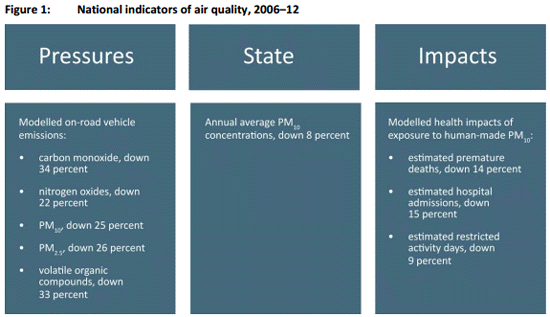
In a Report released late last week that got virtually no coverage, it was announced that our air quality is very good and getting better. It's not perfect however.
Good science undermines silly urban myths and cheap electioneering claims. It can also point to areas that actually do need attention. It would help if we could have similar reviews of our fresh water systems. So far those efforts seem to be 'studied' haphazardly by a whole range of special interests that feed off gaps in our knowledge. It's not only farmers, academics looking for funding are part of it too. And urban impacts seem to escape any investigation.
The air quality reporting system would be a good comprehensive model to follow. Results like this would be good too.
8. Pulling up the ladder
Unions in Switzerland have successfully got a national referendum for a SFr22 minimum wage. That's NZ$28.50 per hour (NZ$59,300 per year).
This is one of four questions to be decided this weekend. The previous Swiss referendum included an anti-immigrant policy that was passed, and which resulted in the EU blocking access to a number of European education and research programs.
Swiss law seems to be being run via bumper sticker politics. Perhaps 'unintended consequences' doesn't translate too well into Swiss. By the time you read this, perhaps the result will be known. (Update: It will be rejected, 3:1)
Perhaps New Zealand should offer incentives to attract small and mid-sized Swiss manufacturing companies who seem particularly vulnerable.
While Switzerland is renowned as a home for hedge fund managers, a secretive banking sector and one of the highest per capita incomes in the world, more than 20% of its GDP comes from an increasingly beleaguered manufacturing sector.
A recent opinion poll by gfs.bern found that 64% of voters were against the proposal, but in a recent referendum voters unexpectedly forced the parliament to draw up plans to curb EU immigration.
Cristina Gaggini, director of the Geneva office of the Swiss business association, Economiesuisse, told the BBC: "I think it's an own goal, for workers as well as for small companies in Switzerland."
9. Green revolution 2.0
People my age remember the endless stories of famines in China, India and Africa. They virtually disappeared, even in Africa, in the modern world. A green revolution especially by 'developments' (read GM) in rice rescued millions from starvation and allowed people to aspire to more reasonable standards and development.
Now a second revolution is underway, this time targeting much more nuanced issues. Plant development for lands that traditionally were regarded as marginal are delivering amazing results. Productivity improvements that are normal in western agriculture are being rolled out worldwide, and along with them much lower unit costs. Even simple financial tools are bringing great change.
The Economist has a good detailed review.
The original green revolution transformed Asia from a continent stalked by hunger into one that could think and plan beyond the next harvest. It helped lay the foundation for the continent’s economic miracle and made possible Asia’s demographic transition from high fertility and high mortality to smaller, richer families. The second green revolution will not do that. But it should complete the first one, mainly by bringing benefits to the poorest, who missed out first time round. It will help mechanise and move more people off farms and into more productive labour. And it should prevent Asia slipping back under the shadow of hunger and all the political and social disruptions that such misery causes. Few other things can promise as much.

10. Today's quote
"Death is caused by swallowing small amounts of saliva over a long period of time." - George Carlin
We welcome your comments below. If you are not already registered, please register to comment
Remember we welcome robust, respectful and insightful debate. We don't welcome abusive or defamatory comments and will de-register those repeatedly making such comments. Our current comment policy is here.