

Here's my edition of Top 10 links from around the Internet at 10:00 am today. We now have a Monday-Wednesday-Friday schedule for Top 10.
Bernard will be back with his version this Wednesday. We will have another guest posting on Friday.
As always, we welcome your additions in the comments below or via email to david.chaston@interest.co.nz.
See all previous Top 10s here.
1. Still stoking the fire
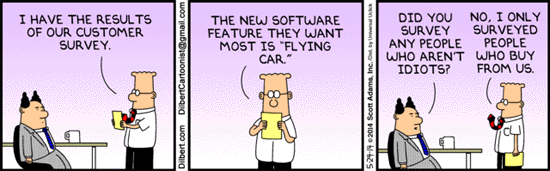
William Pesek at Bloomberg says that despite the changed messages, on the ground China is still going hard with massive stimulus.
No, China isn't rebalancing, he says.
"Tolerance" and "slowdown" clearly mean something different in Beijing's dictionary.
Since November, when the Communist Party announced epochal reforms, President Xi Jinping and Premier Li Keqiang have rarely missed a chance to say China must accept slower growth. Downshifting to a "new normal" is a necessary evil to regear the economy's growth engines to services. Six months on, all they've done is add more and more stimulus to ensure no end to massive investment and exports.
Every time data have suggested gross domestic product might slip below that 7.5 percent line, Beijing has been quick to rev the engine yet again.
Stimulus measures have included tax breaks, bigger investments in housing, faster spending on railways and other megaprojects, and front-loading of outlays at the provincial level. China's largest regional economy, Guangdong, is allocating more than $10 billion to boost growth. The National Development and Reform Commission, the central economic-planning agency, is mulling a $16 billion-plus fund for transportation that will solicit some private investment. The central bank, meanwhile, has eased up on its war against excess credit, and the shadow-banking system is still enabling inefficient state-owned enterprises across the nation.
Does any of this sound like the actions of government ready to let GDP fall to 6 percent, let alone 5 percent? Hardly, which is why economists at Nomura and UBS are rethinking second-quarter growth forecasts. Credit Agricole economist Dariusz Kowalczyk reckons that the stimulus steps that we know about - I'm figuring there are many we don't - will add 1 percentage point to Chinese growth.
2. Beating banks in the loan business
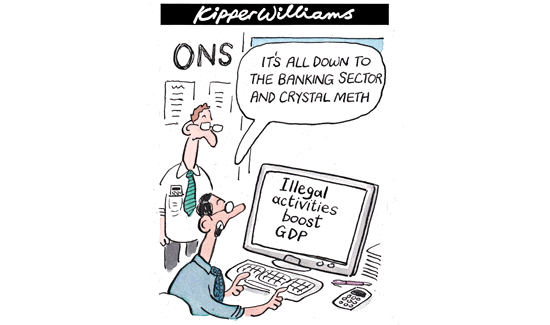
Borrowing money for business operations or expansion is about to be radically transformed - and banks are about to be sidelined.
Companies line Xero and Vend are in a prime position to do so, although Xero as aligned itself perhaps too closely with banks to risk it.
But others are moving into the space, especially for small business whom banks have tried to apply big-business lending standards to. Here's one ...
Square’s motto is “make commerce easy.” For the past four years, this was embodied in its eponymous credit card reader, which lets merchants ring up sales via their smartphones and tablets. But today, the company is diversifying in a dramatic way: Instead of merely processing payments, Square also will provide a way for merchants to inject extra cash into their businesses – no loan application required.
The program, called Square Capital, offers cash advances in exchange for a cut of future sales. It’s available to merchants already using Square’s Register app, which oversees use of its card reader. Businesses can’t apply for these advances, but if they need it, Square may offer one out of the blue. The company uses the massive trove of payments data it collects to algorithmically decide who’s offered an advance, how much they’re offered, and how much interest they’ll pay for it.
Square extends these offers via email or through the web-based Square dashboard where merchants track customer credit card payments, and the advances are paid back through the company’s credit card services. Instead of asking for a fixed regular payment, Square takes a percentage of a merchant’s daily credit card sales, with no time limit for paying off the advance. As described by the company, Square Capital is about Square finding one more way to render the red tape of traditional banking obsolete. “We feel that what Square Capital is doing for access to capital is analogous to what Square did four years ago for card processing,” says Gokul Rajaram, Square’s head of product. “Card acceptance four years ago was equally not transparent, slow, bureaucratic, and not flexible.”
The move is just one way some of the world’s web companies are transforming themselves into operations that behave much like banks. Companies from Square to Alibaba are not only helping you handle money, they’re helping you store it and, in some cases, borrow it.
3. Where the human brain still rules
Here's a story for a long weekend read. Go, the ancient board game, has long been a favorite of computer scientists. Yet no computer has yet defeated a top human player.
‘There is chess in the western world, but Go is incomparably more subtle and intellectual.’ Computer geeks are now trying to challenge the Go masters.
The challenge is daunting. In 1994, machines took the checkers crown, when a program called Chinook beat the top human. Then, three years later, they topped the chess world, IBM’s Deep Blue supercomputer besting world champion Garry Kasparov. Now, computers match or surpass top humans in a wide variety of games: Othello, Scrabble, backgammon, poker, even Jeopardy. But not Go. It’s the one classic game where wetware still dominates hardware.
Invented over 2,500 years ago in China, Go is a pastime beloved by emperors and generals, intellectuals and child prodigies. Like chess, it’s a deterministic perfect information game - a game where no information is hidden from either player, and there are no built-in elements of chance, such as dice. And like chess, it’s a two-person war game. Play begins with an empty board, where players alternate the placement of black and white stones, attempting to surround territory while avoiding capture by the enemy. That may seem simpler than chess, but it’s not. When Deep Blue was busy beating Kasparov, the best Go programs couldn’t even challenge a decent amateur. And despite huge computing advances in the years since - Kasparov would probably lose to your home computer - the automation of expert-level Go remains one of AI’s greatest unsolved riddles.
4. Real 21stC capitalism
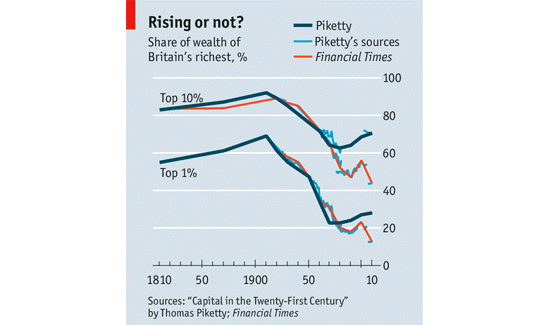
The Financial Times has been looking at the way Thomas Piketty used the data for his ground-breaking book.
But Bernard Avishai has been thinking more about the underlying assumptions Piketty has used. His analysis is helpful:
It’s clear that Piketty admires governments that encourage domestic companies to produce products and provide services. Typically, these governments also educate an élite group of potential managers and scientists, acquire (or ignore) licenses and patents, and organize capital to fund domestic firms. And they insist that foreign companies looking to do business enter into joint ventures with domestic partners.
Those who advocate for this method as a better alternative to foreign investment seem to assume that a company’s assets are made up primarily of physical stuff; Piketty, for his part, defines corporate capital as “land, dwellings, commercial inventory, other buildings, machinery, infrastructure, patents, and other direct owned professional assets.”
But there’s a problem with this assumption. Capitalism isn’t really about physical property - not anymore. In fact, in the twenty-first century, intangible assets, such as the knowledge shared by employees, dwarf physical holdings.
The good news - for Piketty and for everybody else - is that intellectual capital is not inherently scarce in the way that financial capital is. A global company does not give up technology or systems by sharing them, though, again, it might well lose the competitive advantages - and revenues - it gains from employing them. If I give you a dollar, I don’t have it anymore; but, if I teach you something, I don’t stop knowing it. The growing importance of intangible assets in itself might not mitigate inequalities, and might even exacerbate them, at least at first. But the role of intangible assets in foreign investment should inspire some hope that it could help reduce inequalities, too.
An even clearer argument about "why Piketty is mistaken" (?) is here and well worth a read. This misunderstanding about the 'labour-vs-capital' point is important, I think. Kudos to Piketty because without him we would not be hearing or thinking about this important aspect.
5. A piece of the puzzle
As we all know, there is a serious lack of data about "Chinese ownership" of our housing, code for how much of our residential housing stock is owned by foreigners. The Government released some data from IRD records on ownership of rental properties and although it was the latest available, like all IRD data it is not current. But it did not suggest the proportion is high.
There will be many pieces to understanding this puzzle and without them those passionate about the subject will seize of anecdotes to bolster their (generally anti-foreigners-from-non-western-countries) argument.
To add to the factual data, we asked Auckland Council to search their rating records and tell us how many ownership or billing addresses were outside New Zealand. The answer is 1.8% over all types of rated property; raw land, rural, industrial, commercial and residential. We appreciated their reply. This is a summary of the data they supplied:
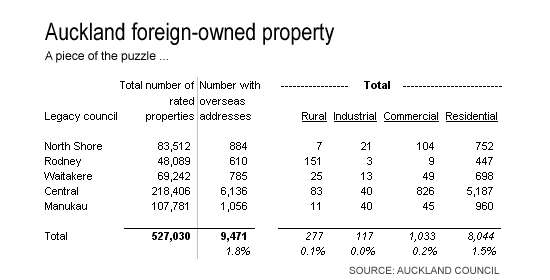
It is certainly no conclusive answer to the issue. But in the absence of proper details which we urgently need to start collecting, it is another of the available data to add to the mix. But those who think we are being over-run by foreign ownership of our land might want to be prepared for some future proper statistics not backing up their position (just as the LINZ-OIO data detail doesn't).

6. Reasons why the sky is not falling
The easiest and cheapest response to observations that the world is not exactly going the way you think it should is to claim that a catastrophe is brewing. Observing that it hasn't happened yet just brings the conspiracy theorists out that 'when it happens it will be worse'. Now ex-Labor politician Gareth Evans in the area of international relations is suggesting the critics 'have no clothes'. Here he is in Project Syndicate:
Though global political conditions are hardly as good as they could be – they never are – there are plenty of grounds for thinking that they are not nearly as bad as so many are claiming.
The international system has been responding to geopolitical challenges more effectively than is generally acknowledged. Despite the meltdown in their relationship over Crimea, the US and Russia have continued to work together to negotiate a diplomatic solution to the Iran nuclear issue, and (with China) develop collective Security Council responses to successive crises in Africa. In almost every area of major power rivalry, potentially volatile issues are compartmentalized, while cooperation elsewhere continues.
No policymaker can be complacent. There is no end in sight to the Syrian nightmare, the respite in eastern Ukraine may be proving temporary, and in Sino-Japanese relations cool heads remain in short supply. Nor is there any shortage of other issues and systemic improvements, not least nuclear-arms reduction, on which to work.
But alarmist pessimism is self-reinforcing, defeatist, and needs to be contested. There is plenty of reason to believe that, where it matters most, we have learned enormously from the mistakes of the past. If we can stay calm and levelheaded, the worst of them will not be repeated.
7. Waning interest
Despite the rising rhetoric from those passionate about the subject (on both sides), we seem to be less interested now than 5+ years ago about 'global warming' and 'climate change'. You can use the Google Trends service as one way of gauging practical interest (people wanting to know more) and this is what it shows for New Zealand:
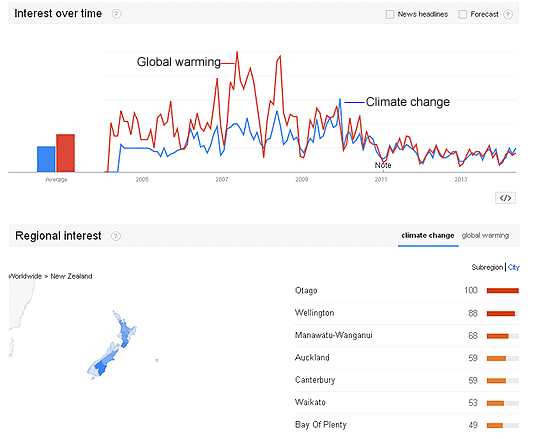
It is fascinating that most of the search interest comes from Otago and Wellington, and not from the big population centres in Auckland and Christchurch. People in the Bay of Plenty seem to care much less. The national pattern is similar to that you can find for most other countries.
The latest Roy Morgan poll on what New Zealanders think are the current 'important issues' supports the declining interest.
Maybe there is a need to change the labels. Here is one suggestion from The New Yorker:
After a report from the Yale Center on Climate Change Communication showed that the term “climate change” elicits relatively little concern from the American public, leading scientists are recommending replacing it with a new term: “You will be burnt to a crisp and die.”
Other terms under consideration by the scientists include “your cities will be ravaged by tsunamis and floods” and “earth will be a fiery hellhole incapable of supporting human life.”
Scientists were generally supportive of the suggestions, with many favoring the term “your future will involve rowing a boat down a river of rotting corpses.”
“Any of these terms would do a better job conveying the urgency of the problem,” Tracy Klugian, a spokesperson for the newly renamed Yale Center for Oh My God Wake Up You Assholes, said.
8. Think twice about using a credit card
Got an updated credit card? Mine arrived a while ago and it includes the new contactless technology - in my case Visa payWave. I didn't ask for it, it was just loaded only my new card when the old one expired. It works as advertised.
I live in Auckland so I use the bus a lot and am at places there are crowds of people. I am vulnerable to the new style of pick pocketing.
These contactless cards use RFID (radio frequency identification) activated by a card reader. That means even when the card is in your wallet and safely in your pocket, someone nearby can swipe it. Detective Inspector Brian Hay, from Queensland Police's fraud and cybercrime squad, describes what he would do if he was an "electronic pickpocket".
"So I know it's you because you're my target. I'll stand close to you in the train and that will allow me to clone your card from your pocket.
"I visit your LinkedIn profile and identify where your work history is and who you've been working with and how long you've been there for.
"If you've got a Facebook profile I'll take the details off that. I'll probably find out where you live because you uploaded a photograph from your iPhone of last weekend's barbeque and you didn't disengage the geotag setting so I know exactly where you live.
"I'll put a profile together, take out an online loan application for $20,000 or $30,000 as well as take out a couple of new credit cards in your name.
"So rather than extract a couple of hundred or a thousand dollars from your card, I'll take out $30,000 of debt in your name."
9. Bond pricing 'sinks'
I have been puzzled as to why bond yields have been falling fast recently, even though there have been no noticeable 'events'. It is something Isabella Kaminska at FTAlphaville can help with.
A lot of people are puzzled over why US yields are falling when nothing has changed on the Fed communication side, and QE is supposed to be slowing.
Frances Coppola notes an even stranger phenomenon. When you look at the very big picture you realise that if there is a correlation between QE and rates, it’s actually a very counterintuitive one:
"Every time QE is announced, yields rise: when it ends, they fall. And no, this doesn’t just affect the 10-year yield. The same basic shape can be observed on just about any maturity over 1 year (short-term rates are propped up by the positive IOER policy)."
It’s counterintuitive because people tend to believe that QE suppresses rates by creating a bid where there otherwise wouldn’t be one.
The standing theory, consequently, is that a QE exit should encourage rising yields.
But as Coppola notes, this isn’t a rational thing to think at all. In reality, QE is and always has been about diminishing liquidity risk in the system. Take the tap away, and you open the door to rollover risk, defaults and so-on — all of which increases risk aversion, which puts a bid on longer dated Treasuries.
As she notes, using a nice sink analogy:
"When QE stops, whether suddenly or gradually, there is of course no immediate withdrawal of liquidity. But the sudden removal of the INCREASE in liquidity gives the impression of a drought. It’s like someone washing their hands under a running tap instead of in the sink: when that tap is suddenly turned off, or the flow through it is restricted, the washer thinks they have run out of water, even though there is an entire sink full because of the previous flow. This is what is happening in financial markets. The Fed is turning off the QE tap."
The other unintended consequence, of course, is that turning off the QE tap encourages the repatriation of liquidity from riskier zones. It does this because it broadcasts a fairly enticing signal to investors that you no longer have to take risk for yield, you can have your safe assets and collect risk-free “rentier” returns which beat the overall growth of the system.
On that basis, as Coppola notes:
"Could it be that all QE3 did was temporarily prop up yields, and now that it is being be removed, yields are simply reverting to their previous trend?"
10. Today's quote
"Some people see the glass half full. Others see it half empty. I see a glass that’s twice as big as it needs to be." - George Carlin
We welcome your comments below. If you are not already registered, please register to comment
Remember we welcome robust, respectful and insightful debate. We don't welcome abusive or defamatory comments and will de-register those repeatedly making such comments. Our current comment policy is here.