
By Bernard Hickey
Sheep farmers in Southland and first home buyers in Palmerston North shouldn't have to care about the exact nature of building consents in Grey Lynn.
But this week it became increasingly clear that all New Zealanders have to care about the housing supply shortages and planning restrictions in Auckland that are acting like a giant handbrake on the economy.
One example of how the isthmus of Auckland has in effect become everyone's back yard was an apparently very local dispute reported in the New Zealand Herald this week.
Local residents in Grey Lynn and Arch Hill voiced their outrage at plans by a developer for a seven storey high block of 30 apartments on Great North Road.
The residents are against more intense development of their leafy suburb close to the CBD.
The developer, Greer Stephens, originally presented a five storey proposal for 20 apartments, but has since upgraded it to seven storeys and 30 apartments and said council officers have indicated their support.
This is despite changes last year to the draft Auckland Unitary Plan that effectively de-intensifed zoning and height restrictions near the CBD.
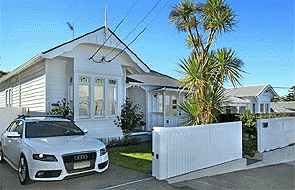
This followed an anti-intensification campaign against the original draft plan by local residents who didn't want their urban landscape of villas, trees and uninterrupted views of the sea and sky to be blighted by apartment blocks.
Fair enough, most fellow villa owners would say.
Not In My Back Yard is a powerful gravitational force in local politics.
That would all be fine if the only parties affected were local residents. But that is not the case with Auckland.
It has a powerful gravitational force of its own on the entire New Zealand economy, including on those sheep farmers in Southland and the first home buyers in Palmerston.
We have seen that in spades over the last year. Real Estate Institute figures released this week show house price inflation in Auckland and Christchurch was responsible for more than 75% of all the house price inflation nationally in the last year.
The Reserve Bank imposed its speed limit on high Loan to Value Ratio mortgages to reduce some of the risks to the financial system from an over-valued housing market, and the Auckland market in particular.
The IMF is not warning that New Zealand's house prices are 80% above their long term averages relative to rents because of the house prices in Invercargill or Palmerston North.
The Reserve Bank has just increased interest rates by 0.75% and is likely to add another hike by the end of next month, in part because of the pressures on inflation being generated out of the housing market in Auckland.
First home buyers and exporters across the nation are paying the price for the 23% rise in house prices seen over the last two years in the central and eastern suburbs that make up the Auckland isthmus.
They're paying the price in a variety of ways.
First home buyers from Ponsonby to Palmerston North have been dramatically curtailed in the last year because of the high LVR speed limit. Exporters are quietly fuming at the strength in the New Zealand dollar despite 20%-plus falls in the prices of milk powder and logs.
Reserve Bank Governor Graeme Wheeler may well be saying the currency is unsustainably high, but as he was saying it and putting up interest rates it rose even higher.
The Government's sense of frustration is palpable over the inability of Auckland to solve its housing supply and affordability problems.
Last week Environment Minister Amy Adams lodged a submission with the Auckland Council criticising the Auckland Unitary Plan as inflexible, costly and too restrictive to meet the housing needs of an expected rise in Auckland's population to two million by 2031.
She pointed to forecasts that showed the plan's newly de-intensified height rules and limits on 'sprawl' would allow only half the necessary new homes to be built.
Anyone reading her submission would jump straight into an auction room and bid whatever it took to buy land on the isthmus, confident that these restrictions plus the inevitable population growth would generate another tripling over land prices over the next two decade.
Finance Minister Bill English was just as frustrated this week when he told a select committee it was "ridiculous" that the Auckland Council restrictions had effectively made it "illegal to build a house that costs less than NZ$600,000."
English pointed to the residents' backlash against the rules on intensification in the debate last year on the unitary plan. "The Auckland Council got rolled by their ratepayers," he said.
Which takes us back to the "outrage" from the Grey Lynn Residents Association and that of Keith Milne, the villa owner living next door to the proposed seven storey apartment block. Understandably, Milne doesn't want an apartment block in his back yard, even though the developer has reassured the council the building would not shade its neighbours or block views.
But has he and the council thought about what that opposition means for the rest of New Zealand?
This dispute on Great North Road may seem like an intensely local one, but it is one that everyone from Invercargill to Kaitaia should know about because it is symptomatic of a tension between private property rights and the public good that needs to be sorted for the good of the economy.
--------------------------------------------------------
A version of this piece has also run in the Herald on Sunday. It is here with permission.
We welcome your comments below. If you are not already registered, please register to comment
Remember we welcome robust, respectful and insightful debate. We don't welcome abusive or defamatory comments and will de-register those repeatedly making such comments. Our current comment policy is here.