

Here's my edition of Top 10 links from around the Internet at 10:00 am today. I think everyone should make some time to read #5 today and follow the links.
We now have a Monday-Wednesday-Friday schedule for Top 10. Bernard will be back with his version this Wednesday. We will have another guest posting on Friday.
As always, we welcome your additions in the comments below or via email to david.chaston@interest.co.nz.
See all previous Top 10s here.
1. Creative destruction
According to the Economist, higher education is one of the great successes of the welfare state. What was once the privilege of a few has become a middle-class entitlement, thanks mainly to government support. Millions in the West graduate and in the emerging world universities are booming: China has added nearly 30m places in 20 years. Yet the business has changed little since Aristotle taught at the Athenian Lyceum: young students still gather at an appointed time and place to listen to the wisdom of scholars.
Now a revolution has begun according to the Economist, thanks to three forces: rising costs, changing demand and disruptive technology. The result will be the reinvention of the university. If you work for one you should be checking out alternatives (unless you think the taxpayer will endlessly meet your salary - voting 'left' will put off the day slightly).
Higher education suffers from Baumol’s disease - the tendency of costs to soar in labour-intensive sectors with stagnant productivity. Whereas the prices of cars, computers and much else have fallen dramatically, universities, protected by public-sector funding and the premium employers place on degrees, have been able to charge ever more for the same service.
The second driver of change is the labour market. In the standard model of higher education, people go to university in their 20s: a degree is an entry ticket to the professional classes. But automation is beginning to have the same effect on white-collar jobs as it has on blue-collar ones. According to a study from Oxford University, 47% of occupations are at risk of being automated in the next few decades. As innovation wipes out some jobs and changes others, people will need to top up their human capital throughout their lives.
By themselves, these two forces would be pushing change. A third - technology - ensures it. The internet, which has turned businesses from newspapers through music to book retailing upside down, will upend higher education. Now the MOOC, or “Massive Open Online Course”, is offering students the chance to listen to star lecturers and get a degree for a fraction of the cost of attending a university.
2. Are markets efficient?
The US Supreme Court last week has accepted the views of Robert Shiller, the Nobel Prize winning economist who thinks the 'efficient market theory' is not all it is cracked up to be. That theory says the share price will reflect all the relevant news about a company's activities. It is an idea than has been widely accepted even in the law, and has become the basis of class action lawsuits; if a company was caught with-holding relevant information that could have affected its share price, investors banded together to sue the company for their losses once it eventually became known and cause the value to fall.
But the US Supreme Court is now siding with Shiller - markets often are not efficient even when they know all the information. They can weight important data incorrectly. More from the NY Times:
Yet the court also accepted that market prices reflect information imperfectly at best, as Mr. Shiller and others have argued. Sometimes, for example, prices are much higher than can be justified by fundamental factors like corporate earnings and other public information. Sometimes, the court suggested, investors may have disregarded major misstatements by companies’ executives.
The irony is that the Court also accepts some aspects of the theory, kind of choosing a middle ground. And that also reflects what the Nobel Prize committee did as well, giving the prize Shiller won jointly to proponents of the theory.
3. Taking systemic risk seriously
As readers of this column will know, Simon Johnson has been a long time critic of banks and especially their regulators. Now he has praise for their new directions, especially in the US where they are starting to look at a broader array of financial operations. Her is particularly encouraged by the work of Kara Stein at the SEC, which he explains in an article in Project Syndicate:
Bank regulators are starting to take these issues more seriously – an encouraging change from the 1990s and early 2000s, when the Fed was among the cheerleaders for unfettered financial innovation, without adequate consideration for systemic risk.
For example, the SEC has traditionally thought about adequate equity capital in a regulated business, primarily as the amount needed to help compensate customers in the event that individual firms fail. But it would be much better, as Stein suggests, to think about equity capital from a systemic perspective – that is, how much loss-absorption is needed to prevent some form of a cascading confidence crisis.
Similarly, regulators should start to think about how and when the structure of particular financial transactions creates a potential systemic risk. For example, short-term funding markets involve the supposedly safe business of borrowing against the collateral of tradable securities, which is a mainstay of how broker-dealers finance themselves. Unfortunately, as we discovered during the financial crisis, such markets can become less liquid or even dry up completely when lenders start to fear unforeseen problems, either with borrowers or with the assets that they pledge as collateral.
The systemic risks in this case do not necessarily lie with an individual firm; rather, the issue is the way in which a particular market has come to operate. Stein has some detailed and credible ideas about how to make such operations less risky for the system as a whole.
More broadly, however, her point is that we need the FSOC to be able to do its job – to look for and assess all kinds of potential systemic risks. This needs to be done as a technical matter, not as part of the political process.
No one likes scrutiny, of course. And everyone in the asset-management industry seems to fear being put under the Fed’s microscope, which is what happens if the FSOC determines that a business is systemically important.
The nature of externalities means that financial firms do not care about the costs that they may create for others. Big and small firms can create a wide variety of externalities, and these have to be examined carefully and dispassionately – exactly as Stein is recommending.
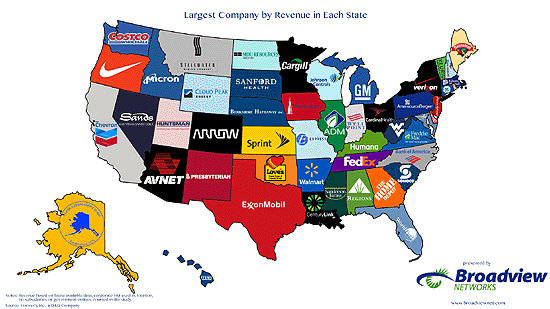
Click on this link to see the table that shows the size of each of the largest businesses in each American state.
4. No shaming the shameless
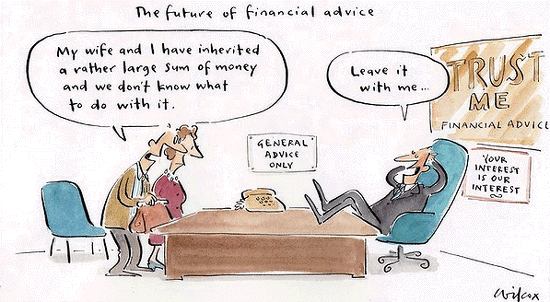
We might never have heard of Deeb Salem if he hadn’t sued Goldman Sachs over a too-small US$8.25 mln bonus - you know, the one where he claimed US$13 mln because "that's what I told my mother I would be getting". But now we know how much they made betting against their customers - and they got away with it. More from The Daily Beast and the US Senate Permanent Subcommittee on Investigations:
Among the schemes that did go forward to completion was an offering of mortgage-related securities called Hudson 1. Goldman told investors that these securities had been assembled “from the street,” suggesting that they came from various Wall Street brokers. Goldman also indicated that it was investing in the offering.
In truth, the securities were ones that Goldman already owned but which were proving iffy at best. Salem personally selected 40 percent of the securities from the Goldman inventory.
And while Goldman had invested $6 million in the offering, what it did not tell investors was that it was betting $2 billion that the securities would tank.
Goldman gave the investors no inkling of how it viewed the market’s immediate future. The subcommittee cites emails written by a senior Goldman exec before the Hudson 1 sale.
“Bad and getting worse…get out of everything…stay on the short side…Game over…bad news everywhere…the business is totally dead.”
The subcommittee sums up this scheme, saying: “When marketing the Hudson securities, Goldman misled investors by claiming its investment interests were aligned with theirs, when it was the sole short party and was betting against the very securities it was recommending… By holding 100% of the short position at the same time it solicited clients to buy the Hudson securities, Goldman created a conflict of interest with its clients, concealed the conflict from them, and profited at their expense.”
In a further conflict of interest, Goldman served as the liquidation agent for the investors, tasked with selling the securities when their value began to plummet in 2008. The primary Hudson investor, Morgan Stanley, pressed Goldman to sell.
“Goldman, however, delayed selling the assets for months,” the report notes. “As the assets dropped in value, Goldman’s short position increased in value. Morgan Stanley’s representative reported to a colleague that when Goldman rejected the firm’s request to sell the poorly performing Hudson assets, ‘I broke my phone.’ He also sent an email to [Goldman] saying: ‘[O]ne day I hope I get the real reason why you are doing this to me.’ Morgan Stanley lost nearly $960 million on its Hudson investment.”
That and much more went into Goldman’s coffers.
5. Making sure they toe the Party line
We don't hear much from China directly. Most of the news we get is filtered through the big American or European media outlets. From where most of us sit, it looks like China is making little effort with its projection of 'soft power'. But like much of what we think we know, that is a mistaken view; China is very active indeed in pushing its 'soft power' even in New Zealand. This is from John Fitzgerald in the ASAN Forum:
New Zealand overseas Chinese specialist James To observes that Beijing has gained overwhelming dominance of Chinese language media in Australia, New Zealand, and the Pacific Islands following a concerted effort at content placement and media industry networking by China’s embassies and consulates in the region. This effort is part of a larger proactive strategy of “group management, extra-territorial influence, counter-infiltration, and counter subversion” targeting Overseas Chinese communities generally - particularly Chinese students abroad - to ensure their loyalty to Beijing wherever they happen to be domiciled.
Beijing’s investments in Australia’s Chinese language media have had negligible impact on the broader Australian public, but they are earning high dividends among the Chinese-Australian communities targeted through an active public-diplomacy program that is highly strategic, clearly focused, and generously supported. Through China International Radio, the World Chinese Media Forum, and other arms of the party-government, the Central Propaganda Bureau outlaws the slightest criticism of the CCP or PRC government on its Australian radio and press networks. It pre-packages its own content for placement in local media, including layout, editing, and typesetting, and has largely banished alternative news sources from co-placement on Australian networks.
In fact, NZ has a local TV 'news' business that is a huge organisation, a media company with more than 100 employees, focused almost entirely on the relatively small New Zealand Chinese (and Korean) speaking community. An organisation that size could only exist with 'sponsorship' and this is where Chinese soft power is being focused; ensuring nothing airs that is not official. And, an example of how they have built their control over Chinese students is pointed to here:
More recently, a report on systematic surveillance of Chinese students in Australia by Fairfax journalist John Garnaut prompted concern at a number of universities where student journalists interviewed Chinese classmates, who confirmed they were under surveillance and that their careers and their families would suffer if they stepped out of line.
6. A narrow path
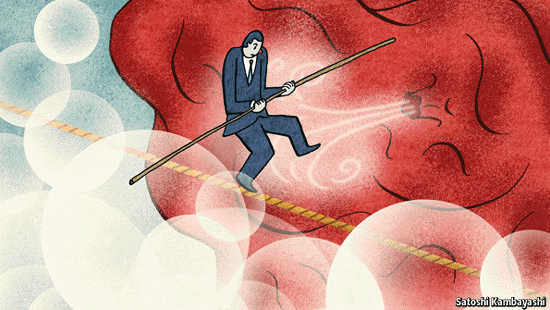
Central banks around the world are struggling to promote growth without fomenting the corrosive risk-taking that QE encourages. The problem is how to avoid bubbles. It's a problem that New Zealand is struggling with. It's one Sweden is too. Here is a review in the Economist:
Until the global financial crisis, central banks treated bubbles with benign neglect: they were hard to detect and harder to deflate, so best left alone; the mess could be mopped up after they burst. No self-respecting central bank admits to benign neglect any longer. “No one wants to live through another financial crisis,” Janet Yellen, then a candidate to head the Federal Reserve, said last year. “I would not rule out using monetary policy as a tool to address asset-price misalignments.”
For Britain and America, the prospect of using interest rates to tackle financial imbalances remains hypothetical. Not so in Norway and Sweden, where central banks have been stingy with rate cuts for fear of inflating home prices and household debt. That has come at a cost: inflation is below target in both countries; in Sweden it is negative. This could become entrenched: Andy Levin, an economist at the IMF, recently noted that long-run inflation expectations in both countries have also dropped below target.
In Sweden, the Riksbank’s stance has been deeply divisive. Two of the six members of its executive board voted in April to cut the repo rate, which is now 0.75%. Lars Svensson, an academic economist who left the board last year, calculates that unnecessarily tight monetary policy since 1997 has raised unemployment by 0.8 percentage points. He believes it has also worsened Sweden’s imbalances by slowing the growth of incomes more than the growth of debt, thereby raising the household-debt ratio, now 174%.
8. What will happen if ...
In a country where owning a car has long been a symbol of luxury and success, around 85% of Chinese car buyers still buy cars with cash. But if they switch to buying on credit, worldwide markets could be affected. More from Reuters:
These [days] young people are willing to buy big-ticket items like a car on credit - a behavior unheard of some 15 years ago in China - and have led carmakers to boost their financing units in the mainland.
"China's car market remains primarily a cash market, but it is starting to move to credit," John Lawler, head of Ford's operations in China, told Reuters in an interview. "It's a demographic and generational phenomenon. Those people who finance cars are primarily younger buyers."
China's central bank gave the sector a boost in early June when it cut the amount of money auto financing firms need to set aside as reserves in a bid to stimulate the economy which is showing signs of slowing.
Global carmakers have been funding their financial units' expansion by selling off their loans in the form of asset-backed securities to beef up their operations in China. That frees up money they can use to lend to Chinese consumers.
9. The current state of the New Zealand property market
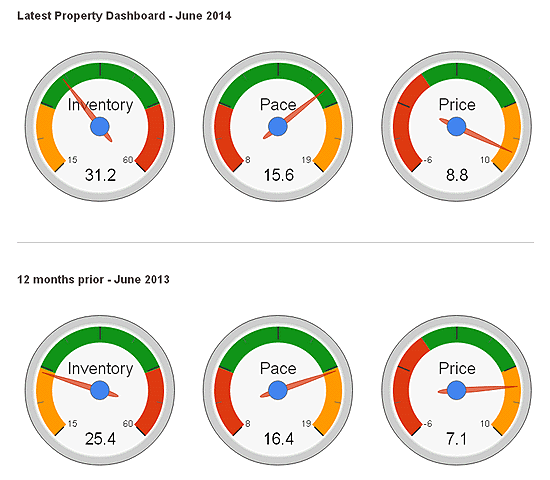
Alistair Helm at Properazzi has developed a visual dashboard to easily see how the New Zealand and regional property markets are faring and changing. The gages above are the overall national indications for June. Inventory levels are low but improving, volumes ('pace') are slowing, and median prices are high and rising.
You can find similar dashboards for every region here. There is quite a variation. It is a useful new innovation if you want a quick but meaningful fix on where your local housing market is at.
10. Today's quote
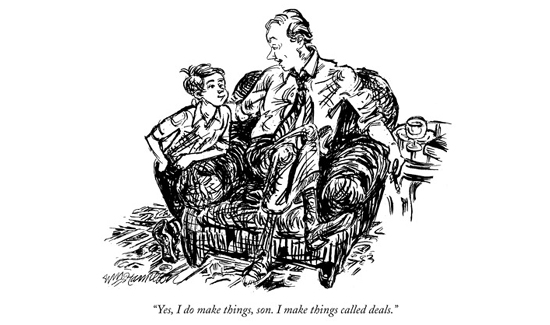
"Honesty may be the best policy, but it’s important to remember that apparently, by elimination, dishonesty is the second-best policy." - George Carlin
We welcome your comments below. If you are not already registered, please register to comment
Remember we welcome robust, respectful and insightful debate. We don't welcome abusive or defamatory comments and will de-register those repeatedly making such comments. Our current comment policy is here.