
By Bernard Hickey
The debate in this election campaign around inequality has burbled along without boiling over.
National has simply denied income inequality has gotten any worse since the mid 1990s, citing the Ministry of Social Development's regular Household Incomes Report.
That's true, but it ignores the huge jump in inequality over the 15 years to 1995 when the economic and welfare reforms of Roger Douglas and Ruth Richardson hit the incomes of the poorest harder than the richest.
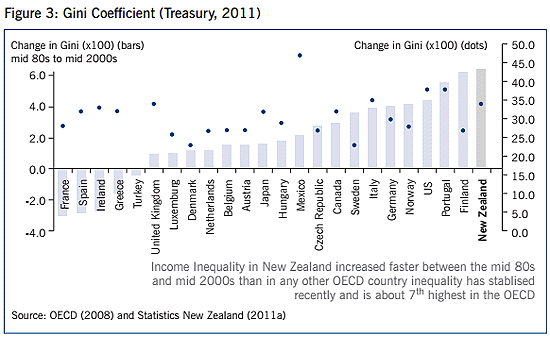
The internationally accepted measure is the Gini coefficient.
New Zealand's Gini rose more than any other OECD country between the mid 1980s and the mid 1990s and by 2011 was the 7th highest in the OECD.
To be fair, New Zealand's Gini has not gotten any worse since the mid 1990s as Governments of both colours did things to first boost incomes of those of low to middle incomes and then soften the blow of the Global Financial Crisis.
This stabilisation happened as inequality in other countries such as the United States deteriorated.
Despite that relative improvement, New Zealand is still a relative outlier with much wider inequality than it had back in the 1970s when our society was less exposed to the world. We saw ourselves as simple, clean, honest and corruption free.
It is now much easier to move money in and out of the country.
Many more of the population have grown up or lived and worked in societies where corruption is a more normal part of life.
There is now much greater variety in incomes and the temptation to use money or make money in corrupt ways is much greater.
Other countries with similar Gini levels to New Zealand include the likes of Italy, India and Egypt. Yet New Zealand is ranked alongside Denmark as the least corrupt nation on the planet by Transparency International.
That's quite an achievement given Denmark, Finland, Sweden and Norway all have Ginis that are significantly lower than New Zealand.
New Zealand's reputation is both an opportunity for our economy to advertise ourselves as a great place to do business, but it also has a value that has to be protected.
Now that the finance company crisis is over and financial market regulation has been modernised and toughened, there may be a temptation to be complacent. But the Serious Fraud Office reports it is busier than ever investigating all sorts of cases of corporate and government fraud.
One of the most high profile was that of ACC Property Manager Malcolm David Mason, who pleaded guilty in 2011 to charges of bribery and corruption for accepting bribes of NZ$160,000 for tipping off a businessman about the leasing of an ACC building.
An OECD team specialising in foreign bribery has visited New Zealand in recent months to assess its vulnerabilities, particularly as its connections with North Asia, South Asia and Africa are growing.
The SFO faces pressure to scale back its operations in the wake of the end of the finance company prosecutions, but that creates a risk.
Just as New Zealand should consider investing to protect its 100% Pure environmental brand, we should be prepared to spend on preventive maintenance on our reputation as the least corrupt nation in the world.
That reputation has a value and it should be protected from the natural pressures of the growth of our inequality since those simple times of the 1970s and early 1980s.
-------------------------------------------
A version of this article first appeared in the Herald on Sunday. It is here with permission.
We welcome your comments below. If you are not already registered, please register to comment
Remember we welcome robust, respectful and insightful debate. We don't welcome abusive or defamatory comments and will de-register those repeatedly making such comments. Our current comment policy is here.