

Here's my Top 10 items from around the Internet over the last week or so. As always, we welcome your additions in the comments below or via email to bernard.hickey@interest.co.nz.
See all previous Top 10s here.
My must read is #2 on the effects of technology on Britain's workforce.

1. Here comes Xi - Chinese President Xi Jingping visits New Zealand next week for three whole days. He'll be visiting Auckland and Wellington and will no doubt be followed by a massive Chinese media entourage.
This is bigger than Lord of the Rings for New Zealand in terms of getting air time in China. Yet there's been very little coverage or sense of anticipation here.
Everyone is still talking about will Barack Obama be coming or not.
Xi Jingping is a much bigger deal. The last time a Chinese President visited New Zealand was in 2003 and back then less than 5% of our exports went to China. Now 25% does.
President Xi is also a much more powerful President than Hu Jintao was. He's more dominant of his own Government and China is now the world's largest economy by some measures.
He has shaken up China's elite in a massive way and embarked on a hunt for 'tigers and flies' -- corrupt big and little officials. One particular focus is hunting down officials who have fled to other countries and salted away ill-gotten assets in all sorts of places. He won't personally be looking for them here next week, but no doubt there is a team trawling through connections here to find people and money.
Perhaps there'll be a few extra (former) Chinese officials on the plane going home next Friday.
Here's a useful piece from Henry Sender on how China's anti-corruption drive may be driving even more people and money offshore.
China’s anti-corruption drive has found a lot of allegedly ill gotten gains. But the campaign may also be spurring a growing number of wealthy Chinese to send their money out of the country – accelerating capital outflows at a time when concerns about weaker growth are also making the Chinese currency less attractive.
Today, private bankers in Hong Kong are offering mainland clients a panoply of investment choices abroad that have the added attraction of qualifying the buyer for a foreign passport. Demand has soared since the anti-corruption campaign was launched, they say. One prominent lawyer who used to specialise in corporate mergers and acquisitions now helps groups of wealthy Chinese acquire real estate in the US. Such transactions do not attract as much scrutiny and often come with residency rights for the buyers and their families.
Now, the data are beginning to support the anecdotal evidence from private bankers and lawyers. China’s foreign exchange reserves fell by $100bn in the third quarter – the largest drop ever, despite a trade surplus and foreign direct investment inflows. China had registered a $51bn outflow beyond the current account in the second quarter, according to balance of payments data, and September numbers suggest a $122bn outflow for the third quarter, according to Kevin Lai of Daiwa Capital Markets in Hong Kong. All this is a dramatic reversal from the early days of the US Federal Reserve’s quantitative easing, when as much as $1tn came into China.
2. 10 million missing jobs - This Deloitte report using the research of Oxford University's Carl Benedikt Frey and Michael Osborne is a detailed look at what robotisation and machine learning might do for work and wages in London and Britain. There's going to have to be an awful lot of re-training and income redistribution if this is all to end well.
We conclude that 35 per cent of today’s jobs in the UK and 30 per cent in London are at high risk of disappearing over the next two decades as a result of technology. There are significant implications for the number and types of jobs at risk. Jobs most at risk from technology are in office and administrative support; sales and services; transportation; construction and extraction; and manufacturing. However, for 40 per cent of UK jobs (and 51 per cent of London jobs), the risk of automation is low or non existent.
The jobs least at risk are in skilled management; financial services; computers, engineering and science; education; legal services; community services; the arts and media; and healthcare. Frey and Osborne estimate that for the UK as a whole, jobs paying less than £30,000 a year are nearly five times more likely to be lost to automation than jobs paying over £100,000. For London, the ratio is more than eight times.
3. Britain's productivity slump - Martin Wolf bemoans a shocking fall in British productivity since the GFC. He's right that it's rarely talked about in public debate.
Why has the productivity collapse been largely ignored in the public debate? For the government, poor productivity is the reverse of job creation, which it hails as its vindication. Gross domestic product in the second quarter of 2014 was only 2.1 per cent above its pre-crisis level. With normal productivity growth, unemployment would undoubtedly far exceed 10 per cent.
The stagnant productivity has allowed the economy to combine weak growth with buoyant employment, at the price of falling real wages. This has been fortunate. But, as labour markets tighten, the UK must now hope the stagnation ends. It must do more than hope. It must try to make that hope a reality.
4. Study the All Blacks - The Productivity Commission is doing lots of great work trying to work out why our productivity performance hasn't been great and what can be done with Government policies to encourage better productivity growth.
The whole business of squeezing more output out of each hour of work or unit of capital or land is quite nebulous, but crucial. Sustainable improvements in welfare are only possible when we manage it, although there is the subsequent question to be answered about who gets to consume those fruits of the better labours, but that's another matter for another day.
Meanwhile, the business of getting better at getting better is a serious one. Who are our high performers we can study? I'd suggest the All Blacks. What are they doing with their structure, their practices and their management that helps them get better continually? I reckon the Productivity Commission needs to do a case study. Now that would be a fun job for an economist.
Paul Conway from the Commission has written a blog musing usefully about whether all this technology is actually improving productivity. He's optimistic, but acknowledges a few challenges.
How does the education system respond to avoid skill mismatches when technology is rapidly making many occupations obsolete? How do firms adjust and grow in the face of highly disruptive general-purpose technological innovation?
I’ve never really been one for making forecasts – the world is just too complex to predict what might be around the corner, much less fifty years out into the future. But I am firmly in the camp of the technological optimists. However, while the conditions are ripe for technological progress to go on as before or even faster, we must be vigilant to ensure that bad institutions and policies do not get in the way.
5. Start by investing some cash - One of the problems (hinted at above by Wolf) is that Governments and companies are not investing heavily in new factories, products, R&D and people to get the economy really going.
One thing companies are doing is borrowing more and then paying the cash back to shareholders through share buy-backs. Others are simply accumulating mountains of cash and then doing share buybacks. It's an amazing trick. It increases the company's return on equity, increases its earnings per share and gooses the share price. Voila! There's plenty of New Zealand companies gearing up to do this too, including Auckland Airport and Mighty River Power.
Here's John Plender from the FT calling for an end to corporate cash hoarding.
Federal Reserve data show that the US non-financial corporate sector has gone from being a net lender to the rest of the economy, to the tune of nearly $500bn at the peak in 2009, to being a modest net borrower in the first half of this year.
The snag is that this newfound confidence is not being reflected in non-residential private fixed investment, which Fed economists reckon increased at an annual average rate of only about 4 per cent in 2012 and 2013. Net investment after depreciation as a percentage of the capital stock remains subdued, hovering around 1.5 per cent a year.
In effect, animal spirits in the corporate sector are being diverted into share buybacks. Such financial engineering reduces the number of shares in issue and artificially boosts earnings per share. For executives whose bonuses and incentive packages are related to earnings per share this works wonders on overall pay. For shareholders it may be another matter.
With equity valuations historically high, this is unlikely to be an efficient allocation of capital. That reflects an ownership vacuum. Over the next 12 months we will find out how damaging this might be for the real economy if quoted businesses continue to invest only halfheartedly in equipment.
6. The living wage - One of the reasons why companies are not investing in new capacity is they can't see the demand in the future from actual consumers to soak up the extra capacity. One reason for that, in the United States at least, is falling real wages, some say since the 1970s.
One way wages were lifted from the 1930s to the 1970s was through strong union movements. They were killed off or died through the 1980s and 1990s all around the developed world. Now some are making a come-back, or at least trying. One new tactic is the push for a Living Wage. New Zealand has a version, which has had some success with the likes of The Warehouse and Wellington City Council.
Apparently, the New Statesman says, the living wage is re-energising the progressive left in America.
Frustrated by the impasse in Washington, campaigners have begun to take matters into their own hands, and, fuelled by further intellectual support in the form of Thomas Piketty's book - a bestseller in the country - a wealth of anti-poverty campaigns and activity is spreading across the country. Although less glamorous than the rock 'n' roll Occupy Movement (which was named the "person of the year" in 2011 by Time magazine and quickly adopted as a brand by the rapper Jay-Z), they are slowly but surely bringing issues of low pay and inequality back to the fore.
Earlier this year, a long-standing "Fight for 15" campaign in Seattle was victorious after the council unanimously voted to impose the highest minimum wage in the US at $15 an hour. Fight for 15 are hopeful that San Francisco will commit to the increase when the proposal is voted on in November. In Los Angeles, the Council is pushing to raise the minimum hourly wage for employees in large hotels. Mayor Emmanuel Rahm, Obama's former chief of staff, is under pressure from the living wage movement in Chicago and is aiming to raise the minimum there to $13 per hour. In New York, Oakland, Washington DC, San Diego and San Jose, there are active and prominent campaigns pushing at city and state level to raise wages for the very poorest.
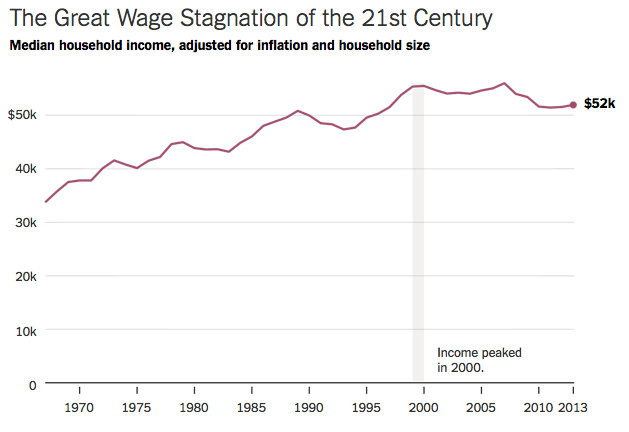
7. The great US wage stagnation - Just in case you think all this talk of flat wages (in the world's largest economy at least) is just a leftist plot, here's David Leonhardt in the New York Times with a juicy chart showing what has happened to real household incomes.
He suggests a few solutions, mostly involving going for really fast growth. He also wants a tax cut for the middle class. In New Zealand we delivered that through Working For Families.
As the 2016 presidential campaign begins to stir, the central question will be how both parties respond to the great wage slowdown. Neither has offered a persuasive answer so far — let alone a solution — which is why the public mood is so sour and American politics has been so tumultuous lately. The partisan makeup of the Senate has seesawed more over the past decade than in any time since just after World War II. The Republicans won big victories in 2004, 2010 and 2014, the Democrats in 2006, 2008 and 2012.
All the while, incomes keep stagnating, and nothing influences the national zeitgeist quite so much as income trends, for understandable reasons.
What can Washington do? The answers are very different for the short term and the long. Over years and decades, nothing matters more than economic growth. The last period of strong income gains — the late 1990s — was also the last period of strong economic growth.
The best hope for doing so, in the immediate future, is probably the oldest and most obvious play in the book: a tax cut.
A few years ago, a middle-class tax cut would have seemed a silly idea. Both Mr. Bush and Mr. Obama had already cut taxes, and the federal budget deficit was enormous. But the deficit has since fallen sharply, thanks in part to lower health costs. Meanwhile, middle- and lower-income families are reaping a disproportionately small share of economic growth. Having the government try to rectify the situation doesn’t sound so silly now — and probably won’t in the 2016 presidential campaign.
8. Where did the money go - All this talk of stagnating incomes is at odds with the economic growth America (and us) have been having for three or four years, or the last 20 for that matter. Where did it go? Not to households in general and less skilled workers in particular.
These charts tell the story, courtesy of Paul Krugman.
Wages for ordinary workers have in fact been stagnant since the 1970s, very much including the Reagan years, with the only major break during part of the Clinton boom. My first chart shows wages of production and nonsupervisory workers in 2014 dollars; we have never gotten back to 1973 levels.

The second point is that rising inequality is a big part of the story for stagnating household incomes. My second chart shows real GDP per household — nominal GDP, deflated by the consumer price index, divided by the total number of households; and compares it with median household income, both expressed as indexes with 1979=100. We’ve had substantial income growth since then, but very little for the median household, because so much of it has gone to the top.

9. ##$$%%!*! ing London banks - John Plender at the FT is still shaking his head at the rottenness of the London and New York banking cultures that created the GFC and have just been caught doctoring LIBOR and forex rates in London. They paid shareholders' money out in fines and seem to be carrying on their merry way.
By now the pattern is familiar. The directors and top executives were in charge but not in control. Their response to criticism over earlier scandals had been hopelessly flabby. All those pious words about raising ethical standards and cleaning up the culture were so much flannel. Meantime, traders left an incriminatory trail in the chat rooms in colourful language confirming that the people who inhabit trading floors are closer to the animal kingdom than the rest of the (unjailed) population.
In effect, they are bonus-hungry hired guns who show no loyalty to their banks, customers or the markets. They have thus threatened the integrity of a systemically important market and undermined confidence in the wider financial system.
Clearly the culture of the world’s biggest banks is fundamentally rotten. The question is whether it can ever be cleared up. It is hard to see how that is going to happen as long as the main thrust of the regulatory response to such egregious behaviour is to fine the banks, thereby bleeding shareholders, rather than go for the directors and executives who have so signally failed to respond to regulatory exhortation.
10.Totally Clarke and Dawe on Tony Abbott's petrol tax, scientists and dealing with reality.
We welcome your comments below. If you are not already registered, please register to comment
Remember we welcome robust, respectful and insightful debate. We don't welcome abusive or defamatory comments and will de-register those repeatedly making such comments. Our current comment policy is here.